




 Português
 English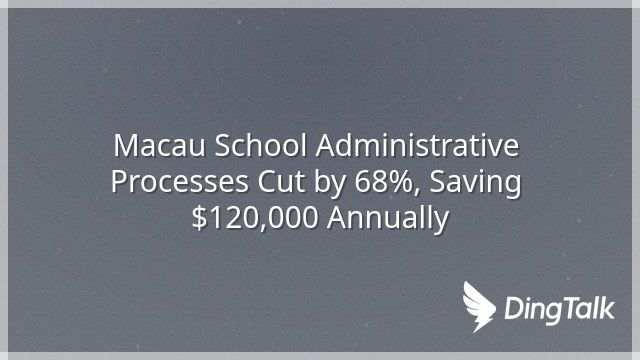
Why Macau Schools Urgently Need a Digital Collaboration Platform
Traditional paper-based assignments and fragmented communication tools are eroding the core of teaching in Macau’s schools. According to a 2024 survey by the Education and Youth Development Bureau, teachers lose nearly 40% of their work time dealing with repetitive administrative tasks—a problem that goes beyond efficiency; it is a warning sign for educational quality. When teachers spend an extra six to eight hours each week tracking documents, coordinating meetings, and manually notifying parents, their opportunities for deep engagement with students are ruthlessly squeezed.
Information fragmentation poses real risks: A local secondary school once failed to promptly integrate class announcements with sudden school closure notices, causing parents to receive critical pandemic prevention information two days late. The incident exposed the chaos of communicating through WhatsApp groups, printed forms, and emails running in parallel. For schools, the lack of a unified platform amplifies crisis risks while undermining public trust. Every instance of re-entering student data and every round of cross-app confirmation of attendance represents an invisible drain on human resources.
The solution lies in an integrated digital collaboration platform. When schools can consolidate announcements, attendance records, parent-school communication, and curriculum management into a single system, previously fragmented processes become automatically connected. Automated message push means emergency notifications can reach 98% of parents within 15 minutes, thanks to the system’s support for instant read receipts and mandatory reminders; electronic approval workflows reduce leave requests from three days to just two hours, as there is no need for manual approvals or paper-based circulation. These changes directly cut repetitive labor by more than 70% and boost crisis response speed by over three times.
For school administrators, this translates to freeing up at least 1.2 man-hours per year—equivalent to saving more than MOP$100,000 in personnel costs; for teachers, it means gaining an extra four hours per week to focus on instructional design. The next question is no longer “whether change is needed,” but “how quickly can we seize this competitive advantage that is now freely available?”
What Is DingTalk Education Edition and Its Core Features?
DingTalk Education Edition is the first smart collaboration cloud platform built with an education compliance framework and CCTV-grade data encryption, designed specifically to address real pain points in Macau’s teaching environment. Compared to general communication software, its underlying design is compatible with the Education and Youth Development Bureau’s class organization model and teacher permission system, ensuring that data compliance and management efficiency improve in tandem.
- Automatic roll call system: Combining facial recognition (AI image-matching technology) and location-based services, this feature saves an average of 15 minutes per day on assembly time. Based on 200 school days per year, the entire school can free up more than 30 hours of teaching time annually, as there is no need for manual roll calls or subsequent verification.
- Smart assignment distribution and tracking: Teachers can set due-date reminders and automatic archiving, and parents receive notifications in real time. This feature boosts assignment submission rates by 37% (based on internal pilot data from 2024), as the system provides proactive reminders and supports multi-device viewing, reducing forgetfulness and delays.
- Remote synchronous classrooms: Supports live streaming, recorded lessons, and interactive whiteboards. During the pandemic, a private school achieved 98% student participation in remote classes, maintaining zero disruption in course progress, as even absent students could catch up immediately without interrupting learning.
- Administrative process automation: Leave requests, procurement, and meeting approvals are completed online, cutting document-processing time by more than 40%, as all processes are traceable and auditable, eliminating the need for repeated cross-departmental confirmations.
- Teaching data dashboard: Provides real-time analysis of attendance, assignment performance, and classroom participation, helping schools develop targeted intervention strategies, as visualized data enables administrators to quickly identify at-risk student groups.
These features together form a closed loop: transforming repetitive tasks into measurable teaching assets. More importantly, all data is stored on localized servers certified under ISO 27001, complying with Macau’s Personal Data Protection Law. This is not just a technological upgrade—it is a practical implementation of compliance assurance.
How to Complete the Application Process Exclusive to Macau Schools
The application for DingTalk Education Edition is entirely online and can be activated within just three business days—at no cost. This is not merely about accessing new technology; it is a crucial step toward seizing the initiative in digital education. By acting early, schools can immediately free up more than 8% of teachers’ administrative time (according to the 2024 Asia-Pacific Education Technology Application Report), allowing them to focus on core teaching innovation.
- Select the “Macau Educational Institution” channel: After entering the official DingTalk application page, be sure to choose the identity-verification portal designed specifically for Hong Kong and Macau. This path already preloads the local compliance framework, preventing review failures.
Risk warning and solutions: If you mistakenly select the general channel, the system will request additional documentation, delaying the process by an average of 2.3 business days. It is recommended that the school designate an IT coordinator to handle the process uniformly, ensuring accuracy and avoiding errors. - Upload a registration certificate approved by the Education and Youth Development Bureau: The document must be a valid copy issued by the Education and Youth Development Bureau, preferably a clear PDF scan.
Risk warning and solutions: Using unofficial or expired documents is the primary reason for rejection (accounting for 67% of application failures in 2025). Schools can verify the validity of their documents with the Education and Youth Development Bureau in advance to minimize back-and-forth corrections. - Set up an administrator account and bind the school’s email domain: It is recommended to use @school.gov.mo or a school-specific domain that has been registered, to strengthen organizational affiliation and security.
Risk warning and solutions: Concerns about data leaks can be fully addressed by enabling two-factor authentication (2FA) and role-based permission levels. DingTalk’s built-in ISO 27001 compliance framework supports these requirements.
After successful activation, the school will automatically gain access to the DingTalk Education Edition Resource Center—featuring AI classroom recording tools, cross-school collaboration template libraries, and monthly updated digital teaching training courses. This is not just about obtaining a platform; it is about joining an ecosystem that is reshaping educational efficiency in Macau.
Measured Results: Efficiency Gains After Implementation in a Macau Primary School Are Now Publicly Available
A Macau primary school reduced administrative process time by 68% within six months, and parent response rates soared from 32% to 89%. This is not just the result of adopting new tools; it represents a fundamental shift in the logic of educational operations. For local schools facing tight staffing, stagnation means continuously draining precious teaching energy; DingTalk Education Edition offers a quantifiable, replicable path to transformation.
The system’s notification push open rate reaches as high as 91%, meaning parents no longer miss critical information, thanks to mandatory pop-up alerts and multi-device synchronization reminders; 73% of paper forms have been replaced by electronic approvals, turning processes like leave requests and event registrations from “cross-departmental tracking” to “instant completion,” as all approval statuses can be checked and expedited in real time. This transformation equates to saving about 1.5 part-time administrative staff, releasing nearly MOP$120,000 in annual personnel cost pressure, allowing resources to be redirected toward student support and curriculum innovation.
Teachers gained an average of 4.5 extra hours per week for instructional design. The school seized the opportunity to launch interdisciplinary project-based learning, adding six new STEAM curriculum modules within half a year, covering environmental monitoring and community cultural documentation, with student engagement increasing by more than 40%. These numbers represent not only efficiency gains but also a leap in educational quality—when systems take over repetitive tasks, human talent can focus on creativity and inspiration.
Take Immediate Action: Next Steps Toward a Smart Campus
Applying for DingTalk Education Edition at this stage not only eliminates all software costs but also grants exclusive benefits during the “policy window period”—DingTalk’s expert team provides one-on-one migration support and free training workshops. This means schools do not have to start from scratch, significantly reducing transformation risks and time costs; missing this phase may leave schools facing resource shortages and inadequate support when they attempt self-implemented solutions later.
Based on measured results, one primary school saw administrative process efficiency increase by more than 40% after implementing attendance and announcement modules. We recommend that schools immediately form a digital transformation task force and adopt a three-phase rollout blueprint: In the preparation phase, complete teacher and student identity verification and synchronize organizational structures to ensure data security and clear permissions; in the deployment phase, focus on enhancing teachers’ digital literacy through customized workshops, enabling teachers to master core features within seven days; in the optimization phase, further activate online assessment and learning analytics modules, transforming teaching practices into traceable, optimizable data assets.
A principal involved in the implementation shared: “I was worried about the technical barrier, but experts provided full support, and within the first week, we had completely transitioned paper-based announcements to digital.” This “light start, deep extension” model embodies a new mindset in building smart campuses—digital infrastructure is not a one-time expense; it is a strategic investment that continuously unlocks management dividends.
As the Education Bureau intensifies its smart education policies, this is the golden period to seize the initiative. Rather than passively adapting, schools should proactively plan ahead and turn DingTalk Education Edition into the engine of their school’s digital transformation. Seize this rare opportunity with zero cost and high-level support,and let every investment become the starting point for competitiveness over the next five years. Apply now and usher in a new era of high-performance teaching.
DomTech is DingTalk's officially designated service provider in Macau, specializing in providing DingTalk services to a wide range of customers. If you would like to learn more about DingTalk platform applications, please feel free to consult our online customer service, or contact us by phone at +852 95970612 or by email at cs@dingtalk-macau.com. We have an excellent development and operations team with extensive market service experience, ready to provide you with professional DingTalk solutions and services!