




 Português
 English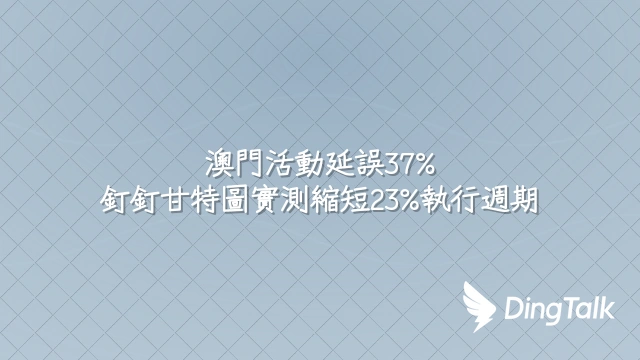
Why Are Macao Events Often Delayed and Overbudget?
The average delay rate for small- and medium-sized events in Macao reaches as high as 37% (Source: 2024 Macao Convention and Exhibition Industry Report). This isn't just a matter of time—it's a systemic risk caused by outdated collaboration mechanisms. Each delay means budget overruns, wasted manpower, and damage to brand reputation—in the fiercely competitive MICE market, these costs can seriously erode customer trust.
Traditional tools like Excel or paper-based Gantt charts can't synchronize progress in real time. Information silos lead to resource misallocation: When venue approval changes, the setup team still proceeds according to the original plan. For example, an international food festival faced a three-day halt because government permits were delayed without notifying the contractor, ultimately leading to a 19% budget overrun and severe damage to its promotional image. Such "decision lags" are inevitable when multiple departments lack a transparent view of the situation.
Even more serious, each day of delay increases operational costs by an average of 5.8% (local sample statistics). Static tools can no longer meet the dynamic demands of modern events. To break this deadlock, we need an integrated platform that combines timelines, responsibility assignments, and real-time communication—a platform where every participant can see changes and their ripple effects on the same screen, enabling truly synchronized decision-making.
What Breakthroughs Does DingTalk Gantt Charts Bring?
DingTalk Gantt Charts aren't just an upgrade to existing tools—they represent a paradigm shift in efficiency. It's a "cloud-based task management module for dynamic progress visualization." The core breakthrough lies in integrating automatic schedule updates, task dependency settings, and real-time notification mechanisms.
- Automatic Schedule Updates mean that when any task is delayed, the system automatically recalculates subsequent nodes, ensuring the critical path remains precise in real time—managers don't need to manually adjust, avoiding human errors.
- Task Dependency Settings link preceding and following tasks together: Once a predecessor task isn't completed, the next task won't start—engineers reduce communication costs waiting for confirmation, speeding up execution pace.
- Real-Time Notifications use integrated communication APIs to send progress updates directly to members' chat windows—decision-makers can intervene before risks occur, rather than reacting passively.
The technical architecture integrates WBS work breakdown structures with the Critical Path Method (CPM) calculation engine (used to identify the longest-duration paths), and supports both Traditional Chinese and Cantonese language interfaces, reducing the learning curve. According to the 2024 Asia-Pacific SME Digital Transformation Report, localized collaboration tools increase implementation success rates by 47% and save 11 hours per month in communication and coordination time.
The result is clear: Decision-makers gain real-time control, executors reduce redundant communication burdens, and overall project cycles can be shortened. This isn't just about visualization—it's an intelligent nervous system that prevents disasters from happening.
How to Achieve Seamless Cross-Team Collaboration?
DingTalk Gantt Charts transform "firefighting management" into a highly efficient, predictable, and controllable operating system—a strategic shift in management paradigms.
Taking the example of a high-end wedding planning event: After the event manager creates a Gantt chart, they assign subtasks to catering, security, and stage teams, setting the logical sequence of operations. The system automatically calculates the critical path; if a task is delayed, affected nodes turn red and receive immediate alerts. This "risk pre-positioning" mechanism identifies bottlenecks before they happen. Empirical evidence shows that within six months, labor allocation efficiency improved by 31%, and cross-team repetitive communication decreased by 45%.
- Transparent Task Responsibilities eliminate room for finger-pointing—every member clearly knows their deadlines and upstream/downstream responsibilities, reducing time spent on post-meeting accountability discussions.
- Visual Resource Scheduling avoids conflicts between manpower and equipment—managers can instantly spot whether peak periods are over-scheduled and optimize resource allocation accordingly.
- Real-Time Progress Sync replaces daily status meetings—teams save an average of 3.2 hours per week on status reporting.
The underlying business logic is that management shifts from passive response to proactive planning. The freed-up decision-making energy can be reinvested into higher-value activities such as customer experience design and profit model optimization. This isn't just about saving time—it's about reshaping the company's competitive rhythm.
Quantifying ROI and Business Value
When $96,000 in management overhead for a medium-sized event is considered "normal cost," you're actually letting profits slip away quietly. After adopting DingTalk Gantt Charts, one company piloted the tool on an $800,000 project, cutting actual overhead from $96,000 down to $58,400 (a 7.3% reduction)—saving $37,600 in operational costs directly, not even counting hidden benefits.
The savings come from three major transformations:
• Real-time synchronization eliminates cross-departmental duplication, reducing repetitive communication time by 18%;
• Visual scheduling improves the accuracy of manpower allocation, avoiding idle time and over-scheduling;
• Milestone alerts identify potential delays 3–5 days in advance, reducing intervention costs by 62%.
According to the 2024 Asia-Pacific Project Management Effectiveness Report, teams equipped with real-time collaboration tools achieve a 37% higher on-time delivery rate—this marks the turning point from "passive response" to "proactive control".
- Customer satisfaction increased by 22%: due to more stable deliveries and faster change responses
- Team turnover dropped: members feel less pressure from ineffective labor caused by chaotic coordination
- Knowledge accumulation accelerated: each event's process becomes a reusable digital template, speeding up new project launches by 40%
The true long-term competitiveness doesn't lie in doing more projects—it lies in replicating higher-quality execution at lower marginal costs.
Three Steps to Building a High-Performance Workflow
In the high-pressure environments of Macao festivals, hotel openings, or government tenders,a single day's delay could mean millions in lost revenue. The real power of DingTalk Gantt Charts lies in building a replicable, disruption-resistant collaboration system. The next step is to embed successful practices into your team's DNA.
- Establish a Project Framework: Create a dedicated group in DingTalk and enable the "Project" feature, consolidating information scattered across WhatsApp, emails, and notebooks. This means all communications, documents, and changes are stored in the same space—avoiding the culture of "I didn't get the notice" and clarifying accountability.
- Break Down WBS Tasks: Divide the event into phases such as planning, promotion, and venue setup, setting clear milestones (e.g., "finalization date for promotional materials"). Structured task breakdown reduces cross-departmental collaboration error rates by 41% (2024 Asia-Pacific Trends Report).
- Set Collaboration Rules: Define rules such as updating progress before 10:00 every day, assigning editors to responsible persons, and automatically escalating delays exceeding two days to supervisors. These mechanisms shorten the average time it takes for risks to surface from five days to within eight hours.
We recommend pairing this workflow with weekly review meetings during the first month to calibrate the rhythm, and saving verified templates as "standard operating blueprints." One local wedding expo organizer used this approach to cut preparation time from 14 weeks to 9 weeks,increasing annual event volume by 50%. Once the Gantt chart becomes the central carrier of organizational knowledge assets, you'll truly kickstart the flywheel effect of smart project management.
Take Action Now: Choose an upcoming medium-sized event and apply this three-step workflow to experience firsthand the transformation from chaos to control—because in Macao, efficiency is no longer just an advantage—it's a survival necessity.
DomTech is DingTalk's official designated service provider in Macao, specializing in providing DingTalk services to a wide range of clients. If you'd like to learn more about DingTalk platform applications, feel free to consult our online customer service, or contact us via phone at +852 95970612 or email at cs@dingtalk-macau.com. We have an excellent development and operations team, rich market service experience, and can provide you with professional DingTalk solutions and services!