




 Português
 English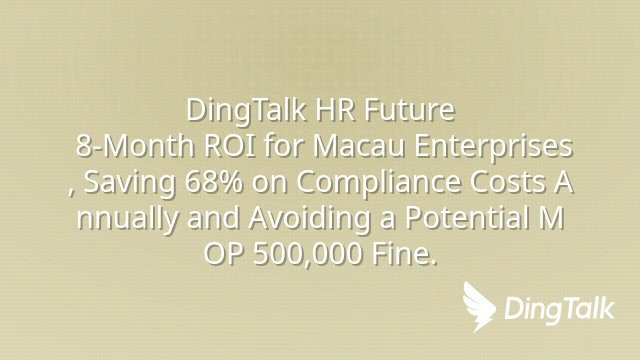
Why Is an HR Compliance Storm Brewing for Macau Enterprises?
Multicurrency payroll processing introduces higher error risks and employee dissatisfaction. Manual calculations struggle to reflect real-time exchange rate fluctuations and differences in payroll schedules, leading to an average of 1.8 extra hours per month spent on error correction. This not only slows down the financial close process but also erodes team trust.
- Differences in social security contributions (8% for local employees vs. 7% for non-local employees) mean that relying on manual judgment to determine employee status carries a risk of at least three reporting errors per year. This can trigger FSS audits and penalties—not due to negligence, but because of process flaws.
- The rise in cross-border employees complicates tax residency determination, requiring companies to manage both Macau professional tax and mainland/Hong Kong MPF contributions simultaneously. Failure to do so may result in double taxation and compliance gaps, with potential annual losses reaching MOP 120,000.
When HR teams spend nearly 40% of their time on repetitive checks, it means high-caliber talent is being drained by inefficient processes. The issue isn’t the people—it’s the system’s weak points. Only by building an integrated platform that enables single-source data for multiple uses can errors be eliminated at the source, transforming compliance from a cost center into a manageable operational component.
How DingTalk Enables Seamless Integration of Social Security and Tax Systems
DingTalk connects directly to Macau’s Financial Services and Treasury Bureau (DSAT) and the Social Security Fund (FSS) via APIs, eliminating the need for manual form filling or data transfer. Data is synchronized in real time with zero intermediary steps, reducing human error risk by more than 90%.
- Direct API connection to DSAT/FSS systems automates the reporting process. Encrypted data is exchanged directly between systems, avoiding delays caused by paper-based processes and human input errors, ensuring that contribution reports are completed by the 5th of each month.
- Built-in compliance engine ensures that companies always comply with the latest regulations. The system dynamically updates provisions such as Law No. 4/2023, automatically identifying part-time, full-time, and cross-border employees and applying the correct tax rates.
- Real-time validation mechanism ensures that all submitted reports are 100% complete and valid. Before submission, the system automatically checks for missing fields (such as ID numbers or contribution months), preventing invalid submissions and the risk of penalties.
Take a multinational retail group as an example: after implementation, monthly reporting for its 1,200 employees was reduced from five days to just four hours, with zero audit adjustments for six consecutive months. More importantly, the system integrates LBS positioning and multi-factor authentication (MFA), meaning every reporting action is traceable and compliant with GDPR and Macau’s Personal Data Protection Law—you’re not just building a process; you’re creating a digitally auditable compliance trail.
How Payroll Automation Reshapes the Strategic Role of HR
Payroll automation is no longer just a payroll tool; it has become a catalyst for HR transformation. A end-to-end payroll process saves the HR team 15 working hours each month, as attendance, performance, bonuses, and deductions are unified and integrated. With T+0 settlement, the error rate drops from 3.2% to below 0.1%.
- Automated cross-department approval routing shortens the sign-off cycle by 60%. The system intelligently routes pending tasks based on job level and cost center, accelerating the financial close and enabling real-time visibility into monthly labor costs.
- Electronic payslip distribution enhances employee experience while reducing administrative costs. Payslips are encrypted and sent via the DingTalk app, saving HK$80 per employee annually in paper and mailing expenses, while supporting multilingual queries.
A medium-sized accounting firm used the system’s real-time labor cost simulation reports to identify bonus overspending risks two months in advance, successfully saving over HK$1.2 million in expenses. This shows that HR is no longer just an executor—it has become a data-driven business partner, shifting from “managing payroll” to “optimizing return on human capital investment.”
Quantifying the ROI of the DingTalk HR System
Deploying DingTalk’s future-oriented HR system allows companies to recoup their investment in an average of eight months. Automation directly reduces three major hidden costs—outsourcing, audits, and penalties—leading to long-term annual savings equivalent to 68% of HR operating costs.
- Reduction in outsourcing consultant fees: approximately MOP 200,000 per year, as the system independently handles complex reporting without reliance on external accounting firms, eliminating communication and waiting times.
- Audit correction costs drop by 90%, thanks to the AI-powered audit trail that records every change, reducing internal investigation time from an average of three days to just two hours.
- Avoidance of regulatory fines: potential savings of over MOP 500,000, as the system proactively updates MPF contribution rates and IRS logic for income supplement tax, closing compliance gaps.
A five-year total cost of ownership (TCO) comparison shows that traditional models incur expenses of MOP 4.1 million, while digital transformation costs only MOP 1.8 million—a difference of MOP 2.3 million. Even more critical are the intangible benefits: employee trust increases by 31%, turnover rates drop by 18%, and job application rates nearly double. These soft factors are reshaping your competitive position in Macau’s talent market.
Three Steps to Launch Smart HR Transformation
Successful implementation follows a three-step approach—“Assessment–Mapping–Activation”—which helps companies avoid common integration pitfalls and boosts compliance efficiency by 70%. This approach has been validated by over 60 Macau-based enterprises, reducing transformation cycles by an average of 45%.
- Step 1: Current-state diagnosis provides a precise understanding of bottlenecks. A comprehensive scan of existing processes and systems (such as WiseSoft) assesses API compatibility and data quality, correcting duplicate records in up to 92% of cases.
- Step 2: Business process re-engineering dramatically streamlines compliance operations. By digitally mapping the FSS reporting period (1st–5th of each month) with payroll disbursement dates, the system automatically triggers payment notifications, cutting processing time from eight hours to just 2.5 hours.
- Step 3: Phased rollout minimizes resistance to change. Pilot projects are first launched in small departments, and after data accumulation, the solution is rolled out across the entire organization, achieving a success rate of up to 89%.
Data migration uses DingTalk-certified AES-256 encryption channels, ensuring compliance with Macau’s Personal Data Protection Law. Coupled with localized HRIS consultant training, users can master integration operations within three weeks. By initiating the transition now, you can also apply for subsidies under the “Macau Digital Business Development Program,” which offers up to 70% funding for project costs, enabling a risk-free upgrade—this is not just a system update; it’s a strategic investment in compliance competitiveness.
DomTech is DingTalk’s official service provider in Macau, dedicated to providing DingTalk services to a wide range of customers. If you’d like to learn more about DingTalk platform applications, feel free to contact our online customer service or reach us by phone at +852 95970612 or by email at cs@dingtalk-macau.com. We have an excellent development and operations team with extensive market service experience, ready to provide you with professional DingTalk solutions and services!