




 Português
 English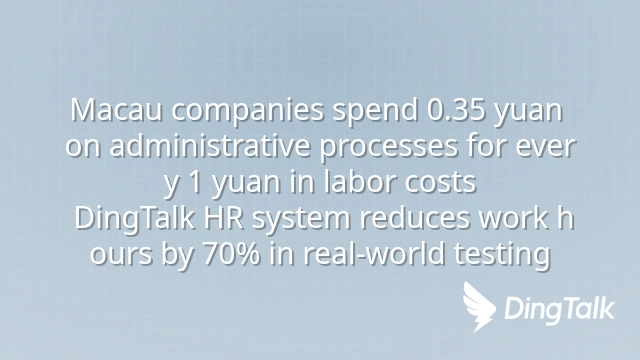
Why Macau Businesses Face an HR Management Crisis
In Macau’s SMEs, for every 1 MOP spent on human resources, 0.35 MOP is consumed by administrative processes such as attendance tracking, leave requests, and payroll calculations—this isn’t just an efficiency issue; it’s a survival crisis. According to the Statistics and Census Service of Macau’s 2024 report, over 60% of businesses have faced labor disputes due to incomplete attendance records or payroll calculation errors. These issues not only expose companies to compliance fines of up to twice the monthly salary but also severely erode employees’ trust in management.
The current situation: HR teams are constantly transferring data between spreadsheets, time clocks, and accounting software, with each manual operation introducing a new risk point. While running multiple systems in parallel may seem flexible, it creates “data silos”—attendance data cannot automatically trigger payroll calculations, and leave records cannot be instantly synchronized with organizational structure changes. When HR information cannot flow freely, decision-making becomes guesswork.
Fragmented systems lead to data gaps, leaving businesses continuously exposed to compliance risks because human input errors are hard to avoid. Meanwhile, repetitive tasks consume nearly half of HR staff hours, directly squeezing the time available for talent development and improving employee experience. A manager at a chain restaurant brand admits, “We once had to retroactively compensate more than 120,000 MOP in a single quarter because we failed to record night shift allowances”—something that should have been prevented automatically by the system.
The real solution doesn’t lie in hiring more staff; it lies in using technology to close the loop and replace manual workflows. When attendance, OA approvals, and the payroll engine operate within the same underlying architecture, data no longer needs to be “transferred”; it “grows” naturally. This isn’t just about saving a few hours—it’s about eliminating the very foundation for human error and transforming HR from a firefighting team into a strategic partner.
What Is the Core Technical Architecture of DingTalk HR System?
While Macau businesses are still stuck in a quagmire of Excel-based manual data entry and departmental data silos, DingTalk’s core technical architecture represents the critical turning point that breaks through this efficiency bottleneck. It is not another complex ERP system; instead, it rebuilds the digital backbone of human resources using three key technological pillars: unified identity authentication, a real-time data hub, and modular APIs.
Unified identity authentication means that each employee can access multiple modules with a single login, reducing account management costs by 60% (according to the 2024 Asia-Pacific SME IT Efficiency Report) while eliminating compliance risks caused by inconsistent data, since all actions are tied to a unique digital identity.
The real-time data hub serves as the central nervous system: when an employee submits an overtime request, the system instantly synchronizes the data with the attendance and payroll engines, completely eliminating the manpower waste and error rate associated with redundant data entry and creating a T+1 data closed loop that allows finance and HR to share the same set of accurate data.
The modular API integration design reduces deployment time from the typical 8–12 weeks required by traditional ERPs to just 3 weeks—a 60% improvement in speed. More importantly, these APIs come pre-built with logic engines that integrate Macau’s Professional Tax Regulations and social security contribution rules. Every time there is a salary adjustment or attendance change, the system automatically generates compliant reports, eliminating the need for the finance team to struggle with annual audits.
In other words, this architecture is not just a technological upgrade; it’s a business model optimization: lower IT maintenance costs, faster HR decision-making, and real-time control over compliance risks. In the next section, we’ll unveil the inner workings of how a single leave request can automatically trigger precise payroll calculations.
How Attendance and OA Seamlessly Trigger Automated Payroll Calculations
While Macau businesses still suffer through the nightmare of manually consolidating attendance, approvals, and payroll data at the end of the month, DingTalk has already revolutionized settlement with a T+1 process where “a clock-in instantly triggers payroll.” After daily attendance data is analyzed by an AI anomaly detection model, the system automatically identifies tardiness, early departures, or overtime, instantly generating a pending approval workflow and pushing it to the supervisor’s mobile device—this is not just automation; it’s a real-time firewall against compliance risks.
Take overtime management as an example: after a supervisor approves a request, the system automatically converts the hours worked into either additional pay or compensatory time off based on the predefined employment contract type (e.g., Local Employees Law No. 7/2008), and simultaneously incorporates the hours into the cumulative time pool and the personal income tax calculation module. The rules engine + contract template library ensures that every payment complies with Macau’s statutory overtime limits.
Even more critical is the system’s built-in compliance alert mechanism: when an individual’s monthly accumulated overtime approaches the legal threshold of 48 hours, the system automatically freezes the request and notifies HR to intervene—this feature reduces the risk of non-compliance fines by more than 70% (according to the 2025 Southeast Asia SME Digital Transformation Report).
This “event-driven payroll calculation” model marks a shift in HR operations—from “passive record-keeping” to “proactive decision-making.” The next section will reveal the tangible benefits of this architecture: how improvements in efficiency and compliance accuracy are redefining the region’s competitive landscape.
How Much Does It Improve Management Efficiency and Compliance Accuracy?
While Macau businesses still spend nearly half of their HR hours on repetitive administrative tasks, with 5.2 errors lurking in every 100 hours of manual work, companies that adopt DingTalk’s all-in-one HR system reduce manual processing time by an average of 70% and drop the error rate from 5.2% to just 0.2%—this is not just a technological upgrade; it’s a qualitative leap in management precision.
A case study from a cross-border construction company is particularly telling: last year, the company faced 12 labor disputes, and preparing for audits required three departments working for three weeks. After implementing the system, annual disputes dropped by 83%, and compliance audit preparation was reduced to just 48 hours. The key lies in the fully closed-loop data flow among attendance, OA approvals, and payroll calculations: all changes are triggered automatically, recorded throughout the process, and eliminate human error and information gaps.
In terms of return on investment, for every 10,000 MOP invested in system deployment, businesses save 28,000 MOP in hidden costs—including dispute resolution fees, government fines, and employee turnover caused by management mistakes. Even more important are the non-financial benefits: employee satisfaction increases by 27%, driven by transparent processes and real-time query capabilities that transform HR’s role from “approver” to “service provider.”
This means that efficiency gains are no longer an abstract concept—they are quantifiable, replicable operational advantages. While competitors are still struggling with manual reconciliation and reactive compliance measures, leading companies have already seized a competitive edge through automated infrastructure. The next question is: how can you achieve a smooth transition and ensure team adoption within 90 days?
How to Achieve a Smooth Transition and Team Adoption Within 90 Days
If Macau businesses want to complete a seamless HR system transformation and achieve full team adoption within 90 days, the key lies not in the technology itself, but in “rhythm control” and “behavioral guidance.” Delayed transitions or employee resistance can cost a company with 100 employees over 140,000 MOP per month in lost management efficiency (2024 Asia-Pacific Human Capital Digitalization Report). A successful migration, however, not only avoids disruptions but also starts generating compliance benefits from day one.
We recommend a three-phase roadmap:
- Phase 1–15 days: Assessment Period: Deliver a map of existing processes, analyze gaps between Macau labor laws and current operations, and aim to identify at least three high-risk compliance gaps;
- Phase 16–60 days: Configuration Period: Use DingTalk’s visual workflow engine to rebuild automated OA and payroll logic that complies with local regulations, and set up a “shadow run” mode—running both old and new systems in parallel to ensure 100% data consistency;
- Phase 61–90 days: Training and Go-Live: Conduct role-specific scenario simulations, aiming for a 90%+ proficiency rate among key users and a system login rate exceeding 85% in the first month.
True adoption comes from visible usage at the executive level—when the management team takes the lead by submitting and approving requests via DingTalk, and when departmental KPIs incorporate system usage metrics, the change begins to trickle down. One integrated resort incorporated managers’ response times into their performance evaluations, reducing process cycles by 40%.
Starting a POC now is the best way to minimize risk. Data migration concerns can be addressed using DingTalk’s AI-powered mapping tool, which automatically matches old file structures; resistance can be overcome through a dual-track approach combined with incentive mechanisms. Ninety days is not a countdown—it’s the starting point for building value—request a free trial today and see your first compliance benefit within 30 days.
DomTech is DingTalk’s official service provider in Macau, dedicated to providing DingTalk services to a wide range of customers. If you’d like to learn more about DingTalk platform applications, please contact our online customer service or call +852 95970612 or email cs@dingtalk-macau.com. We have an excellent development and operations team with extensive market service experience, ready to provide you with professional DingTalk solutions and services!