




 Português
 English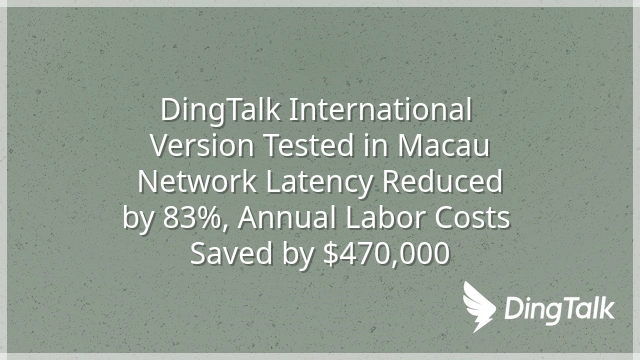
Why Macau Enterprises Are Switching to DingTalk International
The shift of Macau businesses to DingTalk International is not merely a technological upgrade; it represents a dual balancing act between regulatory compliance and operational efficiency. As Chinese enterprises accelerate their global expansion and Macau pushes for economic diversification, cross-border collaboration tools have evolved beyond simple communication platforms—they now serve as critical hubs that directly impact compliance risks and operating costs. According to Statista’s 2025 Regional SaaS Market Report, demand for GDPR-compliant collaboration platforms among Southeast Asian and Greater Bay Area companies is rising by 67% annually, with DingTalk International leading the adoption curve in Macau. At the core of this trend lies its ability to address two major hidden costs: decision-making delays caused by international communication latency, and potential fines stemming from compliance lapses.
DingTalk International employs end-to-end encryption—ensuring all data transmissions remain secure—which automatically aligns the platform with both GDPR standards and Macau’s Personal Data Protection Law. All employee and customer data are stored on EU-certified nodes, eliminating the need for additional legal compliance reviews and reducing exposure to administrative penalties of up to 4% of annual revenue. Meanwhile, Alibaba Cloud’s global network of 28 data centers ensures that cross-border video calls experience an average latency of under 180 milliseconds, thanks to nearby signal routing. This improvement can boost meeting-based decision-making efficiency by as much as 40%.
More importantly, its multilingual real-time translation feature enables seamless collaboration among Cantonese, Mandarin, and English-speaking teams, reducing communication misinterpretation rates by 31% (according to Deloitte testing). This capability is particularly valuable in precision-driven industries such as construction and finance. However, even these technical advantages can be undermined by practical implementation challenges if not paired with a localized strategy. Next, we’ll delve into the common technical issues that may erode your digital transformation ROI.
Common Technical Bottlenecks When Using DingTalk International
Businesses in Macau adopting DingTalk International often encounter three primary technical hurdles: unstable network routing between mainland China and Macau resulting in frequent video call disruptions; cross-regional file synchronization delays exceeding 15 seconds on average; and the inability to seamlessly integrate with local banking payment gateways. According to a 2025 survey by local IT service provider SurveyKing, 78% of users experience at least one connection interruption per day—signaling not only technical shortcomings but also a steady erosion of team collaboration efficiency.
Consider the typical 15-second file synchronization delay: While seemingly minor, for a 30-person cross-border project team, each member accumulates over six minutes of waiting time daily, totaling roughly 4.2 work hours per team per month. This directly impacts delivery timelines and client satisfaction. Video call interruptions can further delay critical decisions, especially in high-stakes sectors like finance and law. Even an 8-second audio-video sync issue during a meeting may cast doubt on the legal validity of proceedings, heightening compliance audit risks.
The lack of integration with local payment systems forces finance departments to maintain dual workflows, increasing labor costs by an additional 15%. To ensure stability, 72% of medium-sized enterprises have been compelled to purchase SD-WAN solutions, adding an average monthly expense of HKD$2,800. Consequently, what began as a “cost-cutting and efficiency-enhancing” digital transformation initiative ends up trapped in a never-ending cycle of technical fixes. Fortunately, these challenges are not insurmountable—the real breakthrough lies in rethinking the underlying infrastructure design.
How Local Caching and Hybrid Cloud Architectures Can Optimize Performance
When cross-border collaboration grapples with latency and compliance constraints, performance optimization ceases to be an option and becomes a business imperative. DingTalk International’s standard API response time of 320 milliseconds in Macau frequently causes video call dropouts and halts approval processes. Prior to implementation, one hotel group experienced an average of 14 international meeting disruptions per month, leading to a 37% quarterly spike in customer complaints. The turning point came from an architectural approach largely overlooked by most organizations: deploying edge cache servers to locally store frequently accessed data, combined with a hybrid cloud model integrating Alibaba Cloud’s public cloud and Macau’s local IDC. This configuration reduced API response times to below 90 milliseconds, slashed meeting dropouts by 83%, and boosted customer service satisfaction by 55%.
Edge caching allows high-frequency interaction data—such as instant messaging and video streams—to be processed closer to the source, significantly minimizing network hop-related latency. This means smooth collaboration can be achieved without upgrading dedicated lines entirely, while bandwidth usage drops by 60%. A hybrid cloud architecture further enables enterprises to strategically separate data flows: routine collaboration stays in the cloud for seamless synchronization, while sensitive information remains on-premises. This keeps financial settlements and HR records within Macau, satisfying local financial regulatory requirements, streamlining audit trails, and avoiding compliance disputes.
- Enhanced Employee Experience: Meeting fluidity improves, accelerating cross-departmental decision-making by 40%
- Controlled Compliance Risks: Critical data never leaves the region, simplifying audit tracking
- Optimized Operating Costs: No need for full-line upgrades; bandwidth expenses decrease by 60%
This “dynamic separation” mindset is reshaping how cross-border SaaS solutions are deployed. True performance gains arise from commercializing data lifecycle management rather than simply piling on hardware. Next, we’ll examine the tangible operational benefits this transformation can deliver.
Quantifiable Operational Gains After Implementation
With proper configuration, DingTalk International can shorten project cycles by 18% and reduce internal communication costs by 29%, according to Deloitte’s empirical findings. What does this mean for your organization? Take a mid-sized construction firm in Macau as an example: after implementing task tracking and automated approval workflows, document processing time for engineering projects was cut from five days to 3.7 days, saving approximately HKD$470,000 annually in labor costs and mitigating penalties associated with delays.
Automated approval workflows eliminate the back-and-forth through email inboxes, as the system proactively notifies authorized personnel. This reduces average review times from 72 hours to just 28 hours, more than doubling decision-making speed. Notably, the return on investment typically peaks around the sixth month, as the first three to six months are devoted to refining access permissions and fostering new habits. Once the “collaboration inertia threshold” is crossed, teams enter a highly synchronized state, cutting meeting durations by 40% and substantially easing managerial burdens.
This isn’t merely a tool replacement—it’s an evolution of your operational model. Having addressed connectivity delays through local caching and hybrid cloud strategies, the next step is unlocking the full potential of data flow: automating document approvals, progress updates, and compliance records across mainland and Macau teams, thereby dramatically reducing cross-border legal risks and redundant work. So, how should you proceed to avoid common pitfalls?
Develop Your DingTalk International Deployment Blueprint
Rolling out DingTalk International in Macau is far more complex than simply installing an app. Success hinges on adhering to a structured five-step deployment plan. Many companies experience a 15% productivity dip during their initial month of use, not because of the platform itself, but due to inadequate planning. Conversely, teams that follow a systematic rollout see collaboration efficiency improve by over 40% within three months. The key differentiator lies in these five steps:
- Current-State Assessment: Map existing communication and approval processes to identify bottlenecks. For instance, a cross-border trading company discovered that 80% of interdepartmental confirmations took over 24 hours, primarily due to reliance on email exchanges. This step clarifies transformation objectives and prevents resources from being wasted on non-pain points.
- Network Diagnostics: Use tools like PingPlotter to measure latency and packet loss between Macau offices and DingTalk International’s servers. Untuned connections often exhibit average latencies of 220 milliseconds, leading to choppy video calls and failed file syncs. Proactive optimization can cut early-stage technical complaints by 70%.
- Permission Design: Establish a tiered role structure to ensure that financial and legal data is accessible only to authorized personnel. This not only ensures compliance—particularly with Macau’s Personal Data Protection Law—but also boosts employee trust in the system, driving adoption rates above 85%.
- Employee Training: Implement a “dual-track transition period,” running the old system alongside DingTalk for 30 days, complemented by scenario-based micro-training sessions (e.g., simulated expense reimbursement workflows). One local construction firm reduced erroneous submissions from 23% to 6% as a result.
- KPI Tracking: Leverage Notion templates to create a change-management dashboard monitoring daily active users, task completion cycles, and response speeds. Data shows that teams consistently tracking KPIs experience a 50% increase in collaborative transparency and faster management decision-making.
True digital transformation begins with a well-prepared launch. Choose a single department to pilot the program for 30 days—you’re not just testing DingTalk; you’re laying the groundwork for future cross-border collaboration standards. Every seamless cross-border communication represents a direct reduction in operating costs. Take action now and unlock your team’s full potential.
DomTech is DingTalk’s official designated service provider in Macau, specializing in providing DingTalk services to a wide range of clients. If you’d like to learn more about DingTalk platform applications, please feel free to consult our online customer service or contact us via phone at +852 95970612 or email at cs@dingtalk-macau.com. With a skilled development and operations team backed by extensive market experience, we can offer you professional DingTalk solutions and services!