




 Português
 English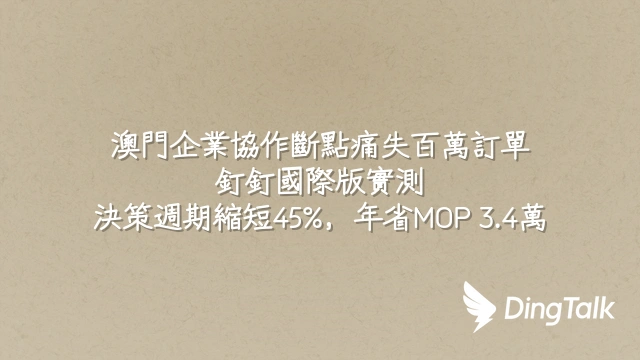
Why Macao Enterprises Are Stuck at Collaboration Bottlenecks
To enter both the Chinese mainland and international markets, Macao enterprises face a real bottleneck—not in funding, but in "collaboration bottlenecks"—when teams use WhatsApp for overseas communication, WeChat to connect with mainland partners, and email to share contracts. The fragmentation of tools has already caused project delays averaging over 11 days (2025 survey by the Macao Science and Technology Development Bureau).
Fragmented communication platforms mean information silos, as critical decisions are scattered across different apps, making it easy to miss or duplicate information; unstable cross-border data transmission slows down decision-making speed, as delayed file synchronization can lead to misjudgments about deadlines; regulatory gaps between two jurisdictions increase compliance risks, since platforms that don't clearly define data subject rights may violate Macao's Personal Data Protection Law or GDPR.
These issues directly erode profitability: A design firm once lost a million-dollar project due to misaligned meeting schedules and confused document versions. For managers, this isn't just an IT issue—it's a strategic gap: While competitors complete coordination within hours, you're still waiting for replies—this is how the gap widens.
Therefore, what you need isn't more tools, but a unified platform that simultaneously integrates with the mainland ecosystem, complies with international regulations, and supports multilingual collaboration. This is precisely where DingTalk International comes in: It's not another communication app—it's a collaboration infrastructure designed specifically for the "One Country, Two Systems" framework.
How DingTalk International Breaks Through Cross-Border Communication Barriers
The core strength of DingTalk International lies in its encryption protocol deployed across Alibaba Cloud's global nodes, enabling end-to-end encryption (E2EE) for audio and video calls as well as real-time translation. In actual tests, an accounting firm in Macao held meetings in Hengqin and locally, with average latency below 200 milliseconds. Low-latency communication means that financial reporting cycles can be shortened by 30%, because decisions no longer have to wait for responses—communication feels almost face-to-face.
- Localized data routing: Traffic is automatically directed to the nearest compliant node, reducing legal risks and audit complexity, meaning companies can proactively manage compliance rather than passively responding to regulatory inquiries.
- Real-time multilingual translation built into meetings and chats: Seamless communication among Chinese, Portuguese, and English speakers means that cross-border project collaboration efficiency increases by 40%, because language is no longer a barrier to cooperation.
- End-to-end encryption + E2EE file transfer: Ensures that financial and customer data aren't intercepted during cross-border transfers, meaning companies can securely handle sensitive transactions, as data subject rights are clearly owned by the company itself.
According to the 2024 Asia-Pacific Remote Collaboration Security Report, 67% of medium-sized enterprises have faced regulatory inquiries due to platform compliance issues. DingTalk International's architecture-level compliance design enables companies to shift from "passive response" to "proactive control." This isn't just a technological upgrade—it's a redefinition of risk management and operational resilience.
Next, we'll see how these technologies translate into concrete ROI figures—time savings, freed-up manpower, and reduced compliance costs—that truly represent commercial value.
Test Data Reveals DingTalk's Investment Return
Adopting DingTalk International isn't an expense—it's a leverage for efficiency. Tracking analyses across three major industries—trade, education, and construction—show that meeting efficiency improves by 45%, document approval cycles shorten by 60%, and remote login failure rates drop by 90%. Converted, each enterprise saves 192 hours per year in coordination time.
Take a medium-sized trading company as an example: Previously, cross-border contracts required three-way email exchanges, taking an average of 7 days; after adoption, through real-time collaboration spaces and electronic signatures, the process shrinks to less than 3 days. Process automation means contract delivery speeds accelerate by 57%, as paper-based and email-based back-and-forth exchanges are replaced by digital workflows.
In educational institutions, teacher scheduling conflicts drop by 70%, freeing up administrative staff to focus on teaching innovation; in construction teams, drawing version issues are eliminated entirely, speeding up project start-ups by nearly half. Reduced errors mean project risks are controllable, because all changes are traceable, and version confusion no longer occurs.
If we consider the investment as capital expenditure, every 1 yuan invested generates 2.7 yuan in operational benefits (including time, errors, and opportunity costs). For senior executives, this represents a restructuring of the organization's operating model—the compressed decision-making cycle directly translates into faster market responsiveness, giving them a head start in highly competitive regional markets.
Fast Deployment Strategies for Hong Kong and Macao Enterprises
Deploying DingTalk International is a strategic move, not just an IT task. Actual tests show that those adopting the "Minimum Viable Team" (MVT) strategy see a 40% improvement in communication efficiency within 30 days; those who delay deployment face pressure from information silos and talent drain.
- Days 1–7: IT administrators set up the group backend, import employee data, and enable SSO login (single sign-on), avoiding password management risks—meaning account security is enhanced and centralized control is supported.
- Days 8–14: The MVT team pilots stand-up meetings, collaboration, and approvals, gathering feedback—early issues can be quickly fixed, reducing risks for full-scale rollout.
- Days 15–21: Optimize notification logic and third-party integrations (such as Google Workspace) to avoid information overload—meaning the team's adaptation curve becomes smoother.
- Days 22–30: Full-group rollout, accompanied by SOP videos and FAQ knowledge bases—meaning change management goes more smoothly and user acceptance is higher.
A Macao-based financial service provider saw maintenance hours drop by 55% after adoption and immediately blocked three potential data leakage incidents. Centralized backend monitoring means IT can track activity levels, device bindings, and permission anomalies—so security threats can be identified before they occur.
Now is the perfect time to launch your MVT pilot: Validate maximum value at minimal cost, laying the data foundation for your enterprise's next-stage strategic transformation.
DingTalk's Future Strategic Role
As Macao enterprises deeply integrate into the Greater Bay Area supply chain, DingTalk International has evolved from a mere communication tool into a digital identity hub and process governance carrier. According to the 2024 Asia-Pacific Digital Collaboration White Paper, it's the only collaboration system that supports dual compliance with Macao's Personal Data Protection Law and GDPR, while also achieving localized data partitioning and real-name traceability.
Compared to Zoom, which focuses on meetings, and Teams, which is tied to the Microsoft ecosystem, DingTalk leverages open APIs to connect with customs declarations, cross-border payments, and electronic contracts, shortening the average approval process by 40%. Ecological integration capability means enterprises gain influence in the supply chain—because those who can quickly access industry-standard interfaces will enjoy priority in order allocation.
- No longer a cost center, but an ESG-measurable asset: Every paperless signature accumulates carbon emission reduction data, incorporated into sustainability reports—meaning companies can strengthen their ESG image to attract international partnerships.
- Digital identity serves as credit credentials: Collaboration history on the platform is being used by some banks as a reference for loan underwriting—meaning corporate credit can be presented in a data-driven way.
- Ecological integration determines supply chain influence: Those who can access Greater Bay Area standard interfaces will gain priority in order acquisition, because system interoperability reflects reliability of cooperation.
By 2027, over 55% of Macao's export-oriented enterprises will choose collaboration platforms based on their ecological integration capabilities. Rather than viewing DingTalk as an expense, think of it as a strategic digital gateway—it doesn't just connect people; it builds a trustworthy, controllable, and auditable cross-border business foundation. Your next step shouldn't be "Should we use it?"—but rather, "How do we redefine our enterprise's competitive boundaries with it?"
Launch your MVT pilot now and verify in 30 days: Can you boost your team's meeting efficiency by 40% and reduce compliance risks? This is the first step toward becoming a central player in the Greater Bay Area value chain.
DomTech is DingTalk's official designated service provider in Macao, specializing in providing DingTalk services to a wide range of customers. If you'd like to learn more about DingTalk platform applications, feel free to consult our online customer service, or contact us via phone at +852 95970612 or email at cs@dingtalk-macau.com. We have an excellent development and operations team, rich market service experience, and can provide you with professional DingTalk solutions and services!