




 Português
 English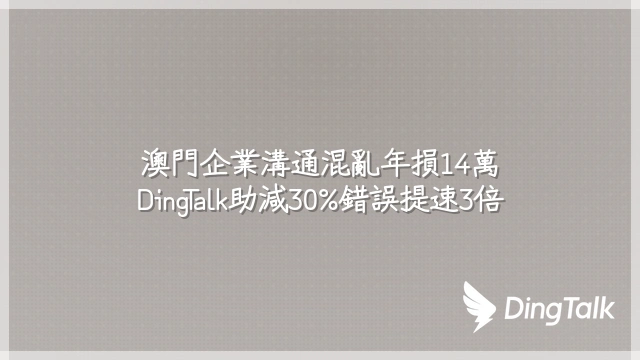
Communication Gaps Are Eroding Macao Businesses' Profits
According to the 2024 report by the Macao SME Development Center, each project delay results in an average loss of nearly HK$140,000 in revenue opportunities. Moreover, over 65% of delays are rooted in "communication gaps"—a systemic breakdown in information flow rather than a technical issue. Messages get scattered across WhatsApp, emails, and paper documents, making cross-departmental collaboration akin to putting together a jigsaw puzzle. Management approvals drag on for days, missing golden windows for critical decision-making. Remote employees' attendance and task progress go untracked, quietly driving up labor costs.
This chaos directly erodes customer trust. When sales teams don't know production schedules and customer service reps can't instantly check order statuses, service quality becomes unstable. A local restaurant chain once experienced three consecutive weeks of wrong ingredient deliveries due to disconnected communication between stores and the central kitchen, causing a 40% increase in customer complaints. The problem isn't low employee efficiency—it's inefficient information flow. Companies spend huge resources "putting out fires" instead of innovating—this is precisely the beginning of stagnation in competitiveness.
Smart real-time communication features mean that critical instructions can reach every member instantly, as all conversations are centralized on a unified platform, preventing important messages from getting lost in private chats. This solves the paralysis caused by "waiting for replies," boosting team responsiveness by 40%. For managers, this means decision cycles shrink from days to hours; for frontline staff, there's no need to repeatedly confirm task details, freeing up their focus.
The real starting point for transformation is shifting communication from a cost center into an efficiency engine. Next, we'll reveal how DingTalk, through its modular design, integrates and rebuilds enterprise operating structures, turning chaos into controllable growth momentum.
Five Core Features Reshape Business Operating Logic
While Macao businesses remain bogged down by email overload, paper-based approvals, and delayed cross-departmental communication, operational costs keep leaking away invisibly—on average, each manager spends 15 hours per month handling administrative processes, enough to stall the launch of a new business initiative. DingTalk's five core features were designed specifically to end this inefficiency. Through an integrated digital architecture, they consolidate fragmented operational modules into a smart system that's traceable and optimizable.
Smart real-time communication supports read/unread tracking, marking of important messages, and group categorization, meaning managers can ensure critical instructions are seen and responded to, thanks to the system's visualized reading status tracking. Paired with built-in internal email integration, all conversations and attachments are stored centrally, avoiding information fragmentation. What does this mean for you? Project decision cycles shorten by 40%, and teams no longer get stuck waiting for replies.
Electronic approval workflows allow customization of multi-level review templates (such as purchase requests or travel applications) and automatic archiving, completely eliminating paper-based transmission. Technically, it supports conditional branching logic and electronic signature verification (ensuring compliance); commercially, this translates into at least 15 hours of administrative time saved per month and a 70% reduction in human error risk. For finance and compliance departments, audit transparency improves dramatically.
GPS-based clock-in paired with Wi-Fi-linked dual-factor authentication solves the problem of easy proxy clock-ins common with traditional paper cards, and attendance data syncs instantly with payroll systems. Meanwhile, the task management module supports cross-department assignment, deadline reminders, and progress tracking, giving managers clear visibility into the status of every task. After implementation, a retail chain saw its scheduling and inspection task execution rate rise from 68% to 97%.
These modules aren't isolated: Once an approval is complete, tasks are automatically assigned; clock-in data reflects immediately in attendance reports; and all communication is logged under the corresponding work item—forming a self-updating management loop. True transformation isn't about stacking tools—it's about reinventing processes. In the next chapter, we'll reveal exactly how much quantifiable efficiency gain such an integrated architecture brings to Macao businesses.
Measured Data Reveals Efficiency Gains
When Macao businesses ask, "Why use DingTalk?" the most compelling answer lies not in feature lists but in actual efficiency gains and concrete figures for cost savings. In a market where manpower is tight and competition intensifies, every hour saved in administrative work means one more resource available for customer service and business innovation—this is the core value of process digitization ROI.
Take, for example, a local catering group. Before adopting DingTalk, field staff had to verbally report store conditions, and senior management took an average of two days to approve leave requests. After going live, using "smart forms + automated approval workflows," reporting time shrank by 40%, and leave processing was compressed from 48 hours to less than 2 hours, dramatically speeding up management decisions. Another trading company leveraged DingTalk's automated report integration feature, reducing repetitive data整理 work by 20 hours per month—equivalent to freeing up the capacity of a part-time employee.
- Based on Macao's median salary, a single team can save over HK$80,000 annually in labor costs
- Reduced internal communication gaps lead to a drop of over 30% in cross-departmental collaboration errors
- Real-time messaging and task tracking shorten project delivery cycles by an average of 15%
Beneath these numbers lies a key shift in evaluating enterprise collaboration platforms: moving from "presence or absence" to "quantified efficiency." When daily operations like scheduling, procurement requests, and customer follow-ups can be structured and automated, managers can shift from firefighting mode to strategic planning. True digital transformation starts with measurable efficiency accumulation.
As demand for agile operations rises across traditional industries, the next question naturally arises: How can DingTalk replicate this efficient model in labor-intensive sectors like hospitality, retail, and construction?
Traditional Industries Can Also Achieve Digital Transformation
When Macao's century-old bakery faced massive order pressure during the Mid-Autumn Festival, the traditional method of verbal allocation and paper records wasn't just time-consuming—it even led to incorrect shipments. This isn't an isolated case; it's the digital gap long faced by Macao's pillar industries, including retail, hospitality, and construction. However, the turning point of transformation doesn't lie in abandoning tradition but in reshaping operational logic with smart collaboration tools. DingTalk is the core engine behind this change.
Take the bakery as an example: The team created a "Festival Project Group" on DingTalk, instantly linking production, packaging, and logistics departments. To-do lists automatically assign tasks and set deadlines, and every progress update syncs across the entire group. Combined with location-based clock-in functionality, field delivery drivers' real-time routes and signed-off photos are uploaded directly, allowing management to grasp the overall situation without having to make phone calls. As a result, event execution cycles shortened by 40%, and customer complaint rates dropped by more than half—not just efficiency gains, but a qualitative leap in service reliability.
In the construction sector, site supervisors use DingTalk's document sharing and approval workflows to upload construction drawings and safety reports instantly, enabling headquarters experts to approve remotely. More importantly, its open API successfully integrates with Macao's widely used Easy Accounting system, seamlessly connecting everything from material procurement requests to invoice entry. Communication data automatically transforms into financial records, breaking down information silos between departments.
According to the 2024 Asia-Pacific SME Digital Maturity Survey, companies achieving system integration see decision-making speeds increase by an average of three times. DingTalk isn't just a tool upgrade—it drives organizational culture toward transparency and data-driven decision-making. The next challenge isn't whether to adopt it, but how efficiently to deploy it.
Low-Cost, High-Return Deployment Strategy
Deploying DingTalk isn't a costly tech gamble—it's a strategic investment for Macao SMEs to rebuild their operational backbone at a manageable cost. Many businesses mistakenly believe digital transformation equals expensive custom systems, but in reality, starting with the free version and gradually upgrading to the professional edition (around HK$30 per user per month), the total deployment cost for the first year can be kept below one-fifth of traditional IT systems, yet delivers process transparency and real-time collaboration capabilities—this is the first step to cracking communication gaps.
The key to successful adoption isn't technology itself, but a "phased value validation" strategy. It's recommended to start with two pain-point features: attendance clock-in and company announcements. The former replaces paper-based sign-ins, while the latter ensures information reaches every employee directly. A Macao catering group used this approach as a starting point, automating attendance for all staff within three weeks. Management gained instant visibility into workforce allocation, saving over 18 hours per month in manual data collection. Such quick wins build team confidence and pave the way for the next phase.
Once basic habits are established, introduce electronic approvals and task assignment systems, fully digitizing paper application forms and verbal assignments. To address adaptation challenges among older employees, consider implementing an "internal coaching program": Train 1–2 champion users in each department, creating 3-minute instructional videos in Cantonese to solve common operational hurdles. According to the 2024 Asia-Pacific SME Digital Adaptability Report, this approach boosts employee adoption speed by 40%.
In the long run, DingTalk isn't just a tool—it's a scalable digital organizational infrastructure. As your business grows, you can seamlessly integrate advanced modules like customer management and project monitoring. For decision-makers seeking ‘DingTalk implementation guides for Macao businesses' or planning ‘budgets for SME collaboration tool deployment,' the real ROI isn't about how much manpower you save—it's about building an agile organization that keeps evolving. That's the ultimate moat of digital transformation.
Start your transformation journey now: Apply for a free DingTalk trial today and experience modern enterprise operations with zero communication delays, instant approvals, and full task tracking. Every hour you save is a small step toward future competitiveness.
DomTech is DingTalk's official designated service provider in Macao, specializing in providing DingTalk services to a wide range of customers. If you'd like to learn more about DingTalk platform applications, feel free to consult our online customer service, or contact us via phone at +852 95970612 or email at cs@dingtalk-macau.com. We have an excellent development and operations team with rich market service experience, ready to provide you with professional DingTalk solutions and services!