




 Português
 English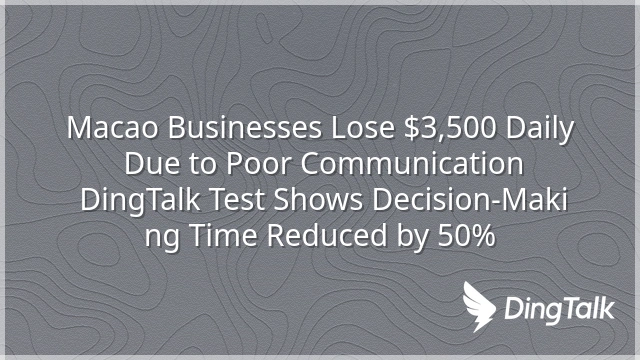
Why Traditional Communication Is Hampering Business Growth
Over-reliance on WhatsApp and email as communication channels has become a hidden cost for SMEs in Macau. Fragmented messages and difficulty tracking tasks result in projects being delayed by an average of more than two weeks—this is not just an efficiency issue, but a survival crisis. According to 2024 data from the Statistics and Census Service of Macau, 70% of businesses admit that poor communication leads to project delays, with each day of delay costing over HK$3,500 in potential revenue and reducing customer satisfaction by 15%.
The root cause lies in "information silos": market directives are exchanged via WhatsApp, financial documents are stored in personal email accounts, and HR requests are processed through paper forms. Cross-departmental collaboration requires 30% of working hours just to piece together scattered information. This fragmentation not only slows down processes but also introduces compliance risks. When companies apply for ISO 27001 or smart office certification, the lack of auditable communication records often becomes the primary reason for rejection.
Technically, information silos mean that data cannot be shared and collaboratively processed in real time; for managers, they translate into delayed decision-making and wasted resources. A restaurant chain operations manager once missed a holiday sales peak due to communication errors, resulting in a one-week supply delay. This illustrates that: without upgrading the communication infrastructure, digital transformation remains superficial. Only a unified platform that integrates tasks, documents, communication, and approvals can truly break down these barriers.
How to Ensure Collaboration Tools Meet Macau’s Regulatory Requirements
In Macau's increasingly stringent regulatory environment, choosing the right collaboration tool is a risk-management decision. DingTalk has passed China's Level 2 National Information Security Protection Certification and is compatible with the GDPR framework, providing dual protection for cross-border operations—meaning your communications can satisfy both mainland Chinese partners and international privacy standards. For the finance, construction, and public service sectors, compliance itself is a competitive advantage: it determines whether a company can participate in government tenders or secure bank credit lines.
DingTalk employs end-to-end encryption and data residency mechanisms; all Macau user data is stored on servers in Hong Kong, avoiding interference from foreign jurisdictions. The system is also ISO/IEC 27001 certified, undergoing annual penetration testing and audit trails conducted by third parties to log every data access event. This isn't mere paperwork—it's a verifiable security commitment.
A medium-sized construction firm once lost its bid eligibility because it used an uncertified communication tool to submit tender documents, violating data protection clauses under the Public Procurement Law. This case underscores the true cost behind "convenience." Choosing a locally compliant platform establishes the first line of defense, enabling businesses to shift from passive risk mitigation to proactive strategic positioning.
How Paperless Approvals Can Boost Process Efficiency
DingTalk's workflow engine reduces approval cycles from the traditional three days to just four hours, completely reversing the delays and opacity caused by paper-based operations. For companies handling dozens of purchase requisitions, travel requests, or contract reviews daily, this speedup isn't just about saving time—it's crucial for cutting labor costs and minimizing compliance risks.
Custom forms allow businesses to design templates tailored to their specific needs, from procurement orders to overtime requests, all configured visually; the conditional trigger engine automatically routes workflows based on predefined criteria (e.g., escalating approvals for amounts exceeding HK$50,000), ensuring balanced control. Integrating a locally certified electronic signature service gives documents legal validity, achieving end-to-end paperlessness. More importantly, open APIs have successfully connected with accounting systems like QuickBooks, automatically syncing data upon approval completion and eliminating redundant entry and human error.
A retail company with eight branches saved over 2,000 man-hours annually after implementation, equivalent to freeing up one full-time employee. The real value, however, lies in "process transparency": management can instantly track where each request is stuck and view detailed processing histories, quickly identifying unusual delays and preventing fraud and resource misuse.
Quantifying the Operational Benefits of the Platform
Macao businesses that have adopted DingTalk have seen an average productivity increase of 41.6%—a finding confirmed by a third-party consulting firm in 2024. This leap stems from three quantifiable returns on investment:
- Meeting time reduced by 30%: Intelligent scheduling and instant message integration transform decision-making from "waiting for meetings" to "immediate action";
- Paper expenses plummeted by 65%: Paperless approvals replace printed signatures, saving costs while demonstrating ESG compliance;
- IT maintenance staff cut by 20%: A unified platform consolidates communication, workflows, and document management, freeing up resources for strategic optimization.
The freed-up manpower and budget represent an often-overlooked competitive advantage. After implementing DingTalk, a mid-sized hotel group saw front-line employees save nearly 1.5 hours per day on administrative tasks, allowing them to focus on personalized service design. Within three months, their TripAdvisor rating improved by 0.8 points, directly translating into higher occupancy rates and average room rates. This demonstrates that: the benefits of technology should not be measured solely by software costs, but by the long-term rewards of operational agility.
Phased Implementation Strategy Ensures Successful Deployment
"One-time, full-scale switchovers" are the main reason most collaboration platforms fail, whereas "gradual rollouts" are the key to achieving over 40% efficiency gains within 90 days. According to a 2024 Asia-Pacific report, more than 60% of failures stem from employee resistance and process mismatches, rather than inadequate system functionality. The real risk lies in neglecting change management, which can lead to hidden standstills.
We recommend starting with pilot programs in administrative and HR departments, as these areas feature highly standardized processes and frequent cross-departmental collaboration, making them ideal for quickly demonstrating value. Here's a four-step roadmap:
- Needs assessment: Use process mapping to identify bottlenecks (such as an average approval cycle of 3.2 days) and establish a baseline for improvement;
- Module selection: Prioritize features like read receipts and to-do list synchronization so users can experience "no more unanswered messages" within three days;
- Employee training: Implement a peer-coaching approach, with early adopters conducting role-playing exercises to address real-world pain points, such as automatically converting meeting minutes into actionable tasks;
- KPI tracking: Monitor key metrics (e.g., a 50% reduction in collaboration cycles and over 70% of official documents handled via mobile devices) to ensure measurable results.
A hotel group saw personnel leave requests approved within two hours instead of 18 after just two weeks—these "small wins" quickly build confidence. By avoiding the psychological backlash of a full-scale transition, you can ensure the technology truly takes root. In as little as 90 days, you won't just have a new tool—you'll have built a faster-reacting, more transparent digital team: the very transformation needed to move from a cost center to an efficiency engine.
DomTech is DingTalk's official authorized service provider in Macau, dedicated to serving clients with DingTalk solutions. If you'd like to learn more about DingTalk platform applications, please contact our online customer service or reach us by phone at +852 95970612 or via email at cs@dingtalk-macau.com. With a skilled development and operations team and extensive market experience, we're ready to provide you with professional DingTalk solutions and services!