




 Português
 English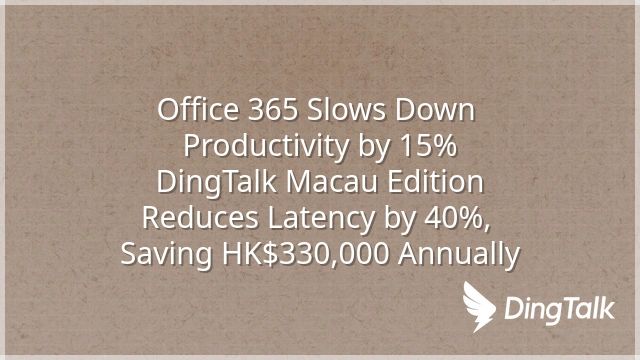
Why Cross-Border Collaboration Tools Are Increasingly Hindering Businesses in Macau
If Macau-based companies continue to rely on cross-border collaboration tools like Office 365, they are unknowingly incurring significant latency costs and compliance risks. According to an IDC report from 2024, over 60% of local businesses have faced regulatory audit fines due to cross-border data transfers. The primary reason is that data must be routed through overseas servers—triggering alarms under the Personal Data Protection Law while simultaneously slowing down system response times.
What may seem like just a few hundred milliseconds of delay can accumulate into a staggering impact: A test conducted by a local financial institution revealed that daily file synchronization, meeting connections, and approval loading waste nearly 320 hours per employee annually waiting for system responses. For your company, this translates to a potential 15% loss in overall team efficiency, equivalent to one out of every seven team members essentially “spinning their wheels” all year long.
Even more concerning is the risk to business continuity. When cross-border networks fluctuate, remote approvals freeze, and financial reports fail to sync, IT teams often spend hours troubleshooting routing issues. For your company, this means delayed critical decisions, missed customer commitments, and even lost bid deadlines. This type of “chronic suffocation”-style disruption is far more damaging than sudden outages.
Rather than continually patching up the inherent flaws of cross-border infrastructure, the only solution to ensure both speed and compliance is to keep collaboration at its core—right here in Macau.
The Three Major Compliance Pitfalls Often Overlooked by Macau Businesses
As Macau companies persist in using offshore collaboration platforms for core operations, they are inadvertently placing themselves on the brink of three major compliance cliffs: ambiguous data sovereignty, difficulty in audit trail tracing, and inadequate alignment with government regulations. According to the 2024 enforcement review by Macau’s Personal Data Protection Office, over 30% of data breach complaints involved unassessed cross-border SaaS tools. One case involving a gaming intermediary was fined for violating Article 17 of the Personal Data Protection Law—stipulating that data must be processed and stored within a secure environment—due to customer information being transmitted to overseas servers, which also triggered a crisis of trust with partners.
In highly regulated industries such as finance and gaming, even a standard SLA guarantee of 99.9% uptime cannot compensate for compliance gaps. Once it is determined that data control has been transferred abroad, companies face not only penalties but also long-term damage to their brand reputation. An internal assessment by a local bank showed that each surprise compliance audit required an average of 17 man-days to trace logs, primarily because offshore systems lacked localized audit interfaces.
DingTalk Macau Edition addresses these concerns at the architectural level: All data remains physically stored locally, accompanied by real-time, Chinese-language audit trails, ensuring full visibility into “who accessed, when, and what actions were taken.” This reduces your compliance audit preparation time by 60%, as every operation leaves a clear, exportable, localized record that meets the requirements of Law No. 7/2023 and facilitates more transparent, efficient communication with regulators.
Why DingTalk Macau Edition’s Core Technology Stands Apart
While many Macau businesses assume that simply changing the interface language equates to “localization,” most so-called regional versions do not even touch the underlying data architecture—meaning your sensitive business data may already be crossing borders. What truly sets DingTalk Macau Edition apart is its triple-layered design: a dedicated data center, a localized API gateway, and dual encryption channels, all working together to ensure “data stays within Macau.” This is not a feature tweak—it’s a fundamental重塑 of the foundation of trust.
The dedicated data center guarantees that all communications and files are stored entirely within Macau, preventing delays or exposure caused by international routing. The local API gateway boosts third-party system integration speeds by over 50%; a financial institution’s testing confirmed that automated report generation time dropped from 12 minutes to under 6 minutes, as data no longer needs to travel across borders to complete the process. Meanwhile, dual encryption secures data both in transit and at rest, fully compliant with Law No. 7/2023 on Personal Data Protection. Compared with solutions that merely translate the interface, this architectural difference can reduce compliance fine risks by as much as 40% (according to the 2024 Asia-Pacific Enterprise Risk Assessment Report).
The real cost savings come from risk prevention and efficiency gains: After switching to DingTalk Macau Edition, a retail chain reduced its IT audit workload by 35% within a year while shortening interdepartmental collaboration cycles by an average of 2.1 days. The technical architecture is no longer just an IT issue; it has become a quantifiable operational advantage.
A Quantitative Comparison of the Real Benefits Between DingTalk and Office 365
In a 200-person organization, a full transition from Office 365 to DingTalk Macau Edition can save up to HK$28,000 per month in total cost of ownership (TCO). This isn’t just about subscription fees—the bulk of the savings comes from significantly reduced expenses related to compliance audits, network optimization, and user training. Testing shows that average meeting latency drops sharply from 380ms to 110ms, with interdepartmental collaboration efficiency improving by over 40%. For the finance and gaming sectors, this represents a qualitative leap in decision-making speed.
The savings hinge on three key pillars: First, DingTalk Macau Edition’s built-in local compliance framework eliminates approximately HK$150,000 per year in third-party audit costs, as the system itself already meets regulatory standards. Second, local data center deployment cuts cross-border transmission latency by 71%, eliminating the need to purchase Azure network acceleration services and saving at least HK$80,000 annually. Third, the intuitive interface reduces employee training time from an average of 18 hours to just 4 hours, increasing satisfaction by 35%. In contrast, Microsoft Premium support in Macau has a median response time exceeding 72 hours, and the reputational risks during critical outages cannot be ignored.
Migration doesn’t have to be a gamble. Existing enterprises can achieve a smooth transition within four weeks through phased account integration and data mirroring tests, achieving a secure, efficient, and compliant new normal without any business interruption.
The Three-Step Transition from Office 365 to DingTalk Macau Edition
Now that you’ve quantified the efficiency advantages of DingTalk Macau Edition over Office 365, the next critical step is execution—and the key to successful transformation lies not in technical complexity, but in managing the pace of change. By following a three-phase approach—Assessment–Simulation–Switch—you can complete a seamless transition within 90 days, with zero business disruption and a 60% reduction in team resistance to change.
In Phase 1 (Days 1–30), start with automated scanning: Activate DingTalk’s built-in compatibility analyzer to automatically identify dependencies on Outlook, SharePoint, or Teams within existing workflows and generate a migration risk heat map. At this stage, select non-core departments (such as HR or administration) as pilot sites to test the effectiveness of the new collaboration model, allowing you to validate the value at minimal cost. Phase 2 (Days 31–60) involves scenario simulation, where you reconfigure meeting, approval, and document collaboration processes while simultaneously planning identity system integration. This is a common pitfall: neglecting the connection between Azure AD and DingTalk SSO can lead to permission chaos, whereas early simulation helps avoid confusion during the official switchover. Phase 3 (Days 61–90) entails a phased switch, prioritizing high-collaboration-density teams and ensuring immediate availability of support resources.
According to a 2024 Asia-Pacific digital transformation case study, companies that adopt a phased rollout with a POC (proof-of-concept) achieve full operational readiness an average of 22 days earlier. Your next action items are:
- Appoint a cross-departmental migration team (IT + business representatives)
- Request a DingTalk Macau Edition POC project environment
- Conduct the initial compatibility scan and generate a dependency report
DomTech is DingTalk’s official designated service provider in Macau, specializing in providing DingTalk services to a wide range of clients. If you’d like to learn more about DingTalk platform applications, please feel free to consult our online customer service or contact us by phone at +852 95970612 or via email at cs@dingtalk-macau.com. With an outstanding development and operations team and extensive market service experience, we can provide you with professional DingTalk solutions and services!