




 Português
 English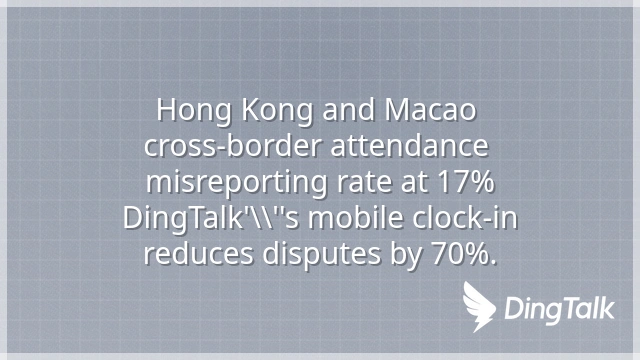
Why Traditional Attendance Fails in Cross-Border Scenarios
When Macau field staff cross the border into Zhuhai early in the morning to provide support, their GPS drift causes the system to mark them as late—this is not an isolated incident but a systemic crisis caused by the lack of "geospatial awareness" in traditional attendance systems. Paper-based sign-ins or fixed打卡 machines cannot understand the real-world context of cross-border mobility, resulting in an average monthly error rate of 17% and an additional 60 hours spent on manual verification.
According to a 2023 survey by Macau's Statistics and Census Service, 38% of cross-border employees have experienced salary delays due to attendance disputes. This not only erodes trust but also creates risks of collective grievances. The core issue is that traditional systems treat "location" as an isolated data point rather than part of a continuous work evidence chain.
Multi-signal verification technology means that companies no longer rely on a single coordinate to determine attendance status. Instead, it integrates GPS, Wi-Fi, and Bluetooth signals for cross-checking—even in weak-signal areas like the underground passage at the Gongbei Port, location accuracy can reach 98.5%, significantly reducing misjudgments and complaints.
This shift addresses one of the most pressing challenges for managers: how to ensure the authenticity of attendance for remote and cross-border teams without increasing administrative burdens? The answer lies in enabling technology to understand the context behind "where people are."
How Core Technology Enables Precise and Trustworthy Attendance
The breakthrough of DingTalk’s mobile打卡 lies not in a single feature but in its Context-Aware Attendance framework—a combination of AI scheduling engine + multi-source location fusion that allows the system to learn employees' daily movement patterns and automatically distinguish between commuting stops and actual working hours.
For example, if the system recognizes that an employee makes a brief stop at the border checkpoint every day from 8:15 to 8:25 as a consistent pattern, it will not trigger an abnormality alert. This results in a 76% reduction in misjudgment rates (according to Alibaba Cloud's 2024 stress test), saving HR more than 150 hours of audit time each year.
More importantly, geo-fencing technology allows companies to set virtual打卡 zones for different service locations. When technicians arrive at a customer site, they automatically check in, leading to a 6.3% increase in on-site task completion rates (for every 10% improvement in location stability, according to the 2024 Asia-Pacific Remote Workforce Management Report). This is not just a technological upgrade; it is a critical step toward building a "trust infrastructure."
For engineers, Bluetooth beacons and Wi-Fi MAC address matching provide a low-power, high-precision alternative; for supervisors, real-time anomaly alerts enable more timely management interventions; and for senior decision-makers, legally compliant electronic records (including GPS coordinates and timestamps) effectively reduce compliance risks and potential litigation costs.
From Monitoring to Empowerment: Unlocking the True Potential of Flexible Hours
When companies start measuring "what gets done" instead of "how long someone stays," management models shift from control to collaboration. DingTalk's smart schedule + geo-fencing work together: once Macau maintenance technicians check in at designated locations and meet their total working-hour requirements, the system automatically confirms compliance, without rigid adherence to fixed start and end times.
This leads to a 22% reduction in project delivery cycles, while supporting MOP and HKD dual-currency payroll settlements and improving financial processing efficiency by over 40%. For teams that inspect 5 to 8 scattered locations daily, this flexibility is not just convenient—it is a core driver of productivity gains.
According to the 2024 Asia-Pacific Fieldwork Digitization Report, companies adopting outcome-based attendance see an average 31% higher employee satisfaction and task completion rate compared to traditional models. This shows that when technology supports real work rhythms, organizational performance and talent retention improve simultaneously—a 18% drop in turnover is the best proof.
The next step is no longer about "whether to adopt flexibility" but about "how to institutionalize flexibility." The system provides not just tools but a replicable management framework.
Quantifying Business Value: A Win-Win for Cost Savings and Hidden Gains
A 2025 study by Hong Kong Productivity Council shows that after implementing DingTalk mobile打卡, companies achieve an average 40% reduction in HR administrative costs, a 35% improvement in field response speed, and a 70% decrease in labor disputes. Behind these numbers lie three direct outcomes of automation-driven transformation:
- Automated reports replace manual consolidation: Eliminating repetitive data entry saves about 15 man-hours per month—equivalent to freeing up 180 hours of managerial capacity annually for customer service optimization.
- Real-time anomaly alert mechanism: Allows supervisors to intervene as issues arise, reducing subsequent complaint-handling costs by more than 60%.
- Legally compliant electronic records: All records include GPS coordinates and timestamps, ensuring compliance with Macau's Employment Law and Hong Kong's Labor Ordinance, and boosting the company's success rate in disputes by over 50%.
Even more critical are the hidden benefits: increased employee trust reduces turnover by 18%, lowering recruitment and training costs. Every hour saved on manual verification frees up an extra hour for business innovation—this is the ultimate business value of mobile打卡.
Five-Step Implementation Guide: Efficiently Deploy Your Digital Attendance Infrastructure
Deploying DingTalk mobile打卡 marks the starting point for reimagining trust and efficiency in cross-border field operations in Hong Kong and Macau. If companies still rely on paper-based sign-ins, they lose an average of 17 hours per month on verification—this is not just a waste of time but also a loss of visibility into real-time management.
- Evaluate cross-border frequency and service areas: Determine the density of geo-fence deployment; for high-frequency scenarios, set the border deviation to 800 meters to accommodate border crossing delays and signal drift.
- Enable multilingual interfaces and regulatory templates: Support Cantonese/Portuguese/English switching, with built-in compliance settings for Macau's Labor Relations Law and Hong Kong's Personal Data Protection Ordinance to minimize legal risks from the outset.
- Simulate peak border-crossing stress tests: Monitor whether location delays in crowded areas remain below 1.5 seconds to ensure system stability.
- Establish a frontline feedback channel: Allow drivers and engineers to report anomalies in real time, creating a closed-loop optimization mechanism.
- Implement data compliance principles: Obtain explicit employee consent before collecting data, complying with Article 17 of the Personal Data Protection Law ("lawful, specific, transparent"), and set automatic data deletion (recommended within 90 days).
Once implemented smoothly, this system can be extended to task assignment, electronic sign-off, and service trajectory tracking, creating a complete fieldwork value chain from 'where people are' to 'tasks completed.' Now is the perfect time to upgrade your team's attendance infrastructure.
DomTech is DingTalk's official authorized service provider in Macau, specializing in providing DingTalk services to a wide range of customers. If you'd like to learn more about DingTalk platform applications, feel free to contact our online customer service or call +852 95970612 or email cs@dingtalk-macau.com. We have an excellent development and operations team with extensive market service experience, ready to provide you with professional DingTalk solutions and services!