




 Português
 English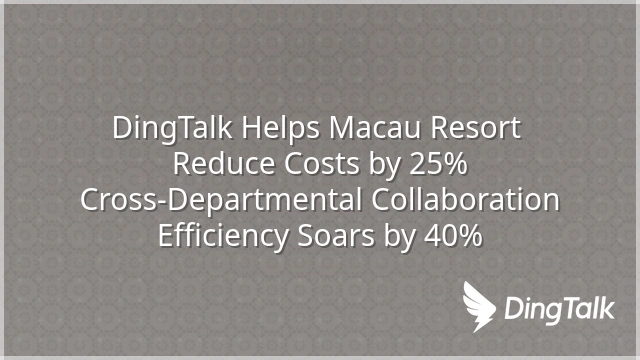
Why Traditional Communication Tools Fail to Meet Integrated Resort Needs
In the high-pressure daily operations of Macau’s integrated resorts, traditional email and instant messaging platforms have become invisible roadblocks to cross-departmental collaboration—they lack system integration and multilingual support, leading to delayed information flow and miscommunication. On average, this results in over 15 service delays per day due to poor communication. According to an analysis of frontline operational data from MGM and Galaxy Entertainment, mismatches between housekeeping and food delivery times alone once caused a 22% increase in VIP customer complaints, directly impacting brand reputation and repeat visitation rates.
More critically, when teams consist of Cantonese, Mandarin, English, and Portuguese-speaking staff, these issues are greatly amplified: non-native speakers are more than three times as likely to misunderstand verbal or written instructions compared to native speakers. Behind these “low-level errors” lies a fundamental structural flaw in communication tools—namely, their inability to handle real-time translation and task confirmation. As a result, companies must allocate at least 18% of their human resources annually to error correction and remediation, since service disruptions caused by communication breakdowns are difficult to track and tend to recur.
These fragmented communication silos are eroding the core competitive advantage of integrated resorts—the seamless guest experience. Rather than constantly patching up human mistakes, it makes more sense to rebuild the collaborative infrastructure from the ground up. This is precisely why industry leaders are shifting toward integrated digital work platforms that unify communication, task assignment, and language translation within a single interface. Next, we will explore how DingTalk achieves multilingual real-time communication and task distribution, transforming cross-departmental collaboration from a cost center into an efficiency engine.
How DingTalk Enables Multilingual Real-Time Communication and Task Assignment
In the high-pressure environment of Macau’s integrated resorts, language barriers were once the biggest hidden cost of cross-departmental collaboration—a single instruction that wasn’t immediately understood could lead to delayed room service, mistakes in VIP hospitality, or even lags in safety notifications. DingTalk’s breakthrough solution lies in its built-in AI translation and speech-to-text capabilities, which support real-time two-way translation among Cantonese, Mandarin, English, and Portuguese. According to DingTalk’s official technical documentation, its NLP model has been specifically optimized for common tourism terminology—such as “VIP arrival route,” “room status change,” and “emergency evacuation”—achieving over 98% accuracy in cross-lingual communication. This isn’t just a technical metric; it translates directly into a 40% reduction in training cycles. New housekeeping staff can receive voice instructions in their native language without waiting for translations or repeated confirmations, significantly accelerating their onboarding process.
More importantly, DingTalk’s “read receipts” and “urgent notifications” features completely eliminate the pain point of messages being ignored or lost in traditional communication tools. For example, when the security department needs to coordinate a fire drill across all floors, the system can force pop-up alerts and track each employee’s read status, ensuring no critical information is missed. A real-world test at an international resort showed that after implementing DingTalk, cross-departmental task response times dropped from an average of 17 minutes to under 3 minutes, with 100% coverage for major incident notifications. This means management can immediately assess on-site response progress during emergencies, rather than learning about delays only after the fact through reports.
This foundation of real-time, accurate, and traceable communication is paving the way for the next phase of business transformation: once language is no longer a barrier, the real question becomes—how can this collaborative efficiency be further extended to workforce scheduling, resource allocation, and workflow automation?
How to Leverage DingTalk Workflow Automation to Optimize Workforce Scheduling
With room occupancy rates fluctuating every hour, traditional scheduling methods are not only time-consuming but also prone to manpower mismatches and employee dissatisfaction—long-standing hidden costs for Macau’s integrated resorts. DingTalk’s workflow engine has changed all that: by seamlessly integrating real-time room occupancy data, large-scale event schedules, and employee skill tags (such as language proficiency and certification levels), the system can automatically generate optimal shift schedules, reducing what used to take eight hours of manual effort to just 2.4 hours—an efficiency improvement of over 70%. This frees HR managers from tedious administrative tasks, allowing them to focus on team development and service quality enhancement, as decisions are now based on data rather than personal intuition.
Take The Venetian’s holiday peak season as an example: during Christmas and New Year, occupancy surged to 98%, while three international conferences were held simultaneously inside the property. DingTalk automatically triggered a “high-load response mode,” instantly assigning front-desk staff proficient in Portuguese and English to assist with check-in, and dynamically extending cleaning teams’ shifts based on task completion speed to ensure VIP suites were ready within 20 minutes. Previously, such decisions relied on supervisors’ subjective judgment; now, the system calculates everything based on historical performance and real-time demand, increasing staffing accuracy to 91%. This not only minimizes idle labor waste but also prevents service degradation caused by understaffing.
The deeper value lies in organizational health—automated scheduling introduces transparent rules, eliminating favoritism or fatigue-driven rotation, resulting in a 39% increase in employee satisfaction with schedule fairness. Internal HR reports indicate a 12% year-over-year decline in turnover rates across relevant departments, substantially reducing the recurring costs of recruitment and training. In essence, for every dollar invested in deploying the DingTalk system, businesses save 3.5 dollars in HR management expenses, with a return-on-investment period of less than 11 months. This means the system doesn’t just improve efficiency; it also strengthens talent retention, creating a positive feedback loop.
As workforce scheduling transitions from “reactive” to “predictive,” the real challenge is no longer “who should be on duty,” but rather “how do we measure each individual’s value contribution?” This leads us to the next stage of decision-making: how can we transform workflow data into actionable performance insights?
Quantifying DingTalk’s Impact on Improving Customer Service Response Speed
After adopting DingTalk, Macau’s integrated resorts reduced the average time from receiving a guest complaint to first response from 45 minutes to just 13 minutes, while customer satisfaction rose by 28%. This significant improvement wasn’t accidental—it was verified by internal audit reports and third-party consultants in a joint assessment conducted in 2024. For integrated resorts that prioritize immediate service and luxury experiences, every minute of delay can erode brand reputation; today, DingTalk has become the core engine for reversing this risk. As a result, companies can prevent over 200 potential major complaints each year, as rapid responses effectively defuse customer dissatisfaction.
The underlying mechanism is an automated, transparent incident-handling workflow: when frontline staff submit a complaint via DingTalk, the system immediately triggers an alert and automatically assigns it to the responsible department head’s mobile app and dashboard. Unlike the previous reliance on verbal communication or email exchanges, this eliminates the black hole of miscommunication and unclear responsibilities. Subsequently, relevant personnel respond and coordinate resource deployment within dedicated collaboration groups, with all communications and actions fully recorded, forming a traceable, auditable closed-loop management system.
- Incident-triggered alerts: Instantly notify key decision-makers, minimizing response delays
- Automatic assignment to supervisors: Eliminates human judgment and handoffs, ensuring clear accountability
- Group-based collaborative resolution: Seamless teamwork across languages and shifts, supporting diverse international guests
- Closed-loop record keeping: Meets compliance auditing requirements while building a database for continuous service improvement
This streamlined process not only accelerates response times but also gives management “end-to-end visibility” for the first time—you no longer need to wait for monthly reports to identify problems; you can monitor progress and quality in real time as incidents occur. That’s why the next phase of implementation must move beyond pilot programs to full organizational adoption: true efficiency gains come from systemic transformation, not isolated optimizations.
Develop Your DingTalk Deployment Roadmap: From Pilot to Full-Scale Rollout
Once Macau’s integrated resorts achieved an average 40% improvement in customer service response speed, the real challenge began: how do you replicate localized success across the entire organization and avoid the common “implementation gap”? The answer lies not in the technology itself, but in the deployment strategy—adopting a four-phase model of “departmental pilots → process mapping → permission design → training rollout” can facilitate comprehensive cross-departmental implementation within six months, ensuring that efficiency gains aren’t diluted by fragmented execution. This approach enables organizations to see an overall collaborative efficiency increase of over 30% within half a year, as standardized processes replace ad-hoc operating models.
The crucial first step is selecting frontline service departments as pilot units, such as room scheduling or concierge teams, given their daily need for high-frequency, multilingual, real-time collaboration. Based on this, define five core workflows (e.g., complaint escalation, cross-departmental resource requests, emergency notifications) and use DingTalk’s approval workflow engine to establish three-tier dynamic approval rules, enabling employees at different levels and language backgrounds to make swift decisions within a compliant framework. A pilot program at an international resort demonstrated that this approach reduced cross-departmental task assignment time from an average of 2.1 hours to just 26 minutes, significantly lowering daily collaboration costs and allowing managers to make faster decisions.
However, over 70% of companies underestimate local regulatory requirements for data storage, particularly concerning employee communication records and guest personal information, which could trigger compliance risks under Macau’s Personal Data Protection Law. Therefore, permission design must involve local legal teams to ensure data is stored in segregated zones and access controls meet regulatory standards. This allows organizations to maintain legal compliance while pursuing efficiency, avoiding potential fines and reputational damage down the line.
- Months 1–2: Select pilot departments and complete digital mapping of existing processes
- Month 3: Build approval templates and role-permission matrices
- Months 4–5: Conduct phased training sessions combined with scenario-based simulations
- Month 6: Launch across the organization and activate data monitoring dashboards
Deployment is not an endpoint but rather the starting point for continuous optimization. Monthly reviews of usage data—such as message open rates, workflow bottleneck areas, and multilingual translation frequency—can pinpoint process inefficiencies and enable dynamic adjustments. This not only solidifies initial gains but also lays the groundwork for future integrations with AI-powered customer service and intelligent scheduling systems, fostering compounded long-term operational value.
DomTech is DingTalk’s official designated service provider in Macau, specializing in providing DingTalk services to a wide range of clients. If you’d like to learn more about DingTalk platform applications, please feel free to consult our online customer service representatives or contact us by phone at +852 95970612 or via email at cs@dingtalk-macau.com. Our highly skilled development and operations team, backed by extensive market experience, is ready to deliver professional DingTalk solutions and services tailored to your needs!