




 Português
 English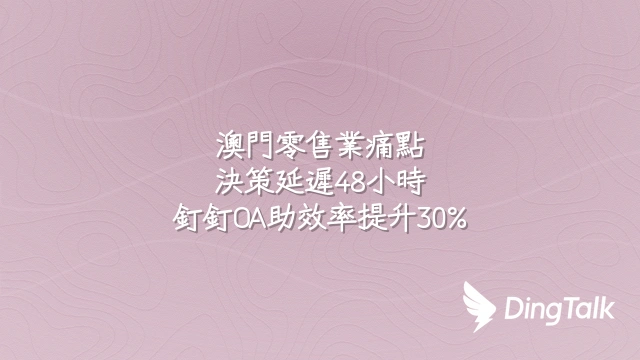
Why Macao Retailers Are Facing a Management Gap
Macao's retailers are at a critical juncture of management gap—store fragmentation and poor cross-departmental communication have led to an average decision-making delay exceeding 48 hours, causing them to miss market opportunities. This is not just an efficiency issue; it's a silent killer that directly erodes profits. According to the 2025 "Macau SME Digital Transformation Report," over 60% of retail businesses still rely on paper-based approval processes, with information transmission depending on instant messaging tools and verbal handovers, resulting in broken command chains, blurred responsibilities, and ultimately slowing down overall operational rhythms.
In traditional operating models, a single purchase requisition could take up to three days to complete approval, while market opportunities often slip away during this waiting period. When competitors can respond to demand changes within hours, a lagging organization is like rowing upstream against the current. Inventory scheduling and promotional response speeds are severely hampered: for example, a chain souvenir brand experienced stockouts at its flagship store for three consecutive days during the Spring Festival peak season due to misalignment between store and warehouse information, resulting in losses of up to 50,000 Macanese patacas per store and damaging the brand's reputation.
Employees are exhausted from repetitive communication and paperwork, with management energy needlessly drained. To break this deadlock, the key isn't simply adding more staff—it's building a unified digital collaboration platform that makes information flow transparent, automates decision-making processes, and visualizes task tracking. Only then can we reduce the 48-hour wait time to within four hours and turn more than 30% of wasted management costs into a competitive advantage.
How DingTalk OA Is Rebuilding Retail Operating Structures
While Macao retailers remain trapped in paper-based approvals and information silos, DingTalk OA is systematically reshaping their operational structures, boosting management efficiency by over 30%. At its core, DingTalk OA integrates smart approvals, task boards, attendance tracking, and real-time communication, creating a seamless digital nervous system connecting retail stores and headquarters.
Smart approvals mean frontline staff can complete expense reimbursements and account entries within two hours, as the process is automatically pushed to supervisors' mobile phones, eliminating email back-and-forth. For businesses, this translates into faster capital turnover, a 40% reduction in financial workload, and an average annual decrease of 18% in administrative costs (IDC 2024).
Task boards visualize store managers' schedules, promotional execution, and restocking progress, triggering alerts whenever delays occur. This means headquarters' audit workload has dropped from 15 hours per week to just four hours, as standardized execution improves and reliance on verbal reports diminishes.
Technically, DingTalk uses open APIs to connect POS systems and warehouse systems. When product inventory falls below the safety threshold, the system automatically generates restocking tasks and assigns them to designated personnel. This reduces out-of-stock rates by 25%, significantly improving the accuracy of promotional preparations and preventing lost sales.
Even more crucial is localized support: the MPF reconciliation interface and free switching between Cantonese, Portuguese, and Simplified Chinese greatly reduce compliance risks and training barriers. This isn't just technical adaptation—it's a deep understanding of Macao's diverse business ecosystem.
Mobile Office Enables 24/7 Operational Monitoring
When night-shift sales unexpectedly drop, store managers no longer have to wait until the next day to find out—their DingTalk app instantly pops up alerts, triggering remote inventory adjustment procedures. The core of 24/7 monitoring lies in transforming passive responses into proactive interventions, and the key is the data integration power of the "Workbench" customizable dashboard.
The dashboard connects POS systems, foot traffic sensors, and HR systems, gathering real-time data on customer traffic, conversion rates, and employee performance—three major KPIs. Previously manually compiled reports are now automatically generated as trend charts, allowing managers to grasp store health at a glance. For instance, when a store's conversion rate drops below 15% for two consecutive hours, the system automatically flags it in red and sends a notification. Regional managers can immediately review the shift's performance and determine whether it's due to insufficient training or imbalanced scheduling. This shortens decision-making delays from "days" to "minutes," avoiding entire-day revenue losses.
The geofencing check-in feature replaces traditional paper-based sign-ins, ensuring that store inspectors actually arrive on-site. The Hengqin case shows that store inspection frequency has tripled, and false attendance records have been reduced to zero—saving about 12,000 Macanese patacas in labor costs each month. These data aren't left dormant in the background anymore—they drive daily actions instead.
With all operational activities made transparent and digitized, management can shift from "firefighting" to "strategic planning." This immediacy is precisely the core of modern retail competitiveness.
Quantifying the ROI of DingTalk OA
When Macao retailers ask, "Is it worth introducing DingTalk OA?" the answer is no longer just "it might improve efficiency"—but rather, "it can create quantifiable value of 468,000 Macanese patacas annually for an eight-store enterprise." This ROI is calculated using the model of "time savings × labor cost reduction + loss avoidance from fewer errors."
Take a medium-sized retail chain as an example: after implementation, three major benefits were simultaneously unlocked:
• Administrative process efficiency improved by 40%, saving store managers six hours per week on paperwork
• Cross-departmental communication costs fell by 60%, replacing chaotic group chats with real-time collaboration
• Personnel disputes decreased by 75%, eliminating arguments over leave requests and scheduling conflicts that used to drain management energy
According to IDC's 2025 Asia-Pacific research, retail companies adopting integrated OA systems achieve an average return on investment of over 1.8 times within 12 months, with communication transparency and process automation being the biggest contributing factors. This means DingTalk isn't just a tool upgrade—it's a reconfiguration of management logic, enabling headquarters to instantly grasp the operational pulse of eight stores while empowering frontline employees to handle 90% of daily tasks independently.
In today's environment where labor and rent costs squeeze profits, the cost of failing to undergo digital transformation far outweighs the cost of investing in a system.
Three Steps to Kickstart Macao's Retail Digital Transformation
The real starting point of digital transformation isn't technology—it's "recognizing pain points." A 2024 Asia-Pacific survey found that 73% of companies that skipped process diagnostics saw lower-than-expected benefits from OA implementations. Skipping the assessment phase in digital investment is like driving through fog without headlights.
Step 1: Precisely diagnose bottlenecks and identify efficiency gaps
Use DingTalk's partner-provided "Retail Process Self-Assessment Checklist" to quickly spot high-risk areas such as inconsistent cross-store inventories and delayed paper-based requests. For example, a pharmacy chain manager discovered that his team spent 2.1 hours daily on collaborative tasks—this data became the key evidence driving change.
Step 2: Choose a compliant and locally adapted solution
DingTalk offers multiple versions, but Macao enterprises must pay special attention to data storage locations and Cantonese usage habits. Select a compliant combination that supports "local server deployment" and "Cantonese interface plus instructional videos," and have a local partner set up permission levels—this is the first firewall against data leaks. Once, a catering brand suffered cost structure leakage because it failed to properly segment financial viewing permissions, and the technical vulnerability eventually turned into a competitive crisis.
Step 3: Replace training with adoption
Rather than forcing learning, design a "seamless onboarding" path. Use DingTalk's on-site implementation services and contextual Cantonese instructional videos (such as "How to Complete Cross-Store Transfers in Five Minutes") to help teams master the tools through real-world tasks. One fashion apparel brand adopted a "one trick a week" challenge, achieving 90% of daily operations moved to mobile devices within three weeks.
Apply now for a free diagnostic service, receive a personalized process heat map and ROI forecast report, and turn vague "efficiency improvements" into actionable, measurable business leaps—every hour you save is room for future growth.
DomTech is DingTalk's official designated service provider in Macao, specializing in providing DingTalk services to a wide range of customers. If you'd like to learn more about DingTalk platform applications, feel free to consult our online customer service, or contact us via phone at +852 95970612 or email at cs@dingtalk-macau.com. We have an excellent development and operations team with rich market service experience, ready to provide you with professional DingTalk solutions and services!