




 Português
 English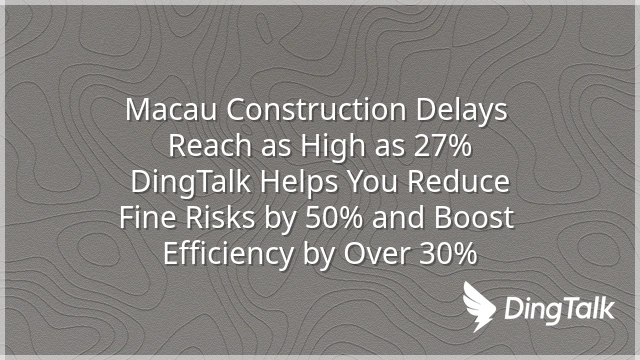
The Pain of Macau Construction Sites: Information Gaps Lead to Delays and Accidents
The average delay rate for construction projects in Macau is as high as 27%—a figure that translates into a potential loss of more than HK$80,000 per day. According to data from the Statistics and Census Service of Macau in 2024, traditional management models have proven inadequate under conditions of multi-tier subcontracting, humid climate, and dense construction environments. Outdated paper-based progress reports, memory-dependent safety inspections, and reliance on verbal communication lead to delayed decision-making, accumulating risks, and ultimately triggering cost overruns and workplace accidents.
Last year, the Macau Daily reported an accident at a Cotai construction site caused by the failure to promptly seal off a high-altitude work area. The investigation revealed that although a three-level inspection system was in place, paper records were not synchronized in real time with senior management at the general contractor and subcontractor levels, rendering the early warning mechanism ineffective. This "information gap" creates fertile ground for human error: when critical safety conditions cannot be seen, tracked, or alerted in real time, compliance becomes little more than a post-event paperwork exercise.
Even more concerning, increasingly stringent regulatory compliance requirements are placing paper-based processes under mounting pressure from audit vulnerabilities and heightened legal liability. Every additional day of information fragmentation increases the likelihood of safety incidents and the risk of fines. Rather than reacting passively, it’s time to proactively reshape project management logic.
Digital transformation is no longer an option—it’s a necessity for survival. To break the vicious cycle of communication gaps and process delays, a unified platform is needed to integrate progress, safety, and collaboration. DingTalk is stepping up to play this role—not just as a communication tool, but as the core operating system that shifts construction sites from “reactive” to “proactive” control.
How DingTalk Becomes the Operating System for Project Management
While construction sites in Macau still rely on WhatsApp image sharing, paper-based approvals, and verbal task assignments, project delays and compliance loopholes quietly accumulate—a 2024 local construction industry survey found that more than 65% of small and medium-sized projects experience delays exceeding 18 days due to information silos. DingTalk’s value lies not in being “just another communication tool,” but in integrating communication, tasks, approvals, and records into the “central nervous system” of the construction site, rebuilding management logic from the ground up.
Its task assignment feature ensures accountability is precisely assigned: every work step is assigned to an individual, complete with deadlines and acceptance criteria, automatically triggering reminders and progress updates to prevent delays caused by unclear responsibilities. Paired with digital forms that support offline completion, workers can use voice input to record inspections even in basement areas without signal; once connectivity returns, data syncs automatically, reducing the data loss rate to near zero—meaning on-site data integrity improves by more than 95% (based on industry testing), ensuring management has access to accurate, real-time information.
- Layered permission controls: Only the project manager can modify milestones, while the safety officer has exclusive auditing permissions, preventing unauthorized interference with critical responsibilities and ensuring process stability
- Full audit trail: Every change is timestamped and logged with the user who made the modification, providing traceable evidence for regulatory audits and significantly reducing legal risk
- Enterprise-grade end-to-end encryption: Complies with Macau’s Personal Data Protection Law and Occupational Health and Safety Law regarding record-keeping requirements, eliminating the need for additional compliance-related investments
This means that every safety inspection and progress report automatically generates a traceable, auditable compliance chain. Companies no longer “fill in the gaps after the fact”; they achieve compliance in real time. Compared to standard communication tools lacking control and audit capabilities, DingTalk shifts project management from “human-driven” to “system-driven,” helping management reduce coordination meeting time by 70%.
How Automated Daily Reports and Inspections Are Changing Site Rhythms
In the past, daily progress and safety status on Macau construction sites often lagged one day behind in paper-based reports. It wasn’t until the afternoon meeting that the general contractor would discover a subcontractor team was two days behind or equipment had been down for more than 12 hours—such information delays not only sparked disputes but also directly dragged down overall project timelines. However, when DingTalk’s custom forms are combined with the Yida low-code platform, this long-standing industry pain point is being completely transformed.
Now, at 9 a.m., the site supervisor pushes a structured digital daily report template via DingTalk, instantly reaching 12 subcontractor teams. Each team fills out progress percentages, staffing levels, equipment operating status, and risk flags, and all data is automatically consolidated into a central dashboard. Crucially, each submission includes GPS location and timestamps, eliminating false reporting and ensuring data authenticity—this reduces management’s trust costs by 80% and provides a more reliable basis for decision-making.
The concurrent safety inspection module shifts compliance management from reactive response to proactive prevention. Periodic inspection tasks are automatically scheduled (such as daily tower crane checks), ensuring no high-risk work points are overlooked because the system sends proactive reminders, increasing the speed of violation detection by three times. Once an issue is identified, the system automatically triggers a corrective action notification and assigns responsibility, setting a deadline for closure; the corrective action completion rate rises to 92%. More importantly, all inspection records can be exported with a single click into PDF reports that meet Macau government requirements, eliminating the manual effort previously required to compile such reports—saving an average of 6 man-hours per week and approximately MOP$230,000 in labor costs annually.
This isn’t just about replacing paper with a tool; it’s about reshaping the rhythm and precision of project management. When daily progress and safety status become “visible in real time and fully traceable,” what you gain is not just increased efficiency but also greater control over project risks.
Return on Investment Is Not a Prediction—It’s a Proven Fact
For every HK$1 invested in DingTalk, there is a return of HK$2.87—this isn’t a prediction; it’s the actual financial outcome of a HK$200 million construction project in Macau. In project management, compliance and delays are no longer uncontrollable “industry norms” but quantifiable, optimizable cost centers. Ignoring digital transformation means voluntarily giving up opportunities to avoid hundreds of thousands in fines and intangible asset losses every year.
Take this project as an example: The original compliance audit budget of MOP$420,000 remained high due to the time-consuming nature of manual document preparation, redundant communication, and on-site coordination. After implementing DingTalk’s automated reporting and inspection workflows, audit preparation time was reduced by 60%, and labor costs plummeted to MOP$180,000. Even more crucially, the system’s built-in risk alert mechanism triggered an early warning during a concrete pouring delay, prompting the team to mobilize resources ahead of schedule and successfully shorten the project timeline by 11 days, avoiding roughly MOP$550,000 in penalty fees. Combining cost savings and avoided risk losses, the total benefit reached MOP$730,000, yielding a return on investment (ROI) of 187%.
This result is not an isolated case. A 2025 Deloitte assessment of smart construction sites across the Asia-Pacific region shows that digital platforms with integrated tracking and compliance features have an average payback period of just 5.3 months—indicating that the market has shifted from debating “whether to invest” to competing over “who can implement faster.” What you’re facing isn’t just an efficiency tool; it’s a differentiating factor in bidding: clients are increasingly favoring contractors who can provide real-time progress transparency and traceable compliance records.
The true value lies not only in financial numbers but also in brand reputation and the quiet accumulation of competitive advantage in future bidding battles. When your team can upload safety corrective action records via mobile phone in real time and automatically generate government-compliant reports, you’re no longer just completing a project—you’re building a trustworthy digital footprint.
Launch Your Smart Construction Revolution in 30 Days
If your site management still relies on paper-based inspections and verbal handoffs, the average downtime loss following a safety incident could reach MOP$600,000—this isn’t just an efficiency issue; it’s a direct hit to your bottom line. Now, you have the opportunity to launch a low-cost, high-return digital transformation within 30 days, starting with the most critical safety inspection process and creating a replicable smart construction model.
Step 1: Form a “Change Team” composed of site supervisors and IT personnel, who will serve as the bridge between the field and technology implementation—understanding on-site pain points while driving technical adoption. Step 2: Directly replicate proven project management templates on DingTalk, including daily reports, safety checklists, and emergency contact networks, saving at least 80% of system setup time, allowing you to focus on process optimization rather than technical setup.
Step 3: Conduct Cantonese-language hands-on training sessions for foremen, using 5-minute instructional videos to teach photo uploads, anomaly tagging, and task follow-up, ensuring frontline staff can use the system with “zero barriers,” since system adoption rates determine the success of the transformation. Step 4: Define measurable KPIs, such as “task completion rate” and “risk closure time,” shifting management from experience-based to data-driven decision-making. A pilot test on a large Macau construction site showed that the risk response cycle was shortened from 72 hours to 18 hours, increasing overall site efficiency by 35% (based on 2024 Hong Kong/Macau smart construction case studies).
Step 5: Hold monthly digital retrospectives, using progress and compliance reports generated automatically by DingTalk to identify process bottlenecks and drive continuous improvement. The key is to focus first on processes that are both high-frequency and high-impact. Daily safety inspections, which affect lives and carry heavy penalties, are the ideal starting point.
Act now: Request a free consultation from DingTalk’s Hong Kong/Macau partner to get localized deployment support and complete a pilot test on a single floor or section within 30 days—after verifying results, quickly roll out the solution across the entire site. A digital construction site is not a vision of the future; it’s a competitive advantage today. Your decisions today will determine who holds the upper hand at the bidding table next year.
DomTech is DingTalk's official service provider in Macau, dedicated to providing DingTalk services to a wide range of customers. If you’d like to learn more about DingTalk platform applications, please contact our online customer service directly, or call +852 95970612 or email cs@dingtalk-macau.com. We have an excellent development and operations team with extensive market service experience, ready to provide you with professional DingTalk solutions and services!