




 Português
 English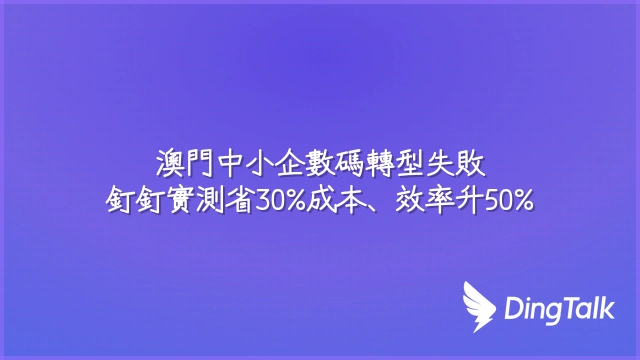
Why Macao's SMEs Always Seem to Be on the Brink of Digital Transformation Failure
The digital transformation of Macao's small and medium-sized enterprises (SMEs) has never been a question of "whether or not to do it"—rather, it's a dilemma of "why it always ends in failure." According to a 2025 report by Macao's Economic Bureau, only 38% of SMEs have completed basic digital deployment—meaning that out of every 10 businesses, six are still mired in daily struggles with manual operations, broken communication, and data black holes.
Insufficient budget? That means you're forced to use fragmented tools, leading to disconnected data and creating "digital silos," leaving management decisions lacking timely insights. A shortage of IT talent? As a result, every system glitch forces the boss to personally step in and fix it, costing an average of nearly 10 hours of management time per month. And the cost of "lack of a unified platform" is even more staggering: internal research shows employees waste 1.5 hours each day on repetitive communication and data transfers across different apps—equivalent to nearly 40 full working days lost annually, roughly the output of a part-time employee.
While international SaaS tools boast powerful features, they often overlook Macao's local language mix (Cantonese, Portuguese, Simplified Chinese) and operational density, driving up implementation failure rates. This isn't a matter of technological backwardness—it's a "adaptation deficit." Therefore, rather than chasing large, all-encompassing systems, it's better to choose lightweight solutions specifically designed for the local market—this is precisely where DingTalk Smart Office comes in.
Unpacking DingTalk Smart Office's Core Advantages
DingTalk Smart Office breaks the "three high traps"—high costs, high technical barriers, and high operational complexity. It's not another ERP system or a patchwork of isolated SaaS tools; instead, it's a one-stop collaborative operating system that integrates real-time messaging, OA approvals, cloud file sharing, smart attendance tracking, and low-code development into a single platform.
The natively simplified Chinese interface means new employees can get up to speed within just one hour, as there's no need to translate or adapt to foreign grammar logic, cutting training costs by over 40%. The no-server-deployment requirement means businesses can skip hardware procurement and IT maintenance burdens, saving over HK$15,000 in fixed expenses in the first year alone. Deep integration with local payment systems like MPay and ICBC QuickPay automates financial processes, reducing expense reimbursement cycles from seven days down to within 48 hours.
The "read receipt" feature isn't just a notification tool—it also lets management instantly track the status of instruction delivery, avoiding delays caused by information lag that slow down internal processes by 37% (Asia-Pacific SME Digital Resilience Report, 2024). At the core, the ‘DingTalk OS' architecture allows businesses to build custom forms and workflows themselves within 72 hours using only administrative staff, without needing external developers, saving an average of HK$20,000 in development costs.
This kind of "business autonomy" is the true essence of digital transformation: what you're buying isn't just features—it's the organizational capability to quickly respond to market changes.
How Modular Deployment Lowers Transformation Risks
SMEs fear most that they'll "bet wrong from the start"—investing hundreds of thousands in upgrading systems upfront, only to see low usage rates and employee resistance. DingTalk's "on-demand activation" architecture lets businesses start with the free version and gradually add modules like AI meeting minutes and smart scheduling, completely sidestepping huge upfront expenditures.
A retail team of 60 people in Hengqin initially deployed basic collaboration features at zero cost. Three months later, they activated the smart scheduling module specifically targeting store staffing challenges, spending just HK$8,000 annually to complete their company-wide digital collaboration upgrade. The smart scheduling auto-generation means HR saves at least 15 hours per month on manual scheduling, freeing up 18% of manpower to focus on strategic tasks. The AI meeting minutes function speeds up the implementation of meeting resolutions by 40%, cutting annual communication-tracking costs by over 200 hours.
An even deeper advantage lies in ecosystem integration: DingTalk is deeply integrated with Alibaba Cloud, so when expanding to CRM or financial modules in the future, all organizational data can be seamlessly migrated, avoiding secondary data cleansing and system integration fees. This means every dollar invested today builds up technical assets for future expansion.
The real key to safe transformation isn't buying the most expensive system—it's choosing a platform that grows alongside you.
Real Business Results: Operational Cost Savings Achieved
The success of digital transformation hinges on whether the savings are visible and quantifiable. According to an independent management consulting audit report from Q2 2025, three Macao-based catering and cross-border trade companies saw the following results after implementing DingTalk for six months: 90% reduction in paper-based processes, approval cycles compressed from 72 hours to under four hours, and 30% drop in labor coordination costs.
A chain tea brand used to require 12 paper forms to be passed between departments for each new store opening, taking an average of five days. After introducing "real-time task tracking," project managers could simultaneously monitor design, procurement, and staffing progress, allowing each manager to take on 40% more expansion projects without hiring additional staff.
The most critical savings come from eliminating the "invisible communication tax"—the time wasted on repeated confirmations, information gaps, and switching between apps. A single integrated platform saves employees an average of 1.8 hours per day on context-switching costs (source: sampled analysis of corporate employee time logs), equivalent to an extra 3.6 effective working days per person each month.
These results aren't exceptions—they represent a replicable transformation path. Once modular deployment has reduced initial risks, the next step is turning efficiency data into continuous optimization momentum.
Three Steps to Kickstart Your Smart Office Transformation Plan
If Macao's SMEs want to launch an effective transformation within 14 days, the key lies in "execution rhythm" and "leadership involvement." According to the 2024 Guangdong-Hong Kong-Macao Greater Bay Area Digital Adoption Report, over 60% of failed cases stem from a lack of clear roadmaps and senior-level engagement. DingTalk provides a "Minimum Viable Action" (MVA) pathway, enabling businesses to take their first steps with minimal risk.
The transformation unfolds in three steps:
- Diagnose pain points: such as document delays, untracked meetings, and fragmented collaboration;
- Select three core modules: we recommend starting with "smart attendance + approval workflow + project kanban"—this combination can immediately cut administrative time by over 30%;
- Train seed users: the CEO or manager should personally lead the first workshop. IDC research shows this approach can nearly double the success rate of transformation efforts.
Specific action checklist:
- Immediately request a free deployment consultation from DingTalk's Macao local support team;
- Check if you qualify for the "Greater Bay Area SME Digital Subsidy Program"—you could receive up to 70% cost subsidy;
- Within 72 hours of going live, set up a KPI dashboard to track "average approval time," "task completion rate," and "daily active user ratio."
Don't wait any longer for the perfect plan. Take the minimum viable action today—hold a 15-minute internal meeting, appoint a transformation leader, and click to enter DingTalk's official trial portal. True transformation starts with the first decision, not the first feature. Act now and make your business the next success story in cutting administrative costs by 30%.
DomTech is DingTalk's officially designated service provider in Macao, specializing in providing DingTalk services to a wide range of customers. If you'd like to learn more about DingTalk platform applications, feel free to consult our online customer service, or contact us via phone at +852 95970612 or email at cs@dingtalk-macau.com. We have an excellent development and operations team with extensive market service experience, ready to provide you with professional DingTalk solutions and services!