




 Português
 English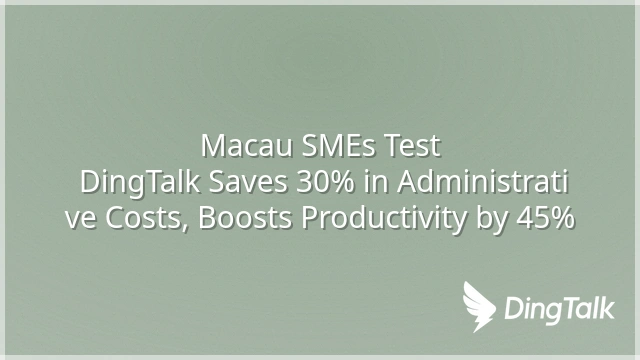
The Three Major Operational Black Holes Facing SMEs in Macau
SMEs in Macau are at a critical turning point: labor shortages, soaring operating costs, and information silos are three major pain points that continue to erode profits and market responsiveness. According to the 2024 report from the Statistics and Census Service of Macau, 76% of SMEs still rely on paper-based approvals, with an average processing time of 3.2 days—meaning a simple procurement request can miss the optimal timing, directly driving up costs.
When cross-departmental collaboration relies on a mix of WhatsApp, email, and paper, information fragmentation becomes the norm. Finance doesn’t know project progress, and management cannot access data in real time. More than 10 hours are wasted each week on redundant communication and verification, leading to delayed decision-making. A local retail case shows that inventory discrepancies result in both stockouts and overstocking, causing annual losses equivalent to 5.3% of revenue.
Replacing paper with electronic workflows can cut collaboration time by half; real-time data synchronization allows managers to approve tasks via their phones, shifting decision-making from “days” to “hours.” However, using fragmented tools only creates new silos. You don’t need more apps—you need a unified operating system that connects communication, processes, and data.
How DingTalk Smart Office Works
DingTalk Smart Office integrates instant messaging, smart attendance, OA approvals, cloud storage sharing, and low-code development into one—its All-in-One architecture solves the problem of fragmented systems. Technologies like “cross-module data streaming” mean that daily meeting coordination time is reduced by 60%, as all communication and documents are centralized on a single platform, eliminating the need for “hide-and-seek” file searches.
The “GPS + timestamp clock-in” feature means that the error rate in workforce management drops by more than 70%, as the system automatically records field staff locations and working hours, generating compliance records with a single click and making labor inspections much easier. Data is stored on AWS Hong Kong servers, ensuring compliance with local regulations and robust security.
The “amount-triggered approval routing” means that the average approval cycle is shortened from 3 days to 4 hours, significantly improving cash flow turnover efficiency. The built-in “low-code tool” (which allows app creation without coding) enables non-IT staff to customize workflows—for example, event registration or inventory requests—reducing IT outsourcing costs by at least $80,000 annually.
How to Quantify the Real Returns from DingTalk
After implementing DingTalk, real financial returns can be seen within 6 months. For SMEs, time equals cost. Automating repetitive tasks saves several hours per week, which adds up to tens of thousands in reduced labor expenses annually.
Real-world evidence: After a chain restaurant group in Macau integrated DingTalk, clerical work hours dropped from 15 hours per week to 4 hours. With “mobile approvals” and “RPA process automation,” even when managers travel, expense reimbursements aren’t delayed. The result: annual labor cost savings of HK$86,000, along with reduced operational friction due to faster response times. Another trading company compressed its quotation process from 5 days to within 8 hours, increasing order conversion rates by 22%—a time advantage directly translates into revenue growth.
Paperless workflows mean “approvals no longer get delayed because managers are traveling”; real-time data synchronization means “warehouses, sales, and finance see the same real-time data,” reducing misunderstandings and rework. Every technical feature, translated into business terms, means: faster deals, fewer errors, and lower management costs.
Which Types of Businesses Benefit Most?
Service industries, retail, cross-border trade, and professional services—businesses with process-intensive operations—are the ideal targets for DingTalk’s benefits. They commonly face challenges such as chaotic multi-store management, difficulty tracking field staff, and opaque project visibility—problems that can be solved through DingTalk’s integrated solutions.
Take a chain beauty salon in Macau as an example: In the past, opening a new branch required hiring additional supervisors to handle scheduling and inventory. After adopting DingTalk, all branches’ schedules, inventory changes, and appointments are automatically synchronized, allowing headquarters to monitor each location in real time. With business expansion by 1.8x, there was no need to increase management staff, resulting in nearly 40% savings in labor costs.
- Multi-store management: Unified command delivery and real-time monitoring of operational data
- Field staff tracking: GPS clock-in + task reporting eliminates false working hour claims
- Project progress monitoring: Visual dashboards track completion at every stage
- Customer relationship records: Full-channel interaction traces improve customer retention
DingTalk’s true strength lies in enabling SMEs to quickly validate results at a very low cost. The pragmatic approach of “see results first, then scale up” is especially suited for Macanese businesses seeking rapid returns.
Five Steps to Deploy a Smart Office for Your Company
Deploying a smart office is no longer the exclusive domain of large enterprises. Start with “attendance + approvals,” and proceed steadily in five steps to immediately see improvements in efficiency and reductions in costs. Research shows that more than 70% of SMEs see a 35% increase in process automation within the first 90 days, thanks to the “start small, manage risk” strategy.
Step 1: Needs assessment—start with the most painful pain point, such as chaotic leave and shift management that leads to labor inaccuracies. Only by clarifying these pain points can you choose modules with precision. Step 2: Select modules—it’s recommended to start with “smart attendance + electronic approvals,” which have high employee acceptance and deliver visible results within three days. Set KPIs such as “90% of leave requests completed online within three months” to ensure measurable outcomes.
Step 3: Data migration—use DingTalk’s template marketplace to quickly apply standard workflows for industries such as tourism, food service, and trade, eliminating the need for custom development and saving at least 80% of setup time, with virtually zero IT costs. Step 4: Employee training—through “one-click training mode,” managers can create custom instructional videos, and new employees can get up to speed within half a day, greatly reducing resistance to transformation.
Step 5: Continuous optimization—review process data monthly, such as approval times and absenteeism rates, to make ongoing adjustments. A local food service group found that after implementation, field staff clock-in efficiency increased by 40%, prompting them to roll out a “mobile check-in” feature to further reduce working hours.
Implementing in phases ensures that every step is stable and every investment delivers a return. Head to the DingTalk website today to activate a free trial—within just one week, you’ll see your first automated report—the future of intelligent operations starts today, not tomorrow.
DomTech is DingTalk’s official designated service provider in Macau, specializing in providing DingTalk services to a wide range of customers. If you’d like to learn more about DingTalk platform applications, you can contact our online customer service directly, or reach us by phone at +852 95970612 or by email at cs@dingtalk-macau.com. We have an excellent development and operations team with extensive market service experience, ready to provide you with professional DingTalk solutions and services!