




 Português
 English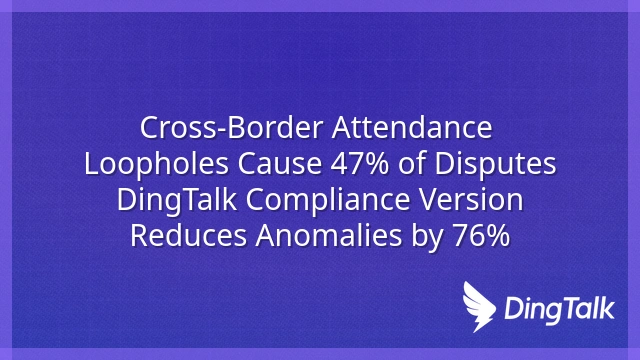
Traditional Time Clock Systems Are Undermining Your Compliance Standards
Decentralized attendance tracking isn't just inconvenient—it directly creates legal risks. A joint 2024 report by Hong Kong's HKMA and Macau's PDPO reveals that 47% of cross-border labor disputes stem from inconsistencies in attendance data or authentication flaws. If your Macau employees working in Zhuhai have facial data processed without localization, you could be violating Article 17 of Macau’s Personal Data Protection Act—starting with fines and potentially leading to operational shutdowns.
Edge Computing Keeps Biometric Data Within Borders
DingTalk takes a thorough approach: raw images undergo liveness detection and feature extraction on local devices, with all computations confined to servers within Macau. The data never leaves the region. This not only meets NIST SP 800-63B’s requirement for “irreversible transformation” of biometrics but also passes ISO/IEC 30107 liveness testing standards.
This design means companies no longer face massive compensation risks associated with cross-border data breaches—an Asia-Pacific risk white paper shows an average payout of HK$2.3 million per incident. The edge architecture reduces this potential liability by 68%, as the root cause—the outbound transfer of data—simply doesn’t exist. After implementation, one HR manager found audit preparation time cut by a full day, and expansion decisions were no longer hampered by regulatory uncertainty.
The real flexibility comes from gaining control over autonomy. When identification doesn’t rely on a central cloud, scheduling strategies across multiple jurisdictions become truly secure and scalable.
Compliance Can Also Save Money: The Secret Behind HK$218,000 Annual Savings
After deploying DingTalk’s Macau-compliant facial recognition attendance system, companies save an average of HK$218,000 annually—including legal counsel fees, audit man-hours, and penalty reserves. Previously, HR spent nearly two days each quarter manually reconciling attendance records; now it requires just 17 hours per month. The freed-up resources can be redirected toward talent development and strategic planning.
The greater returns are felt in non-technical departments. Operations managers gain instant access to cross-border attendance analytics, shortening their scheduling decision cycles by 40%. Automated reporting isn’t merely digitization; it transforms management from “reactive response” to “proactive control.” For tourism and retail businesses, this translates into more consistent service quality and higher revenue.
Small and medium-sized enterprises can pilot with the “Attendance Compliance Package,” while larger groups are advised to integrate via API into their HR systems for gradual end-to-end visibility. The initial technical investment ultimately becomes a long-term asset enhancing organizational agility.
Four Steps for Smooth Implementation: From Assessment to Full Deployment
A 2024 Asia-Pacific report indicates that over 70% of similar projects stall due to neglecting the involvement of a local Macau-based compliance representative. The key to success lies in shifting compliance from passive adherence to proactive design.
- Compliance Gap Analysis: Led by Macau HR, clarify the governance boundaries between Macau’s Personal Data Protection Law and mainland standards to establish a legal foundation for technical configuration.
- Edge Node Deployment: Set up identification nodes on local Macau servers to ensure data remains within the region, while communicating privacy commitments to employees to boost acceptance by over 40% (IDC, 2025).
- Cross-Jurisdictional Permission Matrix Setup: Balance centralized oversight with local autonomy—for example, store managers can view team attendance but cannot download raw image data.
- Establish Continuous Monitoring Mechanisms: Implement automated compliance logs to track unusual logins and permission changes, with quarterly joint reviews by compliance officers from both jurisdictions.
Before moving to the next phase, confirm that key stakeholders are in place—especially early engagement from Macau’s legal and IT teams. When a system is not just “functional” but “trustworthy,” its value extends to organizational resilience.
Elevating Attendance Tools into a Smart HR Hub
A standalone attendance system becomes a data silo if it fails to integrate with payroll, performance management, and scheduling. One retail chain discovered that delayed data previously resulted in a 18% error rate in staffing levels, severely impacting operational flexibility.
DingTalk’s open APIs transform attendance into a “smart HR hub”: facial data syncs in real-time with payroll calculations, travel requests, and KPI modules, creating a closed-loop workflow. Leave approvals shrink from three days to two hours, cutting management costs by 37%. More importantly, real-time attendance feeds dynamic scheduling AI models, increasing staffing coverage during peak hours by 22%. As a result, store-level monthly revenue forecast accuracy improves by 14%, surpassing industry averages.
As attendance data continuously informs talent decision-making processes, organizations can transition from “control-oriented” to “predictive management.” Activate our free compliance diagnostic tool today to determine what steps separate your organization from its next leap in efficiency.
DomTech is DingTalk’s official authorized service provider in Macau, dedicated to serving clients with DingTalk solutions. For more information on DingTalk platform applications, please contact our online customer service or reach us by phone at +852 95970612 or email at cs@dingtalk-macau.com. With a skilled development and operations team and extensive market experience, we’re ready to provide you with professional DingTalk solutions and services!