




 Português
 English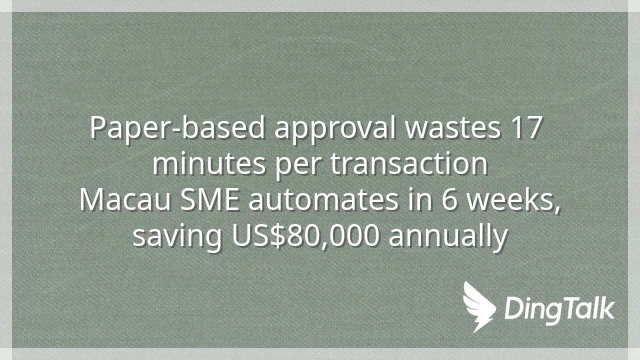
Why Does Your Company Keep Getting Stuck on a Single Leave Request?
In Macau, small and medium-sized enterprises spend an average of 15 hours per week processing paper-based approvals, with an error rate as high as 12%. This isn’t just an administrative headache—it’s a cash flow leak. A local retail case illustrates that a promotional request delayed by three days caused the campaign to miss the holiday peak week, resulting in nearly 18% loss of projected revenue. When managers are out of the office, the entire business chain grinds to a halt, and customer service quality plummets.
What’s truly overlooked is the opportunity cost behind “waiting for approval.” According to the 2024 Macau Business Operations Efficiency Survey, over 60% of companies admit that approval delays directly impact payment cycles, weakening their negotiating position with suppliers and even triggering late-payment penalties. Employees waste nearly two full workdays chasing signatures, verifying details, and re-entering data, eroding morale and straining workforce efficiency—chipping away at operational agility.
Every hour of delay magnifies operational costs and market risks. Traditional methods can no longer keep up with today’s fast-paced business environment. Automation is no longer just an efficiency tool; it’s a critical foundation for survival.
Why Conventional OA Systems Fail Macau Businesses
The problem isn’t the employees—it’s the systems themselves. Legacy OA platforms feature closed architectures, lack mobile support, and require custom coding every time a process needs tweaking. Even forwarding bilingual Chinese–Portuguese documents can cause bottlenecks. Cross-departmental collaboration devolves into manual tracking, dragging each approval down by an average of 1.8 days. The 2024 Local Digital Transformation Benchmark Survey reveals that 68% of management teams are dissatisfied with their current OA systems, with over 40% citing ever-increasing maintenance costs. Many find themselves trapped in a “vendor lock-in” situation: unable to switch, upgrade, or integrate new tools.
Even more concerning is the business risk. Suppliers often provide quotes within 24 hours, but your approval process remains mired in email chains and paper workflows, causing you to miss out on favorable deals. Traditional OA systems not only slow operations but also compromise compliance and audit trails, especially as the Macau SAR government enforces increasingly stringent financial reporting requirements.
The solution isn’t to “upgrade” an outdated system; it’s to transition to an open platform. DingTalk OA natively supports mobile-first instant approvals, allowing users to customize Chinese–Portuguese bilingual approval flows without any coding. It automatically archives records while adhering to local privacy regulations. The system can seamlessly connect with accounting software and inventory systems, breaking down data silos and transforming IT spending from reactive maintenance to proactive investment.
The Three Core Technologies Behind DingTalk OA Automation
DingTalk OA’s breakthrough lies not in its sleek interface, but in three key technological pillars: a modular workflow engine, a real-time communication infrastructure, and intelligent routing algorithms. The modular engine lets you define form fields and process nodes tailored to your needs. For example, an expense report can automatically pull in department, job level, and budget limits, reducing manual verification tasks by 40 per month for the finance team.
Conditional branching capabilities enable automatic routing based on amount or type—for instance, requests over $5,000 go straight to the director, while travel requests bypass regular supervisors. This shortens processes by 60%, ensuring urgent purchases aren’t bogged down in email inboxes. Powered by a real-time communication backbone, all approval notifications are delivered instantly to employees’ DingTalk apps, achieving a 98% read rate compared to the average 32% open rate of emails. Approval cycles shrink from three days to within eight hours.
Intelligent routing algorithms learn organizational permission changes and automatically update workflows when roles shift, eliminating the need for IT intervention. More importantly, its API ecosystem allows DingTalk to integrate with WeChat Pay to auto-generate expense reports or export data to QuickBooks, saving each accountant six hours per week on manual data entry. This isn’t merely a tool upgrade—it’s a fundamental restructuring of operating costs.
How Much Can You Really Save? Real Data Reveals the Answer
After implementing DingTalk OA, companies save an average of 30–45% of time spent on approvals and reduce paper and archiving expenses by 70%. Take a cross-border retail and foodservice group, for example: previously, it took an average of five days from a payment request to final settlement. By automating three core processes—procurement, expense reporting, and scheduling—using DingTalk OA, the cycle was slashed to just 1.2 days. This effectively frees up the equivalent of half a full-time administrative employee’s output annually, which can be redirected toward customer service or new market expansion.
Sensitivity analysis shows that even if SMEs automate just their three most frequent approval workflows, handling 1,200 transactions per year at an average of 25 minutes per task, they could save roughly 500 labor hours. Based on a local monthly salary of MOP$16,000, this translates to annual savings exceeding MOP$80,000. Greater process transparency improves financial forecasting accuracy and more than doubles decision-making speed for sudden store openings or marketing campaigns.
Each automation step creates room for the next leap forward. Once approvals cease to be a bottleneck, your team can focus on growth.
How to Successfully Implement Within Six Weeks: A Five-Step Roadmap
Companies that succeed follow the same five-step approach: process mapping → form design → pilot testing → comprehensive training → data monitoring. Start by pinpointing high-frequency, high-pain-point workflows. According to the 2024 Asia-Pacific SME Digital Transformation Report, prioritizing automation for “leave requests” and “procurement” can unlock 30% of administrative capacity within the first month.
When designing forms, be sure to incorporate conditional logic (such as tiered approval levels for different amounts) to avoid future adjustments. During the testing phase, leadership should personally initiate mock requests—if executives don’t lead by example, employee adoption rates can drop by more than 60%, jeopardizing the entire rollout’s return on investment.
Comprehensive training shouldn’t be limited to a single meeting. Instead, pair it with contextual how-to videos and establish a “digital buddy” system across departments. Finally, data monitoring marks the beginning of value validation: track approval cycle reductions and identify points of failure to drive continuous optimization. Our recommendation is to set an initial goal of getting core processes live within six weeks and immediately launch a proof-of-concept project to turn theoretical benefits into tangible savings.
DomTech is DingTalk’s official designated service provider in Macau, dedicated to delivering DingTalk solutions to clients nationwide. If you’d like to learn more about DingTalk platform applications, please contact our online customer service or reach us by phone at +852 95970612 or via email at cs@dingtalk-macau.com. With a talented development and operations team backed by extensive market experience, we’re ready to provide you with professional DingTalk solutions and services!