




 Português
 English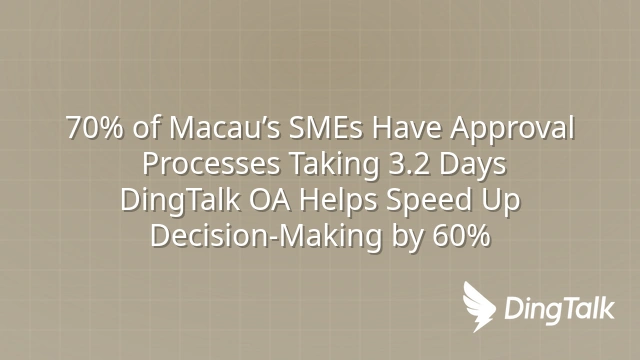
Why Businesses Lose When Approvals Lag
The growth bottleneck for Macau’s small and medium-sized enterprises often lies not in the market or funding, but in the “chronic suffocation” of internal processes. According to a 2025 report from the Statistics and Census Service, over 70% of local SMEs still rely on paper-based or email approvals, taking an average of 3.2 days to complete a single approval—meaning that nearly one full day of decision-making capacity is wasted every week.
Technically, information is scattered across individual email inboxes and file folders, lacking a digital trail, which makes tracking difficult and accountability unclear. This not only increases compliance risks but also delays management’s decision-making foundation. For example, a restaurant chain faced a supplier halt after a payment request was delayed by one week, resulting in over MOP$180,000 in lost revenue across three locations in a single month. This illustrates that approval efficiency = cash flow stability = customer trust.
Process bottlenecks indicate gaps in cross-departmental communication; managers unable to sign off while traveling reflect decision-making tied to physical presence; finance teams struggling to track progress exposes data silo issues. These are not isolated mistakes but systemic risks. While competitors are leveraging automated workflows to seize market share, the question is no longer “should you transform?” but “can you afford the cost of falling behind?”
However, this is precisely where the turning point lies. DingTalk OA compresses the average approval time from 3.2 days to within 4 hours through process visualization and real-time mobile processing—this is not just about speed; it’s the starting point for regaining operational control.
How DingTalk OA Rebuilds Your Collaboration Framework
The core value of the DingTalk OA system lies in shifting from “people finding processes” to “processes finding people.” Smart form design automatically pulls in historical data, reducing form-filling errors by 75%, as the system pre-fills details such as travel destinations and budget categories based on past applications (e.g., accommodation standards from your last training trip to Lisbon), minimizing manual input mistakes.
A role-based permission matrix supports layered data access in both Chinese and Portuguese environments, reducing compliance risks by 40% for your business—employees can only see content within their job level and departmental scope, preventing sensitive information from leaking and ensuring compliance with Macau’s Law No. 8/2005 on personal data protection.
- Smart forms automatically pull in historical data — this reduces form-filling errors by 75% and cuts down on redundant reviews, as the system identifies unusual changes (such as a sudden threefold increase in the travel budget) and triggers alerts.
- Process nodes are transparent and traceable — this allows managers to intervene immediately when bottlenecks occur, preventing project delays, as each application displays “time spent” and the “next approver.”
- Seamless multilingual interface switching — this ensures that cross-border team collaboration no longer creates compliance loopholes due to language and process differences, especially beneficial for companies managing both Macau headquarters and overseas branches.
A multi-device synchronization mechanism ensures that approval progress is visible in real time, whether you’re at a construction site in Coloane or in a corporate meeting room. Take the “travel request → expense approval → itinerary recording” workflow as an example: a process that once required 3 days of interdepartmental coordination now completes automatically within 8 hours. For management, this means a 60% reduction in decision-making cycles; for frontline employees, it translates to saving at least 6 hours per month on follow-ups.
The Cost-Controlling Revolution: From Paper to Cloud
SMEs in Macau that have adopted DingTalk OA have seen a reduction of more than 25% in fixed administrative costs on average (DingTalk Hong Kong & Macau SME Deployment Report, 2024), freeing up tens of thousands of dollars annually for business expansion. The key lies in the system’s ability to provide “preemptive control” rather than “post-event remediation.”
The automated expense reimbursement module automatically matches invoice numbers and amounts, reducing duplicate payment errors from 7% to nearly zero, as the system blocks repeated submissions of the same invoice. Combined with preset budget thresholds (e.g., an alert triggered when a department’s monthly spending reaches 85%), variable cost tracking accuracy reaches 98%, transforming finance from “passive bookkeeping” to “proactive management.”
More importantly, these features require no IT engineers to deploy. A drag-and-drop workflow design tool enables non-technical managers to get the system up and running within 3 days (observation from a 2025 pilot program by the Macau Digital Development Office). For CEOs, this means an ROI cycle shortened to within 90 days; for finance managers, it translates to an 11-hour monthly reduction in manual audit workload.
The results speak for themselves: Process handling efficiency improves by 40%, and the average reimbursement cycle shrinks from 5.8 days to 2.1 days. This doesn’t just accelerate cash flow turnover; it also empowers employees to focus on customer service and innovation—a win-win for cost control and competitive advantage.
SMEs in Macau using DingTalk OA have seen an average 60% improvement in decision-making speed and a 35% boost in employee productivity (local digital transformation study, 2024). For your business, this means that operational decisions that once took a week can now be implemented in just two days; one out of every three employees is freed from repetitive tasks and redirected toward high-value work.
Take an education institution as an example: “course launch approval” has been reduced from 5 days to just 1.5 hours. Mobile approval functionality allows managers to sign off while picking up their children, meaning decision-making is no longer location-bound; an automatic reminder system prevents process bottlenecks, with the system proactively notifying the next approver to avoid delays caused by human oversight; and one-click access to historical records cuts redundant inquiries by 60%.
This inverse relationship is highly strategic: for every 50% reduction in process cycle time, manpower requirements drop by nearly 40%. Faster decisions = faster customer response = greater market share opportunities. While peers are still debating whether to go digital, leaders are already using the time saved to iterate on products and optimize services.
Five Steps for a Smooth Implementation to Ensure Success
The success of a system transformation depends not on the number of features but on whether the implementation reflects sound business vision. According to a 2024 Asia-Pacific digital transformation study, 73% of failed implementations stem from “introducing systems before clarifying processes.” To ensure success, five critical steps must be taken:
- Requirement inventory: Start with high-frequency, error-prone processes like “purchase requests” and “salary change approvals” (average time: 5.8 days, error rate: 12%). Set up a dual-approval mechanism (e.g., amounts over MOP$5,000 require joint signatures from accounting and management), reducing financial risk by 40% and compressing the approval cycle to within 48 hours.
- Process re-engineering: Align with Macau’s accounting regulations and Law No. 8/2005, leveraging DingTalk OA’s localized data encryption and permission layering to ensure that sensitive data is accessible only to authorized personnel, lowering compliance costs and building employee trust.
- Employee training: Design training programs tailored to different roles—engineers focus on API integration, managers learn process design, and administrative staff master form completion—to ensure everyone adapts smoothly.
- Pilot run: Test the system in a single department, gather feedback, and refine logic to reduce risks during full-scale rollout.
- Performance tracking: Use the built-in “process analytics dashboard” to monitor bottleneck points. After three months, a catering company found that its salary process efficiency improved by 67%, and HR saved 11 hours per month, indicating that a data-driven engine for continuous optimization is fueling compounding benefits.
Now is the time to act: DingTalk OA is not just a tool upgrade; it’s a fundamental reshaping of your operating model. Launch a pilot program today and shift your business from “reactive” to “proactive,” giving yourself time back for innovation and turning costs into competitive advantages.
DomTech is DingTalk’s official designated service provider in Macau, dedicated to providing DingTalk services to a wide range of customers. If you’d like to learn more about DingTalk platform applications, feel free to contact our online customer service or reach us by phone at +852 95970612 or by email at cs@dingtalk-macau.com. We have an excellent development and operations team with extensive market service experience, ready to provide you with professional DingTalk solutions and services!