




 Português
 English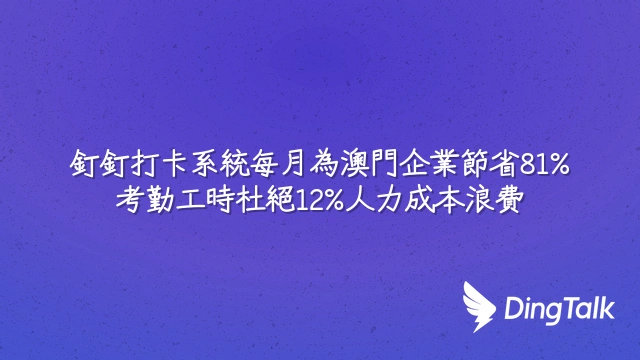
How Traditional Attendance Systems Are Dragging Down Business Efficiency
Paper-based sign-in, manual Excel statistics—these traditional methods are quietly eroding the competitiveness of Macao's SMEs. According to the 2024 Macao SME Digitalization Report, over 68% of enterprises still rely on non-automated attendance systems, wasting an average of 4.7 hours per month on data verification and correction. Translated into real terms, each manager loses more than five full working days annually—enough time to complete a comprehensive business optimization review.
Attendance fraud is hard to detect: Paper records are easily signed for or tampered with, leaving no traceable evidence of the actual check-in location and time in case of disputes;Scheduling chaos is frequent: In shift-based industries like catering and retail, human error in manual scheduling often leads to overlapping shifts or gaps in coverage;Leave approvals are delayed: Paper slips or email exchanges are inefficient, impacting employee experience and operational flexibility. Even worse, these loopholes cross the compliance red lines set by Macao's Labor Law. Once labor disputes arise, businesses face the risk of insufficient evidence.
The mature implementation of cloud-based smart attendance systems offers a solution. DingTalk uses GPS-based check-ins, real-time schedule synchronization, and automated approval workflows to eliminate human errors and moral risks from the outset. Data no longer sits dormant in spreadsheet corners—it instantly aggregates into actionable management insights: Who has abnormal working hours? Which shifts frequently suffer from absenteeism? The system proactively alerts managers, shifting their focus from "firefighting" to "prevention."
When technology can solve accuracy, efficiency, and compliance—all at once—the question is no longer "Should we change?" but rather, "When should we take the lead?"
How DingTalk's Features Precisely Address Local Pain Points
Macao's SMEs are paying a price every minute for ineffective attendance—paper-based sign-ins can be tampered with, verbal reports are hard to track, and field workers' hours remain vague, directly driving monthly labor costs up by more than 12%. DingTalk's five core components offer digital solutions tailored precisely to these hidden losses.
GPS-based check-ins + Wi-Fi binding means remote attendance is authentic and reliable, as the system employs a triple anti-fraud mechanism (geolocation, device ID, account password) to ensure the validity of check-ins. Even when employees work across different branches or client sites, their movements are accurately recorded. After one Macao-based restaurant chain adopted DingTalk, field scheduling became transparent, absenteeism plummeted by 31%, and the company saved over MOP$48,000 per month in unnecessary overtime expenses.
The intelligent scheduling engine automatically generates shift rosters meansshift scheduling errors drop by 70%, as preset rules prevent human mistakes and adapt especially well to fluctuating operational needs. Combined with mobile approval workflows, leave requests and make-up card applications can be approved within 30 minutes, boosting management efficiency by nearly 70%.
- GPS+Wi-Fi dual-lock: Eliminates false reporting, enabling precise attendance across multiple locations
- Automated scheduling engine: Reduces scheduling errors and adapts to changing operational demands
- Real-time approval workflows: Shortens decision-making chains and improves organizational responsiveness
The real transformation lies in the fact that these features accumulate not just attendance records, but analyzable human behavior data. When attendance evolves from a "supervisory tool" into a "data infrastructure for workforce decisions," companies gain first-hand intelligence to forecast peak staffing periods and optimize shift ROI—this is the critical stepping stone toward data-driven management.
How Data Drives Workforce Optimization and Cost Control
You spend money on an attendance system—but if you only use it for "clocking in," you're wasting 80% of its value. The real return on investment (ROI) isn't in the features themselves, but in how data drives workforce decisions—that's the key turning point for Macao's SMEs in digital transformation.
DingTalk's attendance data can be instantly transformed into three core analytical reports: tardiness heatmaps, overtime trend analysis, and departmental attendance rate trends. For example, if the system shows "night shift absenteeism reaching 35% on Mondays," this isn't just an issue of absence—it reveals a disconnect between shift design and employees' daily routines. Adjustments can reduce turnover and enhance service stability. Another example: A certain department averages 15 hours of overtime per month. The data reminds you: It's either low efficiency or insufficient manpower—proactive staff replenishment or process optimization can prevent burnout risks and hidden costs.
Let's do the math: An office clerk earns MOP$12,000 per month. If annual payroll errors due to paper-based attendance oversight (such as false reporting or missed absences) average around MOP$4,800, according to the 2024 Asia-Pacific SME Management Efficiency Report, manual attendance errors typically range from 8% to 12%. Yet DingTalk's annual licensing fee is less than MOP$1,500,just one-third of the cost of erroneous payments yet effectively eliminates management blind spots.
This data isn't just reports—it's your "human health index." When you grasp the behavioral logic behind attendance patterns, you can shift from passive management to proactive allocation—when to hire more staff, which shifts need restructuring, which supervisors require stricter discipline—all based on facts rather than intuition.
A Five-Step Implementation Process for Rapid Deployment
Adopting DingTalk's attendance system isn't just a tech upgrade—it's a turning point for management transparency and compliance risk control. According to the 2024 local digital transformation survey, over 60% of enterprises found themselves at a disadvantage in labor disputes due to incomplete attendance records—and correctly deploying DingTalk can shorten dispute resolution times by 70% and lay a solid foundation for future workforce data analysis.
Step 1: Needs Assessment must start from industry pain points. For instance, the catering industry needs to set up multiple shifts and flexible check-in ranges (e.g., within 500 meters of the store), while the tourism sector must handle time zone differences for cross-border employees—DingTalk supports custom time zones and remote check-in verification, ensuring compliance with Article 21 of Macao's Labor Relations Law regarding legal recording of working hours.
Step 2: Account Structure Design often falls into the trap of confusing permissions. We recommend hierarchical management by department, with HR handling unified authorization to avoid data leaks—this means sensitive company information stays under control, as only designated managers can view their team's data.
Step 3: Check-in Rule Configuration should align with actual operations—for example, allowing three make-up cards per month: both humane and keeping audit trails intact—this meansthe system balances flexibility and discipline, as employees have room for error while the system retains all operation logs for review.
Step 4: Employee Training determines deployment success. Successful cases show that holding two 15-minute online demonstrations plus distributing Cantonese-language illustrated guides can boost adoption rates above 95%. The keyword "Macao company DingTalk setup tutorial" saw a 200% year-on-year increase in search volume, reflecting strong demand for seamless implementation.
Step 5: Online Monitoring requires at least a two-week trial period to promptly fix any abnormal check-ins or location deviations. The real measure of success isn't "full attendance"—it's "data availability": KPIs should include90% attendance completeness for 30 consecutive days andmonthly payroll report generation within two hours.
Quantifying Results: Seeing Operational Upgrades
When attendance is no longer just about "checking in," but becomes the starting point for enterprise digital transformation, are you ready to measure the real value this reform brings? Many Macao SMEs, after adopting DingTalk's attendance system, often see only surface-level convenience but overlook the quantifiable operational upgrade opportunities beneath.
Take, for example, a Macao property management company that used to spend eight hours weekly manually tallying paper-based attendance. After six months of using DingTalk, this dropped to just 1.5 hours—areduction in attendance processing time of 81%. This not only freed up HR staff's capacity but also directly saved MOP$78,000 annually in labor costs. Meanwhile, the incidence of personnel disputes triggered by attendance disputes fell by over 60%, and employee satisfaction with management transparency rose by 42% (internal survey results). These three key indicators—efficiency, risk, and trust—are the golden triangle for evaluating digital transformation outcomes.
The real transformation isn't in the tools themselves, but in the ability to connect data. When attendance records automatically sync with payroll calculations and performance evaluations, companies build a foundational architecture for digital HR. This means no more redundant data entry in the future and reduced risk of human error. According to the 2024 Asia-Pacific SME Digital Maturity Report, enterprises with integrated HR data flows achieve workforce decision-making speeds that are, on average, three times faster.
From the five-step deployment to quantifying results, this is just the beginning. The next step is to integrate the attendance system with OA approval and project management modules, achieving end-to-end intelligent processes—making every check-in a data-driven force propelling your business forward.Digital transformation isn't a one-time leap—it's a series of incremental improvements. Start your DingTalk deployment plan now and turn every second of attendance into a competitive advantage.
DomTech is DingTalk's official authorized service provider in Macao, specializing in providing DingTalk services to a wide range of customers. If you'd like to learn more about DingTalk platform applications, feel free to consult our online customer service, or contact us via phone +852 95970612 or email cs@dingtalk-macau.com. We have an excellent development and operations team with rich market service experience, ready to provide you with professional DingTalk solutions and services!