




 Português
 English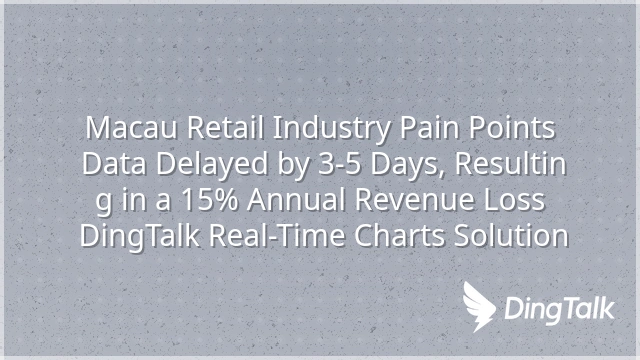
Why Traditional Reports Are Hampering Your Operational Efficiency
In 2023, Macau’s tourist spending fluctuated by as much as ±35%, yet only 28% of businesses were able to adjust their strategies in real time—this isn’t a lack of information; it’s outdated decision-making processes. Traditional static reports are, on average, 3 to 5 days behind, leading to misaligned promotions, inefficient staffing schedules, and even missed peak sales periods. You don’t lack data—you’re trapped in a black hole where you can see the problem but can’t act fast enough.
The core issue isn’t the volume of data; it’s the lack of interactivity. A multi-source data fusion engine allows you to synchronize border-crossing foot traffic, resort occupancy rates, and POS transactions across shopping districts, because siloed databases result in resource misallocation. For example, during festive seasons, a surge in foot traffic without corresponding inventory can directly lead to lost revenue opportunities. Research shows that such mismatches cost retailers over 15% of potential revenue each year.
Technology isn’t just about upgrading tools—it’s about reducing data latency costs from daily losses in the millions to a manageable range. The next section reveals how DingTalk interactive charts leverage technological differentiation to break down data silos, enabling cross-system integration and intelligent push notifications. The true competitive advantage lies in your team’s speed of response, not in what you know.
The Three Technical Pillars of DingTalk Interactive Charts
In Macau’s retail and tourism industries, speed of response is paramount. As a “low-code data visualization engine,” DingTalk interactive charts empower frontline teams to independently build dashboards within three days—compared to more than 14 days required by mainstream BI tools, shortening deployment cycles by over 70%. This means your business no longer has to rely on IT scheduling, because rapid iteration is essential for capitalizing on ever-changing market dynamics.
Its technological differentiation rests on three key pillars: First, a multi-source data fusion engine that instantly integrates POS systems, foot traffic data, and booking platforms, ensuring market shifts are no longer interpreted with a delay, since data silos are the primary cause of strategic failures. Second, real-time dashboard updates, which support dynamic refreshes, allowing promotion effectiveness to be evaluated and adjusted within two hours rather than waiting until the next day’s meeting, because hour-level responsiveness determines ROI. Finally, a message-triggered alert system that sets thresholds for critical metrics and automatically sends reminders, meaning inventory shortages or rising customer complaints can be addressed before they escalate, as earlier risk warnings lead to smaller losses.
These capabilities create a new reality: data is no longer an asset controlled by a select few, but an actionable tool accessible to the entire organization. After implementation, a mid-sized department store saw a 23% increase in promotional ROI within the first month, precisely because marketing and store teams could simultaneously view real-time conversion rates and quickly optimize strategies. With the right tools in place, the next step is how to put them into practice?
Connecting Traveler Footprints to Predict Consumer Behavior
When traveler footprints and consumption data are first overlaid, Macau’s retail decision-making shifts from being “experience-driven” to “behavior-predictive.” By integrating geographic hotspots with POS data through DingTalk interactive charts, businesses can identify six distinct behavioral patterns, such as “long dwell, low spend” or “quick visit, high purchase.” This means managers can design targeted interventions for different customer segments, because ignoring these patterns is tantamount to letting business opportunities slip away.
A luxury resort integrated Wi‑Fi location tracking with its transaction system and set up an automated alert for situations where “foot traffic density exceeds the threshold and conversion rate falls below 15%.” Upon triggering, the system immediately pushed limited-time dining vouchers and queue-free experiences, resulting in a 27% jump in conversion rate within 48 hours. This closed-loop process includes: real-time data ingestion → multi-dimensional filtering (time, area, customer segment) → automated action recommendations. Crucially, the system doesn’t just show “where the crowds are”; it also determines “who is most valuable” and suggests “how to engage them.”
According to the 2024 Asia-Pacific Smart Tourism Report, venues equipped with real-time behavior prediction capabilities see a 3.2-fold improvement in promotional resource efficiency. When you can intervene precisely in the final 30 minutes before a visitor leaves, ROI is directly validated through the “trigger-response” chain. The next question is: Can this optimization permeate both sales per square foot and customer satisfaction metrics, becoming a common language for cross-departmental KPIs?
Quantifying Dual Gains: Increased Sales Per Square Foot and Higher Customer Satisfaction
Results from a pilot program involving eight Macanese retailers show that, after adopting DingTalk interactive charts, average sales per square foot increased by 23%, while customer satisfaction surged by 19 percentage points—this isn’t a vision; it’s a proven reality. For you, every month of delayed deployment equates to giving competitors one more quantifiable market share.
“Real-time insights” are the turning point. Data that once took 24 hours to consolidate now updates automatically within 15 minutes; cross-departmental meetings have decreased by 40%, as all teams share the same dynamic dashboard, shifting debates from “whose data is correct” to “what strategy should we pursue.” Even more significantly, the success rate of personalized marketing campaigns has improved by 2.1 times—when the system links traveler footprints, high-traffic zones, and real-time inventory, stores can precisely target high-value customers who have just left their hotels and are walking toward shopping districts with tailored offers.
- Data response speed: 24 hours → 15 minutes (saving 23 hours and 45 minutes)
- Collaboration costs: Cross-departmental meetings reduced by 40% (saving at least 120 work hours annually)
- Marketing conversion: Personalized campaign success rate improved by 2.1 times (direct ROI benefits)
This benefit aligns with the Macao Government Tourism Office’s “Smart Tourism” initiative. As businesses enhance operational efficiency, they also provide foundational support for city-wide crowd management, creating a win-win scenario for commerce and governance. Cost-benefit analysis indicates that for every 10,000 MOP invested, an additional 38,000 MOP in revenue can be generated, with a payback period of less than four months. The window of opportunity is closing.
Four Steps to Deploy Your Data-Driven Decision Engine
If your team continues to adjust inventory or staffing schedules based on gut feeling, you could be missing out on over 15% of potential revenue each year—this is the price of fragmented data. To transform DingTalk interactive charts into a decision engine, you must systematically integrate them into your existing framework. Here’s a proven four-step approach:
Step one: Inventory your existing data sources (POS systems, Wi‑Fi foot traffic data, ticketing platforms), which enables you to turn scattered data into fuel for trend forecasting, as the quality of foundational data determines the depth of insights. Step two: Establish a Key Performance Indicator matrix (KPI Matrix), such as “dwell time vs. sales per square foot,” so that different departments can use a common language to interpret the market, as shared metrics reduce communication friction. Step three: Build a prototype dashboard and conduct stress tests; it’s recommended to start with a single store near the Border Gate as a proof-of-concept, as this approach has been shown to shorten the validation period from six weeks to within ten days.
Step four: Set up automated alert thresholds and notification mechanisms. When a sudden surge in customer traffic occurs but there aren’t enough cashiers available, the system immediately sends a reminder to the manager’s DingTalk workspace, effectively bringing “data-driven actions” to life, because only real-time responses can prevent service breakdowns. However, over 70% of implementations fail due to disputes over data access rights and cultural resistance—the solution lies in pairing the rollout with incentive programs; for instance, incorporating dashboard usage into store manager evaluations. Companies that successfully drive adoption have seen an average 30% increase in their ability to respond to anomalies.
Start Now and Seize the Next Wave of Independent Travelers
Use DingTalk’s free trial version to launch your first interactive chart within 72 hours. This isn’t just a technology upgrade; it’s a shift in decision-making culture—whoever masters the data feedback loop first will be able to position themselves strategically ahead of the next wave of independent travelers and gain a competitive edge. Pilot results speak for themselves: a 23% increase in sales per square foot, a 3.8x return on investment, and a payback period of under four months—these aren’t aspirational goals; they’re realities you can begin implementing today. Is your team ready to embrace this data-driven operational transformation?
DomTech is DingTalk’s official designated service provider in Macau, specializing in providing DingTalk services to a wide range of clients. If you’d like to learn more about DingTalk platform applications, please feel free to consult our online customer service representatives or contact us by phone at +852 95970612 or via email at cs@dingtalk-macau.com. We have an excellent development and operations team with extensive market experience, ready to offer you professional DingTalk solutions and services!