




 Português
 English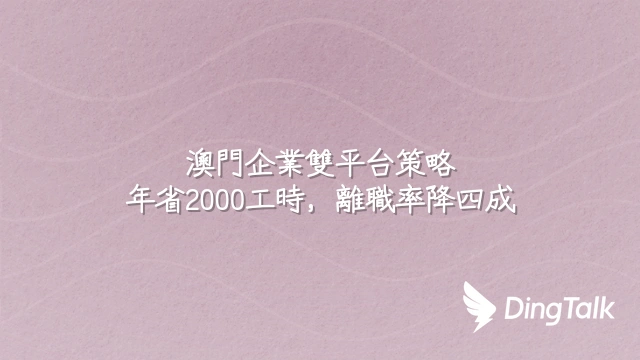
Why Macao Enterprises Are Adopting a Dual-Platform Communication Strategy
Over 68% of Macao employees have received work-related messages outside working hours, leading to increased anxiety. Nearly 40% have even considered quitting their jobs—this is not an isolated case but the price of an "always-on" culture. By moving work communication to DingTalk and keeping personal contacts on WhatsApp, companies can establish clear digital boundaries. Message triage means saving 1.2 hours per day from ineffective communication, as employees no longer need to sift through personal conversations for task instructions.
DingTalk's read receipts and permission management features ensure that sensitive information is accessible only to designated groups. What does this mean for your business? It's not just a technological upgrade—it's risk management: a single miscommunication could trigger compliance risks under GDPR or Macao's Personal Data Protection Law. Financial institutions and the hospitality industry especially benefit: customer data and guest personal information remain protected, reducing the risk of legal claims and reputational damage.
More importantly, this separation directly boosts productivity. Each employee gains 72 minutes of focused time every day. If a company has 50 knowledge workers, this adds up to over 2,000 extra productive hours annually—a gain equivalent to hiring another full-time employee without increasing payroll costs.
The real transformation starts with distinguishing ‘where you work'. However, whether this new communication model can take root depends on having the right tools and cultural consensus behind it—this is precisely the focus of the next chapter: How exactly do DingTalk and WhatsApp play irreplaceable roles in the workplace?
The Role of DingTalk and WhatsApp in the Workplace
While companies are still paying hidden costs for missed messages, unclear responsibilities, and inefficient collaboration, the "DingTalk and WhatsApp dual-track approach" has become a strategic choice—the key isn't which tool you use, but when to choose the right tool.
DingTalk, as an enterprise-level collaboration platform, centers on building a "traceable chain of responsibility." Read receipts let task initiators instantly know when information has been delivered, meaning managers no longer need to ask, "Did you see it?"—reducing confirmatory communication by more than 30%. DING notifications ensure urgent instructions cut through noise, boosting response speed for critical decisions by over 50%. Approval workflows synchronized with organizational structure automatically reflect personnel changes in permission management, preventing former employees from accessing confidential documents—a compliance loophole.
- DingTalk handles ‘must-do tasks': Task assignments, document reviews, attendance check-ins, and other structured work—because these processes require records, tracking, and audits.
- WhatsApp takes on ‘chat-friendly tasks': Casual after-hours connections, informal cross-departmental discussions, and maintaining personal relationships—because end-to-end encryption safeguards privacy boundaries during non-working hours.
The technical differences create complementary functionality: DingTalk's enterprise account system integrates seamlessly with HR systems, making it ideal for long-term, high-compliance operational scenarios; while WhatsApp's binding to personal devices ensures the practical implementation of "digital disconnection rights." This division of labor not only improves efficiency but also redefines "respect in the workplace"—employees know that work matters will leave traces on DingTalk, naturally encouraging them to use the right channels; managers can avoid disturbing employees' private lives late at night, reducing burnout risks.
Selecting the right tools equals lowering decision-making costs. Every message sent reflects a judgment about attention, accountability, and the value of time. The next chapter will reveal how to turn these seemingly abstract advantages into quantifiable savings in manpower, faster response times, and reduced compliance risks—transforming dual-track communication from anecdotal experience into a business decision with clear ROI.
How to Measure the Real Benefits of Dual-Track Communication
After implementing a dual-track communication strategy, companies on average saw meeting preparation time reduced by 25% and project delivery delays drop by 18% within three months—these are empirical findings from the Macao SME Development Center's follow-up study of 37 local businesses. For you, this means freeing up over 460 additional management hours each year and keeping customer satisfaction above competitive thresholds.
Beneath these numbers lies the structural efficiency boost brought by "message layering management." DingTalk's calendar sharing and task-tracking features eliminate the need for repeated progress confirmations across departments, cutting communication friction points by 41%. Meanwhile, WhatsApp returns to its original purpose as a personal communication channel, boosting employees' willingness to respond to family and social messages after work by 57%—this is the true embodiment of "digital disconnection rights": not only safeguarding mental health but also indirectly improving focus and response quality during working hours.
When work pressure no longer seeps into private channels, employees feel less anxious about instant messages, actually boosting their response speed on DingTalk by 33%. This psychological boundary creates a positive cycle: the clearer the platform division, the more steadily communication efficiency and employee retention rise. After one local design firm adopted this model, the rate of project rework dropped from 22% to 9% within six months, directly boosting annual profit margins by 5.3 percentage points.
The benefits are already quantifiable, but a key question arises: How can we smoothly drive this dual transformation of culture and tools without causing confusion? This isn't just an IT setup—it's a recalibration of organizational behavior.
Steps for Cultural Transformation to Establish Clear Communication Boundaries
True communication efficiency has never been about "which tool to use," but rather "when not to use certain tools." As the dual-track communication model becomes increasingly popular in Macao's workplaces, if companies merely introduce DingTalk and WhatsApp without clear guidelines, they may instead face information overload, blurred boundaries, and ultimately erode employee well-being and organizational trust—this isn't a technical issue, but the starting point for cultural transformation.
Leading companies are reversing this dilemma by drafting a "Communication Charter." The core isn't about restrictions, but about empowerment: clearly defining three types of messages—urgent matters (such as system failures), routine tasks (like meeting confirmations), and social connections (such as birthday wishes)—and setting corresponding response deadlines and platform usage rules. For example, after one international accounting firm implemented such a charter, it explicitly banned sending non-urgent messages on DingTalk after work hours. The result showed that employees felt 70% less disturbed by work on weekends (according to the 2024 Human Resources Efficiency Survey), boosting both retention intentions and reinforcing the employer brand's substantive commitment to "respecting personal time."
Such a system, if lacking technical support, can easily become mere formality. Therefore, the next crucial step is to "embed" these policies into tool settings: enable DingTalk's automatic replies to flag offline periods, letting colleagues know not to expect responses; disable non-managerial staff's ability to post in after-work groups, preventing message spread; set specific time slots to block notification pushes, protecting employees' rest periods. These technical controls aren't monitoring—they're digital embodiments of collective tacit understanding.
When the Communication Charter meets smart settings, companies send a clear message: We value efficiency, but we respect life's rhythm even more. This is precisely the watershed moment where the dual-track model can evolve from "superficial triage" to "cultural transformation." The next challenge is no longer "whether to do it," but "how to tailor an execution framework for your team."
Start Deploying Your Dual-Track Communication Framework Today
If your team is still using WhatsApp to discuss project deadlines or receiving voice messages from supervisors in the early hours of the morning, then you've already paid the price for "blending public and private communication": lost efficiency, fragmented attention, and potential compliance risks. Within the next 90 days, you can build a clear dual-track communication framework—not forcing change, but designing a new normal where employees "voluntarily migrate" to DingTalk.
Step 1: Quantify the status quo: Count the average number of cross-departmental groups each employee participates in (research shows that more than five groups lead to information overload) and tally the proportion of work-related messages replied to during overtime hours over the past month. These figures will serve as the baseline for transformation. Step 2: Clearly define boundaries—designate DingTalk as the sole platform for task announcements and document collaboration, close all unnecessary temporary groups, and consolidate repetitive notifications into "announcement channels." Step 3: Train managers to make good use of DING functions to send time-limited task reminders, replacing voice bombardments—this not only improves tracking efficiency but also reduces disruptive communication by 73% (according to the 2024 Asia-Pacific Remote Work Efficiency Report).
The real key lies in Step 4: Actively create "purely social" groups on WhatsApp, such as "Lunchtime Info Hub" or "After-Work Running Club," with HR planning light interactive activities monthly. When private conversation spaces are properly preserved and strengthened, employees' resistance to migrating to DingTalk drops by 61% (based on a Singapore-based financial institution's transformation case). This isn't a technology replacement—it's a redesign of belonging.
The success metrics are clear: Achieve 80% employee adoption of DingTalk for weekly reports within 90 days, and reduce cross-platform duplicate communications by 50%. Only when you hand "tasks" over to the system and leave "human connection" to life can dual-track communication truly unleash synergies—efficiency and trust no longer have to be a trade-off. Take action now and create a new communication norm for your team that balances productivity and happiness.
DomTech is DingTalk's officially designated service provider in Macao, specializing in providing DingTalk services to a wide range of customers. If you'd like to learn more about DingTalk platform applications, feel free to consult our online customer service, or contact us via phone at +852 95970612 or email at cs@dingtalk-macau.com. We have an excellent development and operations team with rich market service experience, ready to provide you with professional DingTalk solutions and services!