




 Português
 English
In Sina Weibo, hundreds of millions of users watch, share, and interact every day. When hot topics spark massive discussions, Sina Weibo faces traffic surges far beyond its usual peak levels. During these moments, Weibo’s product, tech, and application teams must work together to handle the traffic spikes.
IM (instant messaging) apps are a key link connecting all parts of Weibo. In earlier years, Sina Weibo used a self-developed IM app—a mini IT team built this app for internal communication across Weibo’s various business modules.
In the first half of 2023, Sina Weibo signed a partnership with DingTalk and migrated its entire workforce onto DingTalk. In the view of Wang Wei, COO of Sina Weibo, DingTalk’s user experience, openness, and AI capabilities were enough to impress Weibo at this critical moment.
01
Abandoning in-house development—everyone moves to DingTalk
Many large companies with development capabilities face this choice: Should they rely entirely on their own technical expertise to build a global, fast-responding communication system? Or should they abandon in-house development and embrace mature products already on the market?
High costs of in-house development
Against the backdrop of cost-cutting and efficiency gains in internet companies, any in-house app must have a strong enough reason to exist—just as with new business ventures, the input-output ratio is the decisive factor. However, in-house development requires building a dedicated R&D team, along with considering hardware and operational costs, and the development cycle tends to be long. By contrast, purchasing a mature software solution involves a fixed cost.
External solutions deliver a better user experience
By adopting external software, companies not only enjoy the convenience and user experience offered by a mature platform but also benefit from continuous updates and iterations that bring new features and surprises. This allows companies to focus more on honing their core competencies.
Once an app is developed, much less manpower is needed for maintenance—but legacy tech architectures often struggle to support new requirements. Sometimes, the question isn’t whether innovation is possible, but whether it can be done at all.
02
DingTalk’s open AI capabilities impress Weibo once again
In fact, when Weibo considered adopting an external IM app, it surveyed every available solution on the market—including major players beyond DingTalk. AIGC capabilities and openness were key factors in Weibo’s decision to choose DingTalk.
AIGC dramatically boosts B2B productivity
Wang Wei believes that enterprise office scenarios represent an important application area for AIGC in the B2B space, and that AIGC significantly enhances productivity for businesses. The IT team at Sina Weibo couldn’t develop a general-purpose large model in-house. He wanted a B2B solution that would allow Sina Weibo to adopt AIGC early, greatly improving work efficiency and productivity.
On April 11, 2023, Alibaba officially launched the Tongyi Qianwen large language model. A week later, DingTalk announced that it had integrated the model. DingTalk’s strong commitment to large models in the AI space became the final push that tipped the scales in favor of DingTalk. DingTalk articulated its vision for AIGC in enterprise office scenarios earlier and more clearly than others.
Just as DingTalk announced its “all-in-AI” strategy, Sina Weibo internally organized an AIGC competition. This allowed more AIGC capabilities to be integrated into DingTalk, turning the platform into an all-in-one app. Sina Weibo views DingTalk as an open AI system, where its employees can develop custom features, improve workflows, and boost efficiency.
Openness = support for “tweaking”
For digital enterprises like Sina Weibo, which have built many systems in the past and accumulated vast amounts of data, the new IM platform needs a sufficiently open ecosystem to integrate different systems without creating data silos. Weibo prefers to work within an open ecosystem to develop customized features.
This is especially true for internet companies, whose workforce consists largely of technical developers. They need flexibility: the platform must provide open APIs that give developers room to experiment and build their own solutions.
In other words, Wang Wei sees DingTalk’s openness as one of its core competitive strengths.
Especially when it comes to core competencies, companies cannot simply buy off-the-shelf business systems—but they do need flexible solutions. “In trendy terms, we call this ‘tweaking,’” Wang Wei says.
03
50+ business systems, 100+ bots deeply integrated with DingTalk
After Sina Weibo migrated to DingTalk, it integrated more than 50 existing business systems—including news publishing systems, data portal systems, sales systems, product deployment systems, and command systems—and over 100 bots into DingTalk to ensure tight integration between the IM platform and business operations.
This deep integration, combined with DingTalk’s efficient reach capabilities, provides strong support for handling tasks across various business systems. Employees can use DingTalk bots to quickly issue commands to business systems, and the systems can provide real-time feedback to employees, greatly improving the efficiency of business communication and operations.
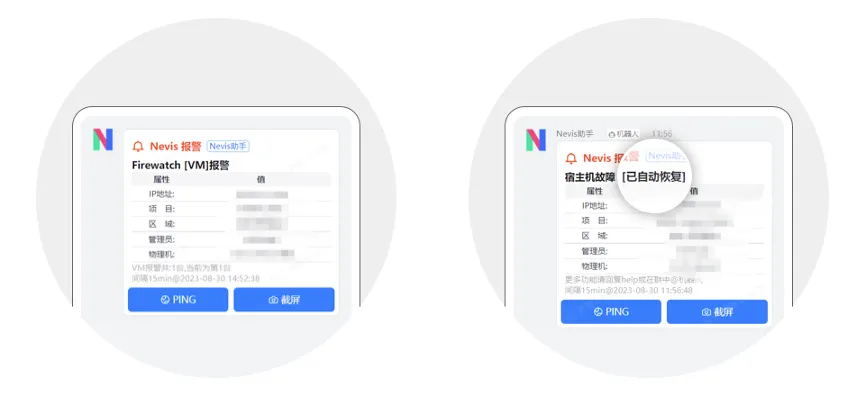
When a hot event occurs, the relevant teams can rapidly scale up or down their operations and maintenance resources. There’s no longer a need to boot up computers, log into VPNs, scan QR codes, or go through other cumbersome steps. On mobile devices, employees can simply open DingTalk and adjust operations and maintenance resources on the fly—even during lunchtime, they can make adjustments directly from the cafeteria.
When the IT team needs to promptly notify on-call staff and on-call groups about system issues, DingTalk bots can use features like Ding to alert the responsible personnel immediately, speeding up problem resolution. After a system failure is resolved, the bot automatically syncs the system status back to the DingTalk group, creating a closed-loop workflow for issue management.
Weibo and DingTalk are also actively exploring AIGC applications. “We’re among the first users of DingTalk’s ‘Magic Wand.’ After activating it, our HR, operations, and other teams started using the Magic Wand to generate various notifications and copy, which we then fine-tune manually. This has greatly improved the efficiency of our copywriting work,” Wang Wei explains.
Sina Weibo has launched an internal initiative to innovate work methods, with different roles delving deeply into how DingTalk can be integrated with business processes. Initial explorations have led to several applications: Weibo’s WeiBot integrates the capabilities of Tongyi Qianwen, giving every employee a dedicated AI assistant. There’s also a video bot: employees can send message commands to the bot, and it can fix videos directly, providing real-time feedback on the results. This has dramatically shortened business processing timelines.
The closer DingTalk’s capabilities align with Weibo’s use cases, the more pronounced the benefits become. The value of DingTalk becomes clearer, and the gains for Weibo grow larger.
DingTalk’s value to Weibo lies in strengthening the foundations of digitalization—equipping the company with new collaboration tools and capabilities, accumulating data, use cases, and experience in preparation for the next wave of the internet, and ensuring that Weibo is positioned on the right side of the curve when that wave arrives.
DomTech is DingTalk’s official service provider in Macau, dedicated to providing DingTalk services to a wide range of customers. If you’d like to learn more about DingTalk platform applications, feel free to contact our online customer service, or call +852 95970612 or email [email protected]. With a strong development and operations team and extensive market experience, we can provide you with professional DingTalk solutions and services!