




 Português
 English
On the shores of Qingshan Lake in Hangzhou, Zhejiang, a large number of smart manufacturing companies have gathered. Among them is a dynamic headlight manufacturer—Zhejiang Dishi Technology. As an "invisible champion" in the industry, Dishi Technology has become a core component supplier for well-known electric vehicle brands such as Xiaomi, NIU, and Ninebot, with sales growing at a rapid pace of over 30% year after year.
Behind these impressive figures lies not only the rapid growth of China's new generation of smart manufacturing but also a story of strategic execution and organizational evolution.
Zhejiang Dishi Technology was founded in 2016 and began fully adopting DingTalk in its second year of operation. Today, Dishi employs nearly 700 people, and the expanding scale of the company has led to soaring management costs. In recent years, as more and more manufacturing firms have entered this field, competition in the industry has intensified, and price wars have escalated. The core challenge facing Dishi Technology is clear: it must control costs while enhancing organizational capabilities and accelerating operational efficiency.
"There are two situations that are particularly frustrating," admits R&D Director Zeng Xin. "One is when the boss lays out the strategy, and the senior leaders sound convincing, but they actually fail to support the boss's vision. The other is when the boss thinks an idea is great, but six months later, what the senior leaders say and what they actually do turn out to be completely different."
This is not an isolated case—it is a common problem faced by many companies: a "disconnect" exists between strategy formulation and implementation. As a result, the boss's ideas often remain "on paper" and struggle to be put into practice.
To address the challenge of strategy execution, Dishi Technology has tried various management approaches. Initially, the company adopted the classic Five Forces model (developed by Harvard Business School professor Michael Porter in the early 1980s, which identifies five forces that determine the level and intensity of competition in an industry). The company's management team used PPT presentations to conduct detailed analyses of the market environment and competitive landscape, spending significant time preparing materials—but still struggled to break down the strategy effectively.
Later, the team experimented with the OGSM strategic-decoding method. However, lacking a unified digital tool, the strategy breakdown had to be done in Excel spreadsheets, leading to fragmented data, inefficient communication, and a disconnect between planning and execution.
To solve these problems, the CEO of Dishi Technology personally led a "visit" to eight department heads, gaining deep insights into the pain points and collaboration barriers in each business area. This research made the management team realize that the company urgently needed a digital tool that could make the strategy "visible and actionable."

One of Dishi Technology's biggest pain points was that strategic data was scattered across various Excel files and PPT presentations, making it difficult for management to obtain a unified, holistic view. The boss often operated in a "black box": unsure whether strategic goals were being taken up, by whom, or how well they were being executed.
In the second half of 2024, after extensive comparison and evaluation, Dishi Technology ultimately chose DingTalk Agoal as its strategic-management platform.
Agoal's OGSM "one-page" feature solved this problem once and for all. With this feature, the boss can see the entire breakdown of the strategy on a single interface: from top-level goals to the decomposition of sub-goals, to specific execution strategies and measurement metrics. It becomes immediately clear how the strategy is broken down, who is responsible, and the progress of each task. All information is presented in a highly visual format, greatly easing the boss's anxiety about strategy execution.
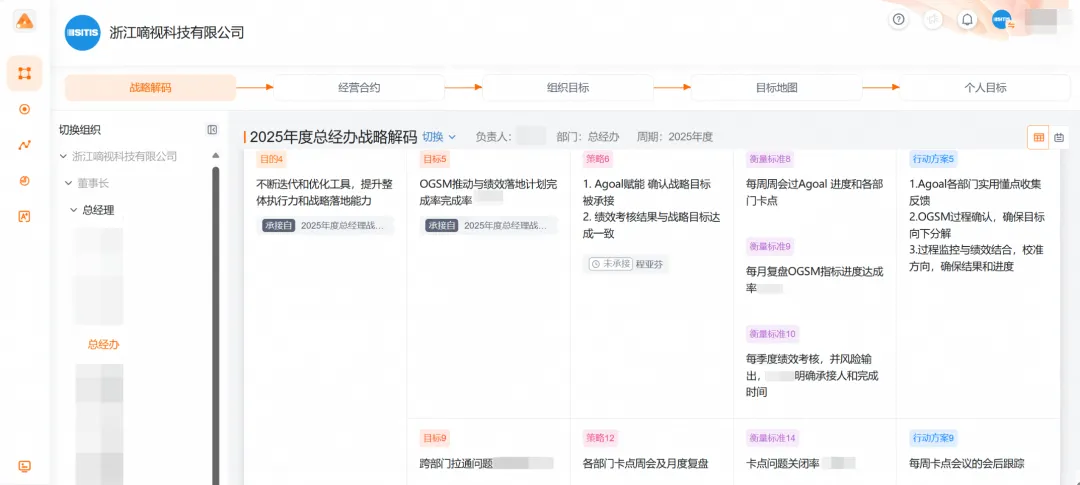
More importantly, Agoal is built on the DingTalk ecosystem, and every step in the strategy-decomposition process is promptly communicated via DingTalk messages. When a goal needs to be assigned, the relevant person in charge receives a notification; when goal progress is updated, senior managers can track it in real time. This seamless integration reduces the need for manual follow-ups and greatly improves the efficiency of strategy execution and decomposition.

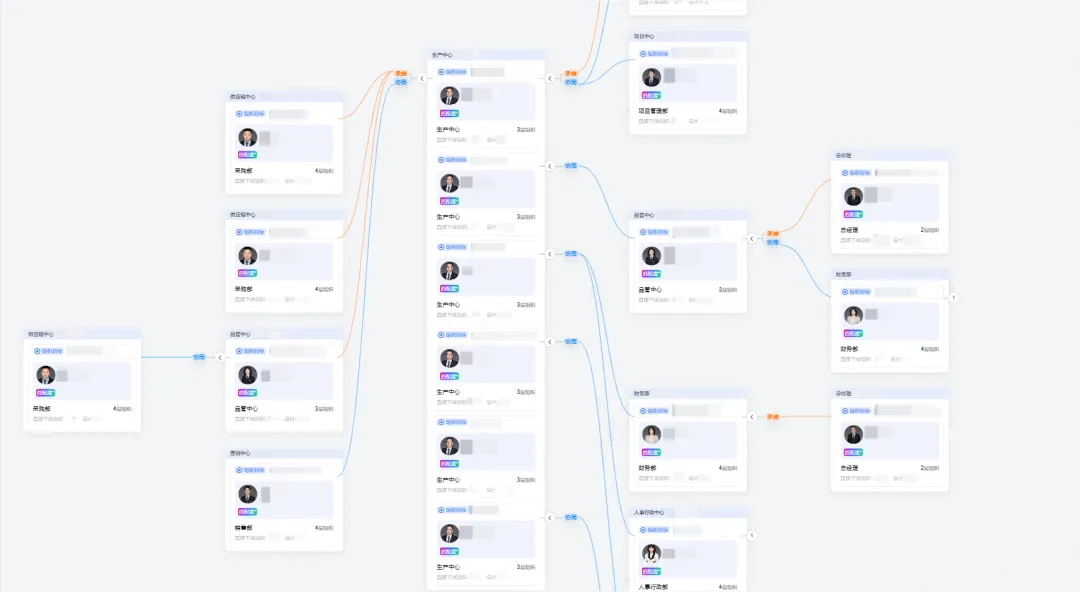
Agoal's goal map ensures that employees' daily work is tightly aligned with the company's strategic objectives.
For example, the company's strategy calls for "reducing costs and increasing efficiency," but some departments still devote most of their energy to boosting production capacity. The goal map enables management to spot deviations in real time, adjust resource allocation, and ensure that strategy and execution are truly aligned.

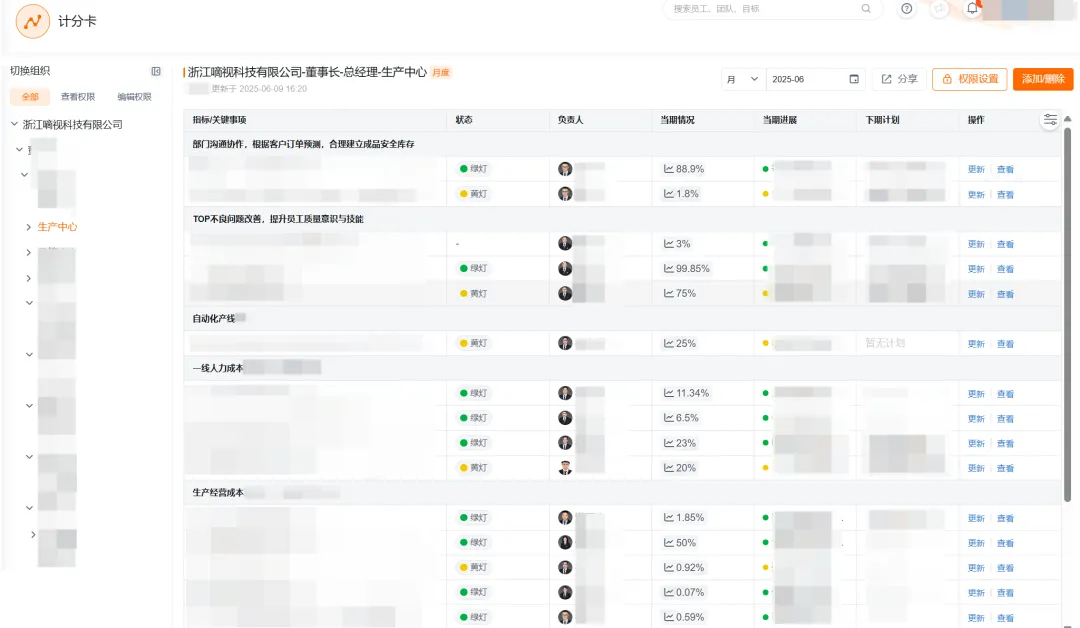
The scorecard is a metric-tracking tool within Agoal. Each core business metric has a designated owner, along with its completion progress and status. Every week, Dishi Technology's management team holds a business-management meeting based on the scorecard, reviewing goal progress item by item and promptly identifying issues and deviations. Compared with using Excel spreadsheets in the past, the scorecard makes problems more focused, and the team's self-motivation and collaborative effectiveness have improved as well.
After several months of implementation, Dishi Technology has made significant progress in strategy execution. "The rate of achieving strategic goals has increased, cross-departmental collaboration has become smoother, and management meetings are more efficient. More importantly, the company's decision-making model and organizational atmosphere have improved," says Zeng Xin.
In the past, decisions relied on experience and intuition; now, with data support, decisions are more objective. Goals are transparent, progress is traceable, and suspicion and misunderstandings between departments have decreased.
DomTech is DingTalk's officially designated service provider in Macau, specializing in providing DingTalk services to a wide range of customers. If you'd like to learn more about DingTalk platform applications, you can contact our online customer service directly, or call +852 95970612 or email [email protected]. We have an excellent development and operations team with extensive market-service experience, ready to provide you with professional DingTalk solutions and services!