




 Português
 English
In the Spring Festival travel rush and during major transport missions at Beijing Capital International Airport, more than 600 special vehicles operated by Beijing Airport Ground Services achieved an outstanding performance of "zero failures, zero delays." Behind this achievement is the company's digital vehicle maintenance management system, built on DingTalk's low-code platform, which provides robust support.
— Beijing Airport Ground Services Co., Ltd.
General Manager, Information Technology Department
Chen Weiwei
In the busy Spring Festival travel season at Beijing Capital International Airport in 2025, the peak demand for the first flights of the morning created a "repair rush" for the special vehicles on the apron.
In the past, such moments often left the special vehicle maintenance team scrambling: drivers used walkie-talkies to call for help, mechanics rushed around on-site, and paper work orders were passed between departments... Unclear fault information, slow repair response times, and difficulty in data accumulation had long plagued the airport's special vehicle operations and maintenance.
This year, a brand-new low-code digital system is quietly transforming the situation.
Beijing Airport Ground Services Co., Ltd. (hereafter referred to as "Beijing Airport Ground Services") has taken the lead in introducing DingTalk's low-code platform into its special vehicle maintenance management system, marking a new pilot project for digital transformation in the civil aviation ground services industry.
01
Low-code replaces the "old three": paper forms, walkie-talkies, and Excel
Beijing Airport Ground Services is a core ground services enterprise under the Beijing Capital Airport Group, providing a full range of ground services to domestic and international airlines. Managing special airport vehicles is a key component of its operations.
The company operates hundreds of special vehicles, including tow tractors, de-icing trucks, and shuttle buses, supporting the safe and on-time operation of thousands of flights. These vehicles act like the "capillaries" of the airport, supporting critical functions such as aircraft takeoffs and landings, baggage handling, and passenger transportation.
To manage such a large and complex fleet of special vehicles, the challenge lies in ensuring that every vehicle can be deployed when needed, remains operational, and does not fail at critical moments—and that every maintenance task is performed promptly, compliantly, and traceably.
In the past, the company relied mainly on the "old three": paper work orders, walkie-talkie communications, and Excel spreadsheets.
For example, during flight operations, if a tow tractor suddenly breaks down, the driver typically calls for help via walkie-talkie.
The on-duty mechanic often has to wait until arriving on-site to make a preliminary assessment of the problem. If the vehicle model is unfamiliar, additional personnel must be called in or experts consulted over the phone. This back-and-forth not only wastes time but also risks delaying the entire flight.
Daily vehicle maintenance was even more cumbersome: managers manually calculated maintenance intervals using Excel spreadsheets and posted reminder notes for drivers— a process that was both tedious and prone to errors.
After evaluating various IT solutions, the team ultimately turned to DingTalk's low-code platform.
The flexibility and efficiency of low-code perfectly match the complex and ever-changing nature of airport operations. Using DingTalk's low-code platform, a functional system can typically be developed in just 2–3 weeks and immediately tested. Sometimes, a single functional module can be completed in just a few days— whereas traditional development methods may take months, with much slower updates and iterations.
Chen Weiwei, General Manager of the Information Technology Department at Beijing Airport Ground Services, said, "High efficiency and low cost are the main reasons we chose DingTalk's low-code platform."
02
Repair time reduced by 40%: Every driver now has a "dedicated 4S shop"
In the past, if a driver noticed an unusual noise from a vehicle, they would report it to the management department, and the vehicle manager would then relay the information to the mechanic. During this back-and-forth communication, a significant amount of information was often lost or distorted.
The change brought by the DingTalk low-code platform is that every driver now has a "dedicated 4S shop"—a convenient way to report issues and check the status of their vehicle.
Drivers simply scan a QR code or select the vehicle to initiate a repair request, upload photos or videos, and the system automatically notifies the relevant personnel. The fault description no longer gets "distorted" through multiple layers of communication; mechanics can immediately grasp the real situation on-site, reducing information loss and misinterpretation.
After implementing the low-code system, the average repair time dropped from 90 minutes to 54 minutes, significantly improving on-time flight support rates.
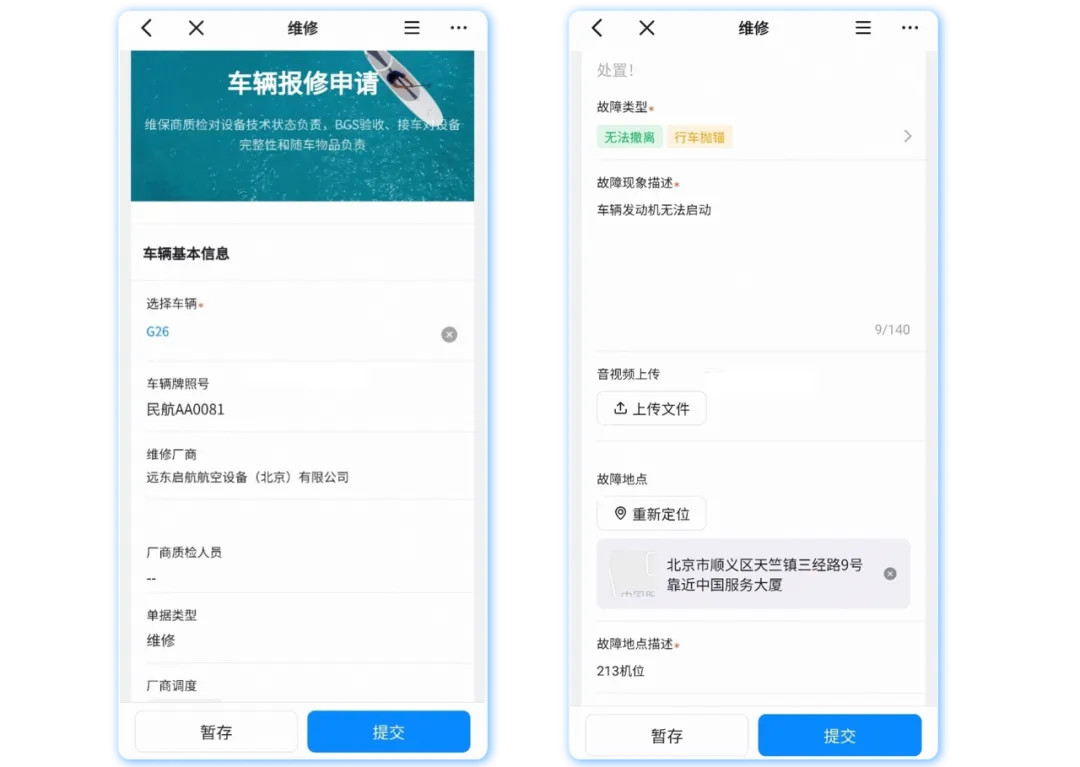
Furthermore, the system digitizes repair work orders and introduces a dual-approval mechanism.
After special vehicle maintenance is completed, the work must be inspected and approved by both the maintenance management department and the user department, ensuring a closed-loop quality assurance process.
Compared with the previous paper-based work order system, information now flows with "near-instant response," greatly shortening the repair cycle and reducing paper documentation by 90%.
The application of DingTalk's low-code platform has also proven effective in vehicle maintenance and management.
The system automatically generates maintenance schedules, using multi-dimensional data such as mileage and engine operating hours to intelligently remind drivers, managers, and maintenance providers, preventing vehicles from being "out of maintenance" due to oversight.
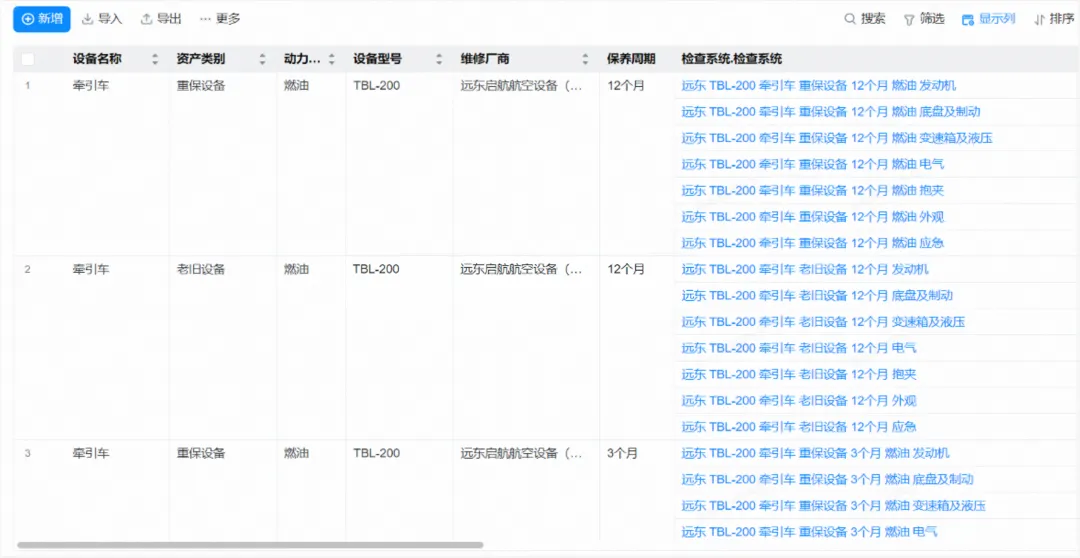
Maintenance tasks are also managed in a structured manner, with steps such as inspection, reset, cleaning, debugging, repair, and replacement clearly defined. Estimated work durations are precise to the hour, and text, images, and videos can be attached, making maintenance work more standardized and transparent. Daily and scheduled vehicle inspections have also been digitized through QR code scanning, with inspection results instantly entered into a defect classification and management system, eliminating "perfunctory" inspections and formalism.
03
Reducing costs through digitalization: Data decides which tires to purchase
As the system continues to operate, Beijing Airport Ground Services has also reaped some unexpected benefits—upgrades in management enabled by data analysis.
For example, in tire management, the system requires that photos be taken and saved each time a tire is replaced, along with a record of the tire's serial number, which is linked to the repair work order. This not only improves compliance and prevents potential fraud but also allows management to identify anomalies through data analysis.
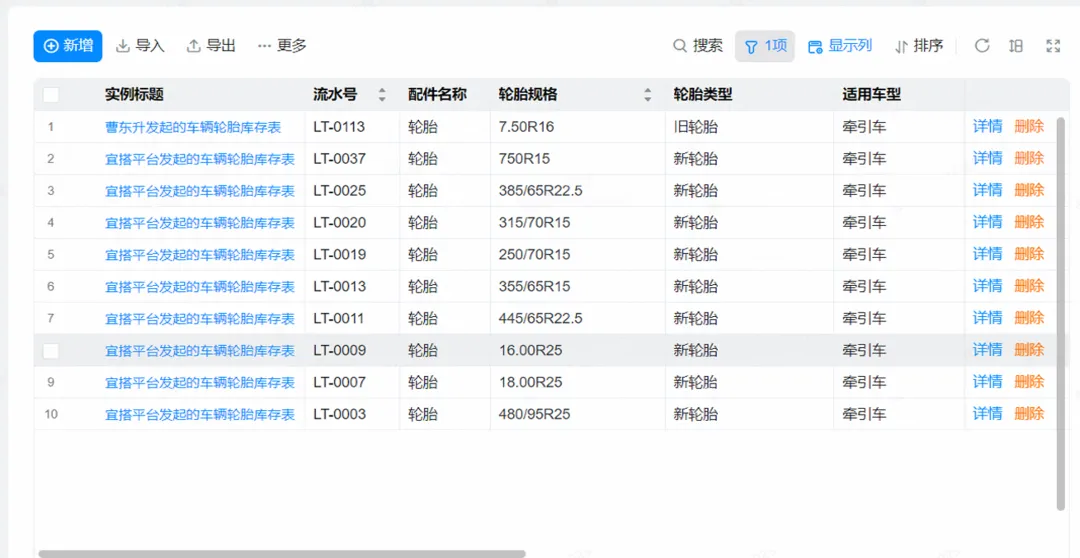
Data analysis has also helped Beijing Airport Ground Services optimize its procurement strategy.
By comparing the lifespan and cost of different tire brands, management can make more informed purchasing decisions. "Some tires may have a higher unit price, but their longer lifespan makes the overall cost lower. These insights are only possible through data analysis."
This data-driven approach to management has enabled Beijing Airport Ground Services to achieve cost savings and operational efficiency while ensuring safety.
The upgrade of Beijing Airport Ground Services' vehicle maintenance management system is still ongoing. General Manager Chen revealed that the system is currently being piloted on a portion of the tow tractors and will gradually be expanded to cover all more than two dozen types of special vehicles.
More importantly, this solution based on DingTalk's low-code platform is not limited to vehicle maintenance.
From paper-based work orders in the past to fingertip operations today, from fragmented information systems to efficient data flow, Beijing Airport Ground Services' experience shows that digital transformation is not as distant as it seems. By building a bridge with low-code, the technical barriers have been lowered, and business implementation has become faster.
For civil aviation ground services—a sector that places extremely high demands on the efficiency of information flow—this innovation not only boosts efficiency but also provides a valuable reference model for other industries and traditional enterprises seeking intelligent upgrades.
DomTech is DingTalk's official service provider in Macau, specializing in providing DingTalk services to a wide range of customers. If you'd like to learn more about DingTalk platform applications, you can contact our online customer service directly, or call +852 95970612 or email [email protected]. We have an excellent development and operations team with extensive market service experience, ready to provide you with professional DingTalk solutions and services!