




 Português
 English
DingTalk was born from co-creation with our customers, and over the years we have consistently adhered to a design philosophy that product features originate from customer needs. When we noticed that free customers who upgraded to paid plans often faced bottlenecks in their design and development capabilities, we realized that even with extensive customization and open APIs, not all customers could achieve the results they expected from DingTalk. From a design perspective, how can we deliver an application that aligns with a customer's business characteristics and specific demands? How can we use "Super Service" to address the challenges customers face when customizing DingTalk apps, especially for enterprises with varying levels of design expertise?
Next, let’s take DingTalk Exclusive Edition’s Super Service for large customers as an example, and discuss how effective B2B customer service is delivered by integrating the three stages outlined in the diagram above.
Effectively Identify Problems and Gain Insights into Customers' True Needs
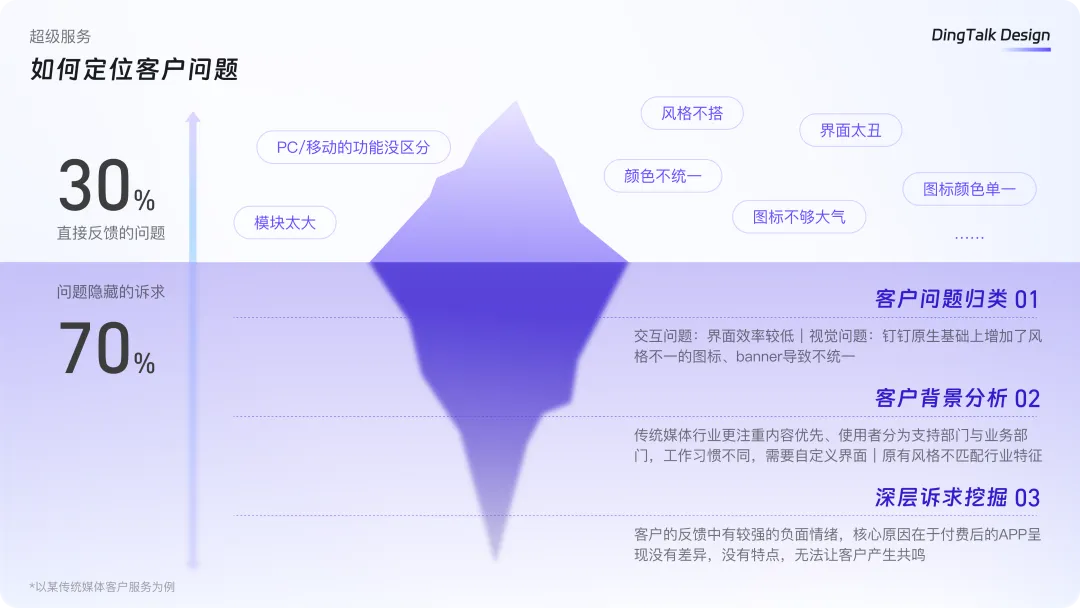
Typically, the issues customers raise are quite focused and direct—for example, in terms of design: "Your 'Workbench' page looks too ugly—it feels low-end"; "This module is too big; we don’t need it—can you remove it?" If we address only these surface-level complaints, can we truly solve the customer’s underlying problems while maintaining a positive partnership? The answer is clearly no. Instead, we must focus on uncovering the customer’s true needs rather than getting trapped in the problems themselves. To do this, we need to clarify the following questions:
The industry characteristics of the customer
Different industries have vastly different design preferences. For instance, designs for traditional media companies must align with the reading habits of print media in terms of content readability, layout, and typography, and reflect a more formal and rigorous work style. If the "Workbench," as the customer's entry point, does not match the company's brand identity, it will be hard for the customer to accept it.
The customer's lifecycle stage
In addition to categorizing customers based on their level of usage, DingTalk also divides them according to whether they are in the free or paid phase. When a customer transitions from free to paid, if there is no noticeable change in the interface—the first thing they experience—they may feel frustrated and wonder, "Where did my money go?"
The diversity of customer roles
Unlike C-end customers, whose interests are usually unified, B-end products are sold to decision-makers, implemented by project executors, and used by employees and administrators (including decision-makers). In addition to understanding the pain points of each role, we must also consider who the decision-makers are, what drives their purchasing decisions, and how we can help executors effectively communicate with decision-makers.
Design Should Go Beyond Surface-Level Problems and Deliver Above-and-Beyond Results
When customers complain about your product, they are often already carrying strong negative emotions. As designers, we have a natural advantage in using concrete and timely deliverables to demonstrate our understanding and respect for the customer, thereby earning their trust while showcasing our design expertise. How can we use our solutions to show that we truly understand the customer and care about their needs?
Prioritize Solving Clearly Defined Customer Issues
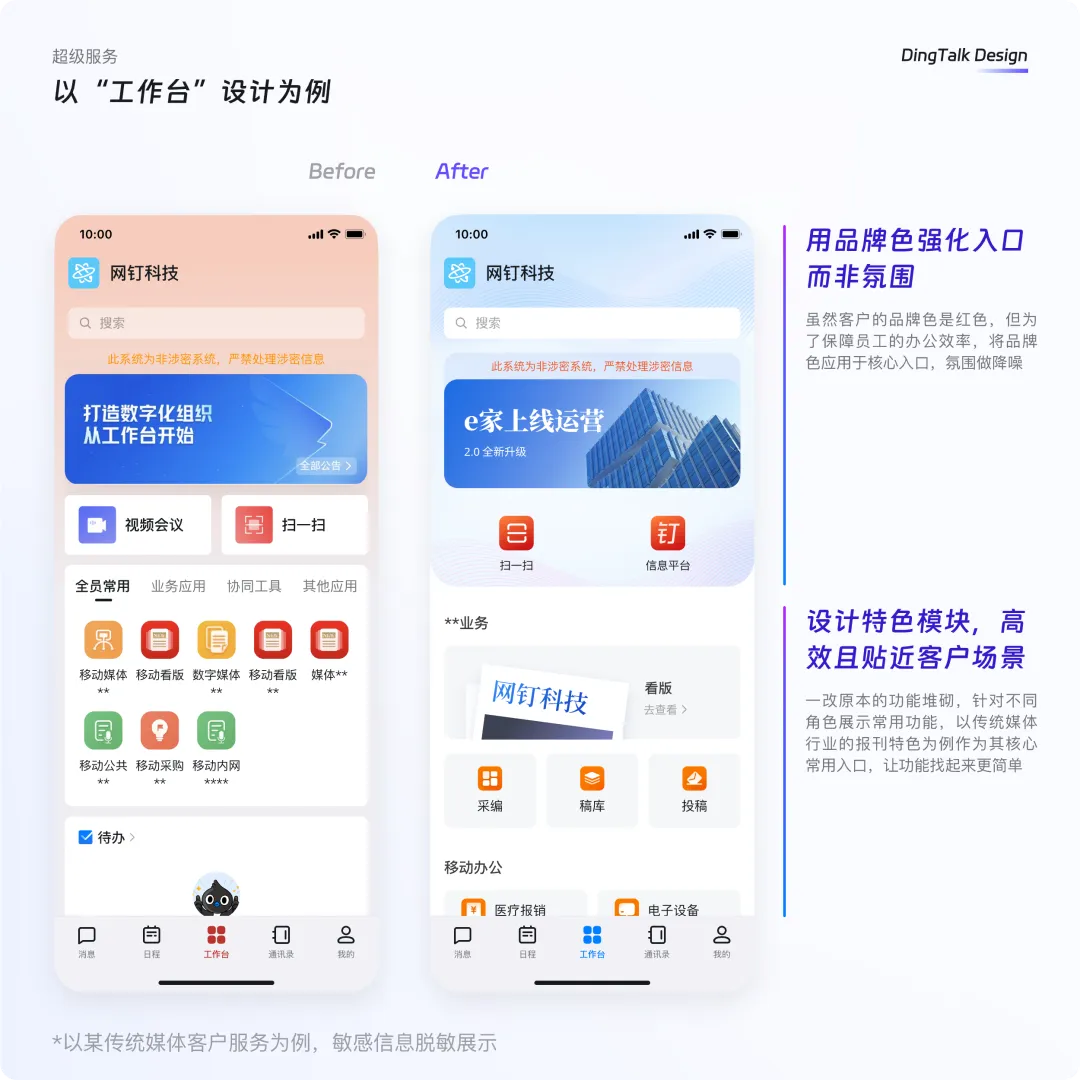
This is especially important in terms of improving efficiency, aligning with the customer’s work style, and matching the stylistic preferences of their industry. Based on preliminary research and feedback from various user roles, we make targeted optimizations. For example, in optimizing the "Workbench" for a traditional media company, we made the following improvements:
Propose Extended Solutions Through Insightful Analysis
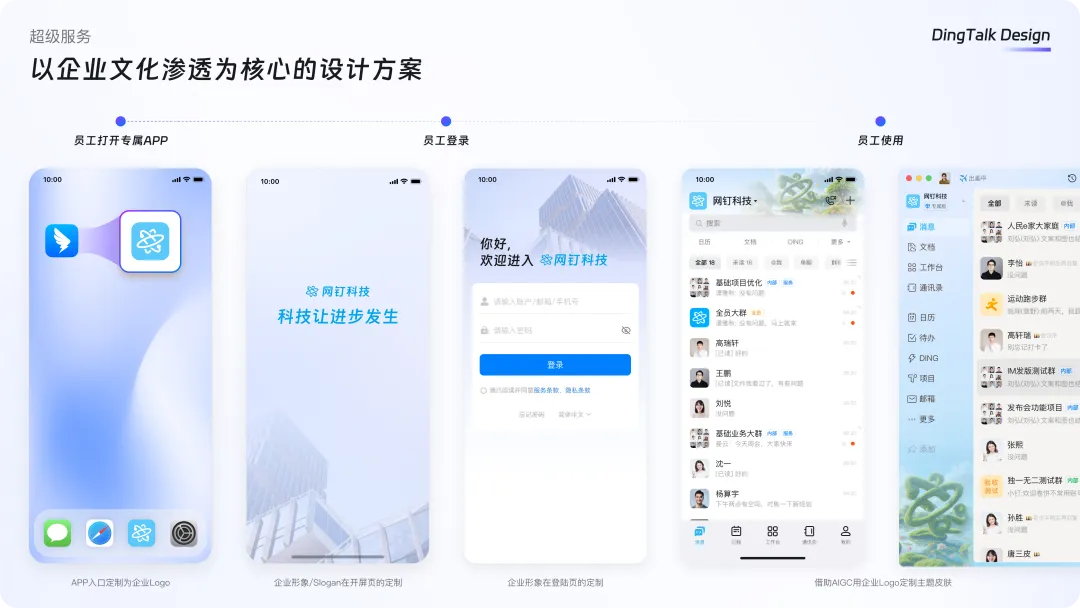
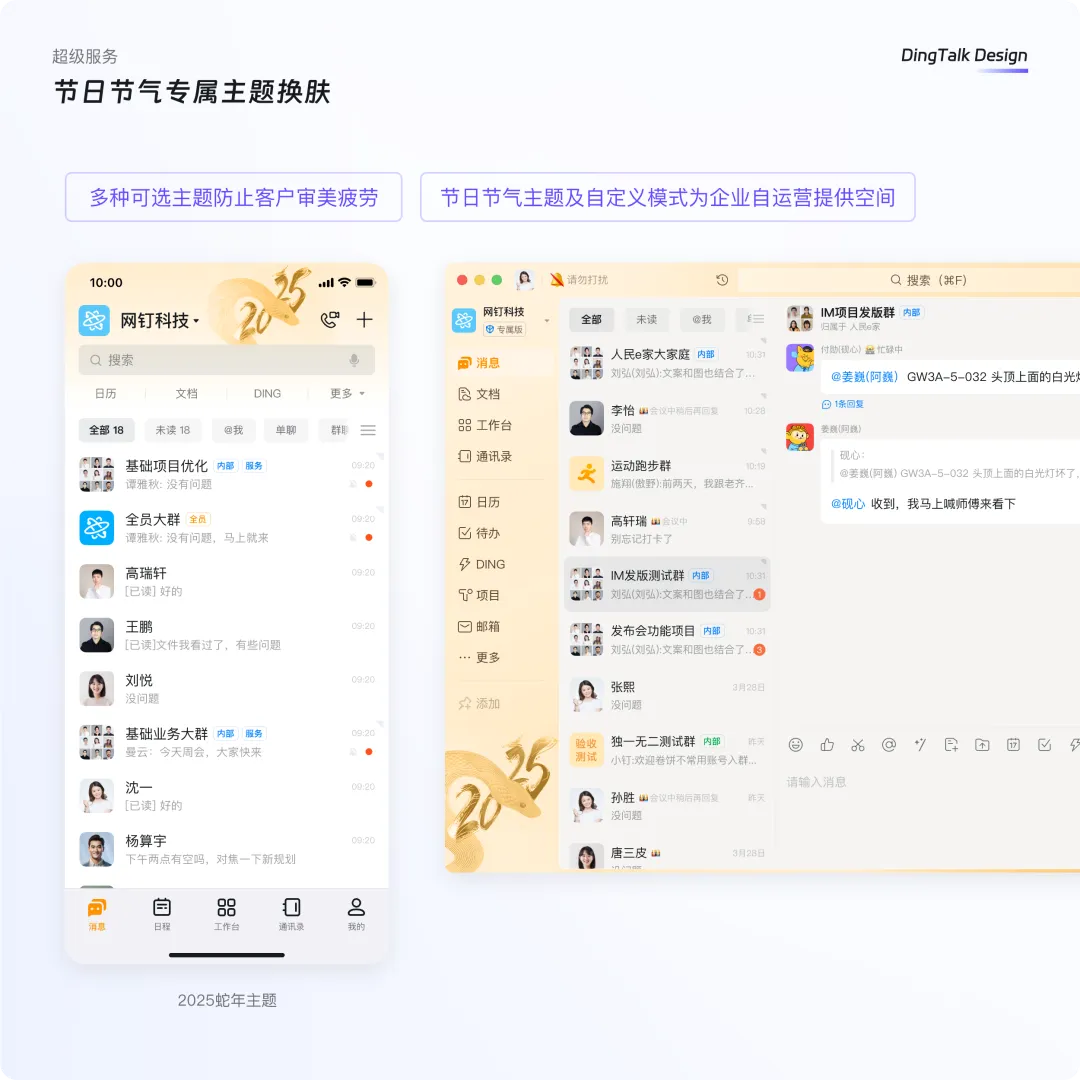
To help paying customers feel the difference between the paid and free versions, and to emphasize that they are using a branded app rather than just DingTalk, we developed design solutions that enhance the company’s brand and culture across key touchpoints—from registration/login and using office apps to chatting. Our goal is to strengthen the customer’s sense of ownership over their "customized DingTalk," so they feel their investment is worthwhile. This approach not only shows decision-makers that you understand their needs but also provides executors with stronger evidence to present to leadership.
Deliver Effective Presentations Through Customer Stories and Provide Ongoing Support
When presenting internally, we are usually clear about the audience’s characteristics and priorities, and tailor our explanations accordingly. However, when presenting to external customers, we often struggle to resonate with them due to insufficient information or a lack of understanding about their organizational structure. By weaving insights from earlier research and field visits into customer stories, we can effectively bring customers into the scenario and help them appreciate the benefits of our proposed solutions.
At the Interaction Level
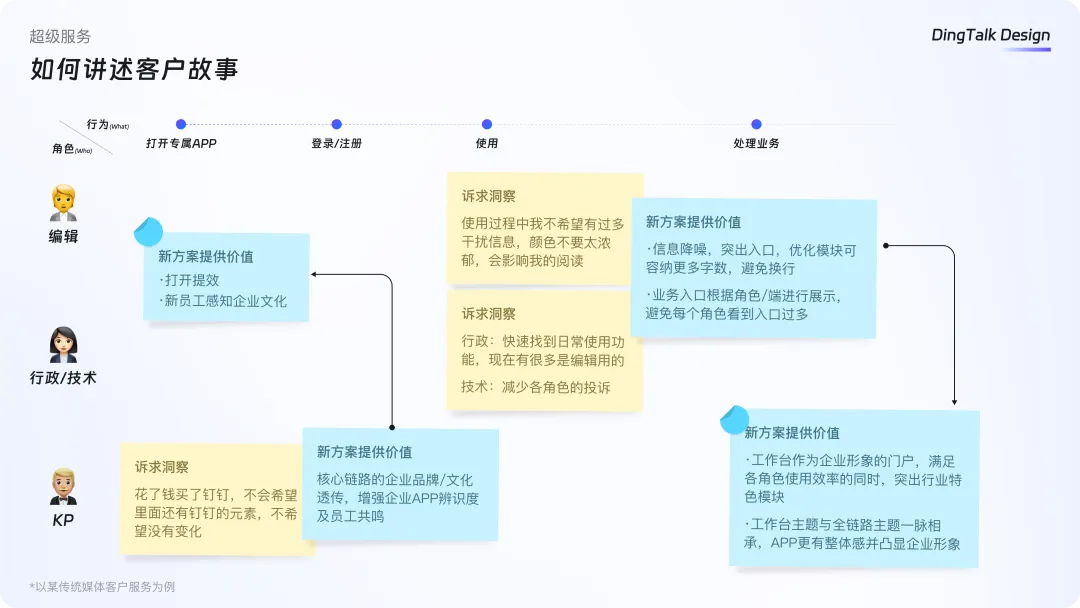
We use three key elements—Who, What, and Value—to explain how a specific role uses the new design to accomplish a task and what value it delivers. For example, in the traditional media industry, an editor’s workflow—from selecting manuscripts from a database, to gathering and editing news, to finalizing layouts—often spans multiple business systems. In addition, daily tasks may involve monitoring public information, scanning codes for campus access, or topping up meal cards. Only by aligning our design with the actual user journey can we demonstrate that our solution truly understands the customer’s needs.
At the Visual Level
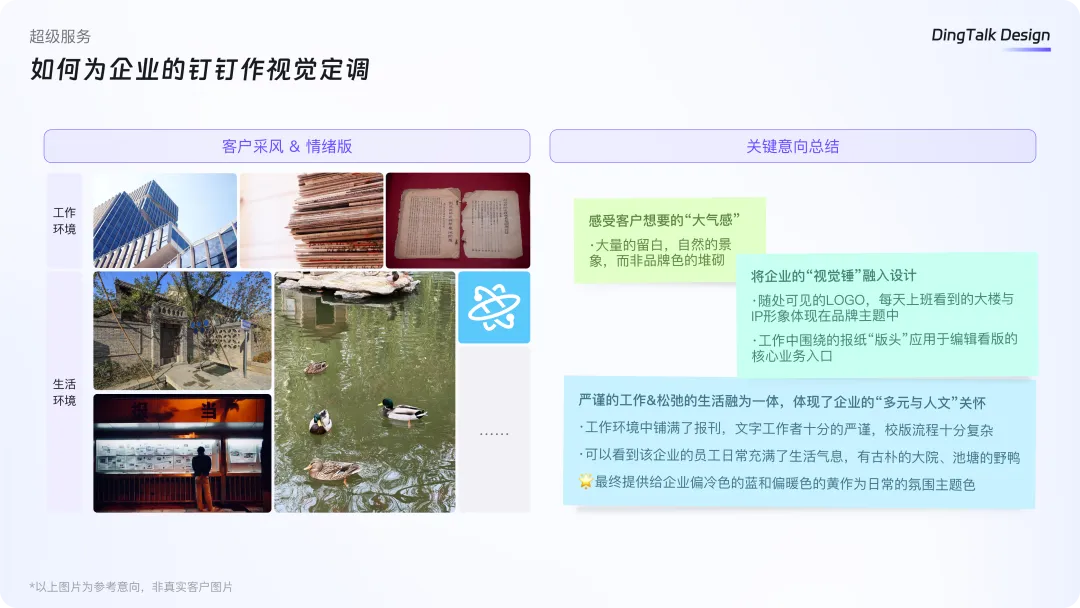
We document the customer’s workplace environment, work conditions, and visual impressions through photos and notes, capturing the feelings evoked by the customer and their work setting. We then explain how these insights are incorporated into the design, making it easier for customers to emotionally connect with the proposal. At the same time, this approach reflects what the customer wants to convey to employees and visitors about their corporate culture and brand identity—making the solution more compelling.
Enhance the Listener’s Experience
During a Super Service visit, we not only uncover unique challenges faced by each enterprise but also identify common issues and opportunities in DingTalk’s product and service offerings. For example, during a recent customer service visit, a decision-maker asked whether DingTalk offers a one-click feature to remove the red notification dots. While DingTalk does have such a feature, it is intentionally less visible in typical office scenarios to avoid users missing important notifications. However, in management settings, leaders may frequently be distracted by irrelevant alerts, and DingTalk has yet to provide differentiated experiences for different user roles. This insight gives us valuable direction for product improvement. By actively listening and continuously serving customers, we can create a more satisfying experience for them.
In Conclusion
An effective B2B customer service hinges on a deep understanding of the customer’s true needs. Rather than focusing solely on the problems they raise, we should build comprehensive solutions based on these insights. During presentations, we should use customer stories to effectively communicate the core principles of our proposals, and extract valuable feedback from decision-makers to inform future product enhancements. By continuously refining every product detail for different customer roles, we can ensure that Super Service is truly integrated into every aspect of our work.

DomTech is DingTalk's officially designated service provider in Macau, dedicated to providing DingTalk services to a wide range of customers. If you’d like to learn more about DingTalk platform applications, please contact our online customer service, call +852 95970612, or email [email protected]. With a highly skilled development and operations team and extensive market experience, we are ready to provide you with professional DingTalk solutions and services!