




 Português
 English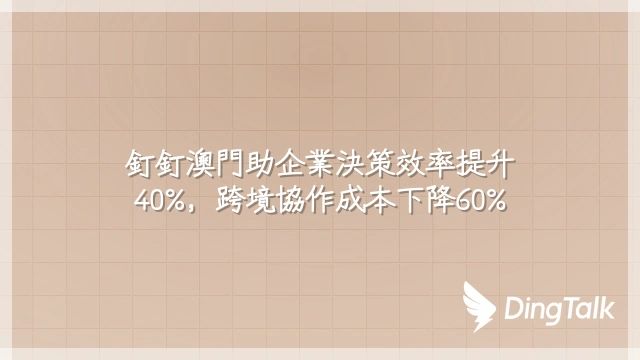
Why Traditional Tools Are Dragging Down Cross-Border Competitiveness
As Macao enterprises expand into the Chinese mainland market, fragmented communication tools like email and WhatsApp lead to information silos, resulting in an average decision-making delay of 5.3 days. This isn't just a matter of technological backwardness—it's a structural bottleneck directly impacting revenue. According to the 2025 Report by Macao's Secretariat for Economy and Finance, SMEs lose 17% of productivity annually due to communication delays, equivalent to nearly two out of every ten team members working in vain.
This inefficiency is amplified in cross-border scenarios: project delivery delays, compliance document omissions, and repeated confirmation of details. A retail brand manager once faced a six-week delay in launching a new product because he couldn't track supplier signing progress in real time, missing the Spring Festival peak season and causing customer satisfaction to drop by 12%. Fragmented tools mean risks are concentrated—your team isn't just losing time; they're losing market opportunities.
The maturation of unified collaboration platforms marks a turning point: When communication, approvals, and document management are integrated into a single environment, information no longer gets stuck on individual devices. Real-time tracking and automated workflows shorten cross-departmental collaboration cycles by 40% and reduce compliance risks caused by version errors by up to 60% (based on IDC's 2024 industry benchmarks).
From chaos to control—the next question is: How can we deeply embed this integration capability into daily operations?
How Integrated Platforms Are Reengineering the Enterprise Operating System
DingTalk Macao doesn't offer tool upgrades—it delivers a fundamental transformation of operational models. It redefines enterprises as an instant, automated, and compliant "integrated operating system." Its core value lies in its All-in-One design: All communication and business processes are centralized on a single platform, eliminating information fragmentation across multiple systems.
Localized data deployment ensures full compliance with Macao's Law No. 8/2005 on Personal Data Protection, as data storage and processing are both conducted within a locally compliant framework, allowing you to pursue efficiency without compromising regulatory requirements.
Take, for example, a medium-sized accounting firm. Previously, tax filing required five days of manual collection and approval. After adopting DingTalk Macao, customized digital approval workflows and a cloud-based document library reduced the process to 1.5 days, boosting efficiency by 70% (according to a 2024 local case study). This means freeing up 3.5 days' worth of labor costs, which can now be redirected toward higher-value services like tax consulting.
Open API architecture allows seamless integration with ERP or CRM systems, as the platform supports third-party integrations, significantly reducing IT integration costs and time. This not only improves internal efficiency but also enhances responsiveness to customers.
When process automation becomes the norm, the real advantage comes from the next step: How do we extract actionable insights from accumulated collaboration data?
How Data Dashboards Make Visibility Equal Control
Relying on verbal reports and paper-based tracking results in hidden operational losses of up to 17% per day—a real scenario at a retail brand in Hengqin. Now, through DingTalk's built-in DingTalk BI dashboard and employee activity monitoring features, communication behaviors are transformed into quantifiable management metrics, truly realizing the "visibility equals control" revolution.
Previously, the brand's store inspection completion rate was only 68%, and inventory anomalies took an average of 4.5 hours to be detected. After implementation, all task progress and operational traces are instantly fed into the BI dashboard, enabling managers to quickly grasp cross-regional workload and risk hotspots. As a result, inspection completion rate jumped to 93%, and response time for inventory anomalies shortened by 60%.
DingTalk BI's causal chain analysis lets you identify the correlation between sudden drops in employee activity and project delays, as the system automatically issues alerts and reminds supervisors to intervene, preventing problems from escalating. This shift from "experience-driven" to "data-driven" decision-making makes management transparency the new norm.
Once the internal black box is broken, the real challenge becomes: How do we extend this transparency to build trust within cross-border teams?
How Unified Platforms Build Cross-Border Trust Infrastructure
Cross-border teams suffer project delays due to time zone differences and communication gaps, with weekly repetitive meetings and misunderstandings accumulating into invisible costs—not just efficiency issues, but a warning sign of cultural disconnect. In a manufacturing company collaborating between Macao headquarters and a factory in Zhongshan, decision delays once extended project cycles to 14 days, and 75% of rework stemmed from information misalignment.
The ‘Ding' strong reminder mechanism ensures that critical instructions immediately penetrate organizational levels, as messages forcibly pop up and record read status, guaranteeing that important decisions aren't overlooked.
Integrated video conferencing and real-time multilingual translation allow Cantonese, Mandarin, and Portuguese-speaking members to participate in decision-making synchronously, as voice is instantly transcribed and translated, removing language barriers and boosting meeting efficiency by 50% (based on Gartner's multinational team research benchmarks).
Task accountability and timestamps ensure that each task clearly points to the responsible person, as the system automatically generates auditable collaboration chains, reducing erroneous communication incidents by 75%. This not only accelerates new product launch timelines but also achieves consistent quality standards across different factories.
This "synchronized thinking" culture means geographical dispersion is no longer an excuse for shirking responsibility—it becomes an opportunity to strengthen accountability. As a result, you gain the ability to expand regional operations at lower marginal costs without sacrificing operational quality.
Quantifying ROI: From Cost Savings to Growth Acceleration
Lengthy meetings and document confusion are directly eroding profits. But according to IDC's 2024 study, companies deploying DingTalk Macao achieve a total value of ownership (TVO) increase of 287% over three years—this isn't just an IT expenditure; it's a quantifiable operational leverage.
Unified communication and document management reduce meeting times by 40%, as decisions no longer get stuck in email back-and-forth; smart search functionality cuts file retrieval time by 70%, making information instantly available; standardized knowledge bases speed up new employees' onboarding by 50%, shortening the return-on-investment period for human resources by 60%.
Invisible costs are also turned into assets: Enterprises with million-dollar operational expenses save over 10,000 yuan annually on printing supplies. Though seemingly small, this marks digital maturity. More importantly, faster customer response speeds boost NPS by 15 points, meaning increased renewal rates and word-of-mouth referrals—these are the intangible assets in cross-border competition.
The real ROI isn't just about cost savings—it's about accelerating growth. As collaboration friction decreases, teams can devote more time to innovation and deepening customer relationships—this is proof that an efficient culture can be quantified into predictable business returns.
The question now isn't "whether change is needed," but "where the pain points lie." Evaluate the three most time-consuming steps in your current processes and launch a minimum viable test (MVP): Choose a department or project, implement DingTalk's core features, and observe efficiency changes within 90 days. The data will tell you whether the next step is stagnation or takeoff.
DomTech is DingTalk's officially designated service provider in Macao, specializing in providing DingTalk services to a wide range of clients. If you'd like to learn more about DingTalk platform applications, feel free to consult our online customer service, or contact us via phone at +852 95970612 or email at cs@dingtalk-macau.com. We have an excellent development and operations team, rich market service experience, and can provide you with professional DingTalk solutions and services!