




 Português
 English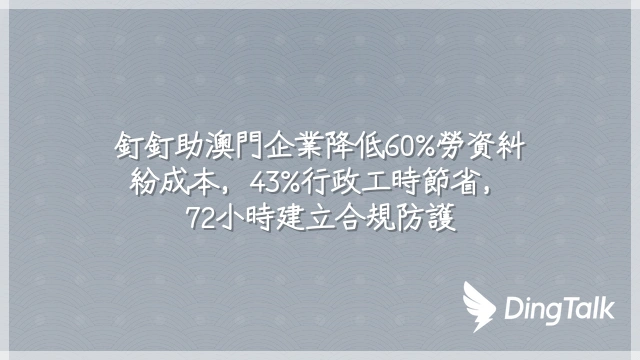
Why Traditional Attendance Systems Are Putting Companies at Legal Risk
Macau businesses aren't unwilling to comply with the law; rather, paper-based sign-in sheets or decentralized Excel spreadsheets simply can't meet the requirement under Article 26 of the Labor Relations Law to "retain attendance records for three years." According to statistics from the Labour Affairs Bureau in 2024, over 35% of labor disputes stem from incomplete attendance records or doubts about their authenticity—meaning that once a dispute arises, companies often lose lawsuits because they can't provide sufficient evidence.
DingTalk's GPS + Wi-Fi dual-location check-in (technically ensuring precise location) means companies can build an electronic evidence chain recognized by courts, as each check-in comes with an unalterable timestamp and device information, making the entire process fully traceable. When employees claim they were forced to work overtime, you no longer need to spend time sifting through chat screenshots—instead, the system outputs a complete report in seconds, giving you full control over the dispute.
A restaurant group manager used to spend six hours every month verifying store attendance, yet still faced issues like missed checks and proxy sign-ins. After adopting DingTalk, abnormal behaviors are automatically flagged and reminders are sent, reducing inspection time by 70% and resulting in zero lawsuits throughout the year due to insufficient attendance evidence. Compliance is no longer a cost—it's now a built-in competitive advantage within the system.
However, comprehensive attendance tracking is only the first step in defense. True risk prevention lies in avoiding violations at the source—especially hidden overtime caused by inflexible scheduling. The next chapter reveals: how a digital scheduling system can proactively intercept overtime risks, shifting compliance from "post-event defense" to "preemptive control."
How Smart Scheduling Proactively Intercepts Overtime Risks
If an employee works continuously for more than six hours without taking a 30-minute break, or exceeds the monthly overtime limit of 48 hours, they could face a fine of up to MOP 100,000. Such violations often result from "human scheduling errors" rather than deliberate noncompliance. DingTalk's smart scheduling system is precisely the digital solution designed to address this blind spot.
The system automatically tracks each employee's accumulated working hours, meaning supervisors receive early warnings before reaching statutory limits, as it instantly calculates daily and monthly total hours worked. After one local retail chain adopted the system, overtime hours plummeted by 72% within three months. According to the 2024 Asia-Pacific HR Tech Report, companies with real-time working-hour monitoring capabilities saw an average 58% reduction in labor disputes.
More importantly, DingTalk supports custom scheduling rules tailored to different job categories—meaning restaurants can set shift intervals and meal breaks, while transportation companies can activate flexible calculations based on driver rotation schedules, thanks to customizable rules. This ability to achieve "differentiated compliance" is a key advantage that traditional paper-based or generic Excel systems simply can't match.
Your team deserves a scheduling mechanism that protects both the company and respects employees—avoiding fines is just the basics; the real value lies in building a compliant culture that's auditable and traceable. And once working-hour management is solidified, the next question arises: Do instructions and commitments made during daily communication also carry legal validity?
Real-World Applications of the Legal Validity of Electronic Communication Records
In Macau, an unacknowledged transfer notice could easily turn into a lawsuit. But according to Article 6 of the Electronic Commerce Law, as long as the sender's identity and content integrity can be verified, electronic documents have legal effect—meaning any formal message you send via DingTalk is admissible evidence in court.
DingTalk's read receipts and complete archiving features mean companies can eliminate the excuse of ‘I didn't see the announcement', since message statuses are transparent and traceable. Highly regulated industries such as finance and healthcare can even enable sensitive-word monitoring and automatic archiving, ensuring all instructions leave a digital trail that's traceable and auditable, as the system operates in administrator-compliant mode.
- Communication transparency: Read and unread statuses eliminate information gaps
- Compliance automation: Meets Macau's electronic evidence preservation standards
- Risk preemption: Key decisions leave digital footprints
A local chain organization once faced a dispute over schedule changes. After adopting DingTalk, they used read records as evidence, reducing coordination time from three days to two hours. This saves over 200 hours annually in internal coordination costs—not just efficiency gains, but a shift of management resources from firefighting to strategic planning.
Electronic communication ensures the legality of instruction delivery, but when formally changing employment relationships, is a paper signature still required? The answer is no—as long as you use an electronic signature mechanism with strong legal backing.
The Judicial Strength of Electronic Signatures Replacing Paper
According to Macau's Electronic Transactions Law, qualified electronic signatures carry the same legal weight as handwritten ones. DingTalk eSign uses a triple-layer mechanism—real-name authentication, biometric verification (such as fingerprint or facial recognition), and blockchain evidence storage—to ensure every signature is traceable and irrefutable, as both identity and operation are rigorously verified.
After one accounting firm adopted the system, new hires could complete their employment contracts, confidentiality agreements, and overtime consent forms on their very first day. This reduced the compliance process from three days to just two hours, as all documents were processed online in real time. The system automatically logs signing time, location, and device information, and immediately uploads it to the blockchain for evidence storage. In case of a dispute, companies can retrieve legally valid records within minutes. According to the 2024 Asia-Pacific Digital Compliance Report, companies with complete electronic-signature trails saw a 47% higher litigation success rate.
- Onboarding documents: The contract takes effect before the new hire even sits down
- Performance evaluations: Disputes are clarified with concrete evidence, avoiding verbal disagreements
- Clause changes: Updated notices automatically track reading and confirmation status
The real value isn't saving paper—it's building a proactive compliance culture: The system sends reminders 30 days in advance for contract renewals, policy adjustments, and other key milestones, enabling HR teams to shift from reactive responses to strategic preemptive controls. Once all commitments are solidified in an unalterable form, that's the final mile toward automated compliance.
The Cost Savings of Quantitative Compliance Transformation
Once electronic signatures secure the compliance baseline for documents, the real operational transformation begins. According to a 2024 report by our local partner, after companies adopt DingTalk's compliance suite, HR administrative hours drop by an average of 43%, and labor dispute handling costs fall by 60%, thanks to fully automated processes and proactive risk management.
Take a medium-sized enterprise with 100 employees as an example: Previously, they spent 500 hours annually dealing with attendance anomalies, overtime calculations, and vacation tracking, with labor and potential fines totaling over MOP 180,000. DingTalk's automated comparison of statutory working hours, real-time alerts for overtime risks, and retention of communication and approval records shifts companies from reactive firefighting to proactive compliance. Every check-in, leave request, or shift change generates an unalterable timestamp, allowing companies to complete data backup within 72 hours during surprise audits.
The intangible benefits are equally critical: Brand image improves due to transparent systems, and job seekers prefer companies with fair processes; management no longer spends energy responding to disputes, instead focusing on talent development and service innovation. A hotel HR manager confessed: "We've had zero labor disputes in the past six months, and employee trust has clearly risen."
Compliance is no longer a cost center—it's now a measurable competitive lever. From paper to digital, from defense to offense, DingTalk helps Macau companies turn regulatory pressure into organizational resilience—act now and try DingTalk's compliance suite for free. Build your auditable compliance system within 72 hours.
DomTech is DingTalk's official designated service provider in Macau, specializing in providing DingTalk services to a wide range of customers. If you'd like to learn more about DingTalk platform applications, feel free to consult our online customer service, or contact us by phone at +852 95970612 or email at cs@dingtalk-macau.com. We have an excellent development and operations team, rich market service experience, and can provide you with professional DingTalk solutions and services!