




 Português
 English
Recently, IDC released the "Guide to Building an Enterprise Low-Code Development System" report. With its leading "low-code + AI" products and mature solutions, DingTalk was selected as a representative vendor in the report, and its "low-code + AI" case with HuanShi Logistics was included as an industry best practice in the report.
In July this year, DingTalk was already recognized as a representative vendor in IDC's "China Low-Code Development Platform Technology Evaluation, 2024" and "Generative AI + Low-Code: Exploring a New Generation of Development Paradigm." The reports show that DingTalk's low-code capabilities rank first in China and have the highest AI integration. This latest inclusion of the DingTalk x HuanShi Logistics best practice further demonstrates that DingTalk not only possesses leading product capabilities but has also accumulated extensive industry implementation and service experience.
The report points out that as low-code development platforms are increasingly adopted, enterprises are building their own low-code development systems. This is not just a technological revolution; it represents a comprehensive reshaping of organizational structures, management processes, and even corporate culture—aiming to maximize the potential of low-code platforms and drive enterprises toward greater intelligence and agility.
Taking HuanShi Logistics as an example, the rapid growth of its global business has led to a surge in digitalization needs, especially in key business scenarios such as logistics quoting and order management.
By introducing DingTalk Yida, HuanShi Logistics accelerated the development of its business systems. Compared with traditional development methods, using Yida requires only one-fifth of the manpower. In just one week, HuanShi Logistics independently built a CRM-like sales management system using Yida, enabling full lifecycle management of orders from pre-sales to after-sales. The company then exported this system as a SaaS service to other small and medium-sized logistics enterprises, addressing the industry's widespread challenges in order management.
The report also notes that deep application of low-code can help enterprises enhance their digital capabilities and cover long-tail digital scenarios, though coverage remains limited. The emergence of generative AI, however, opens up new possibilities for more scenarios. The integration of low-code development platforms with generative AI is fundamentally transforming the field of application development by lowering technical barriers, improving development efficiency, and enabling smarter, more user-friendly application development.
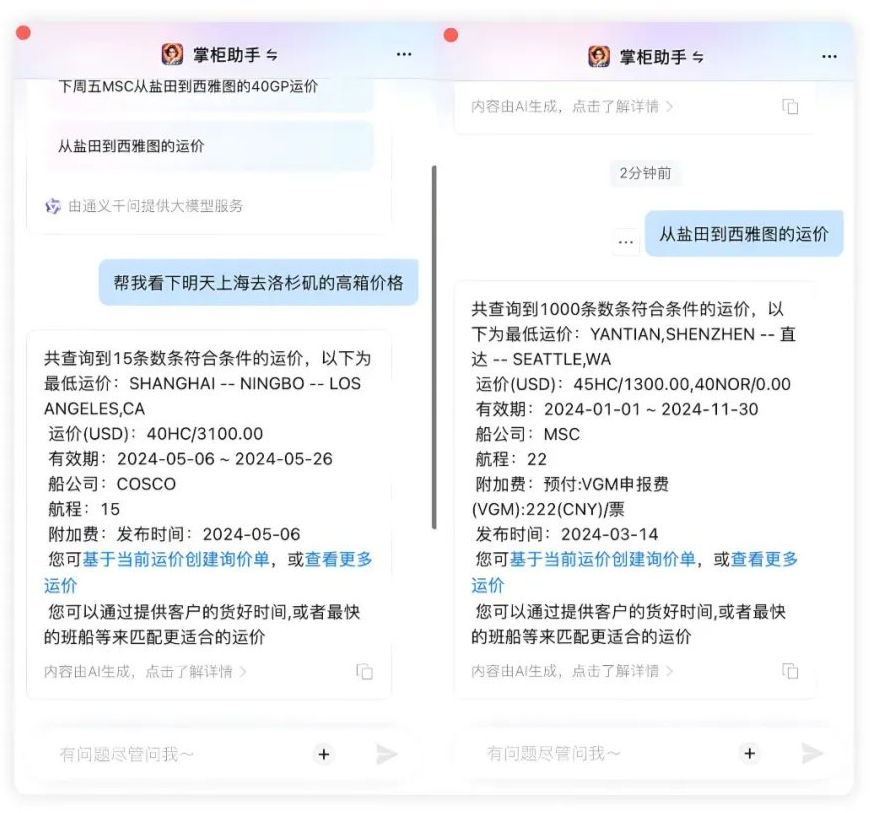
HuanShi Logistics has also integrated DingTalk AI capabilities to intelligently upgrade its proprietary ERP system.
Leveraging DingTalk AI, HuanShi Logistics has integrated data from thousands of international logistics companies and shipping lines within its ecosystem, providing the latest real-time shipping logistics quotes. An AI assistant enables customized and instant responses. When faced with customer inquiries, sales staff simply ask the AI assistant, which quickly matches the inquiry with precise shipping rates from a vast database and automatically generates a personalized quote that can be shared with a single click. This completely transforms the previous manual quoting process, significantly improving both quoting efficiency and customer experience.
IDC believes that during the digital transformation of enterprises, there are numerous long-tail scenarios in organizational governance and business operations that are difficult to cover with off-the-shelf software and must be addressed through low-code and AI. Digital platforms represented by DingTalk and "low-code + AI" development tools can deeply embed AI into real-world software and business workflows. By layering AI assistant capabilities onto low-code-built, digitally native products, these platforms enable an iterative productivity upgrade that combines "business-specific expression with data intelligence," making large models a true driver of productivity.
Currently, DingTalk's low-code and AI solutions are widely applied across various industries, including manufacturing, energy, retail, construction materials, and healthcare. They have received high recognition from leading customers such as FAW Group, CATL, Mengniu Group, Sungrow Power Supply, Awinic, Zhejiang University, Youngor, Shanghai Mitsubishi, and the Sun Yat-sen University Cancer Center. In the future, DingTalk will continue to advance product innovation and scenario implementation to address the growing demands and challenges enterprises face during digital transformation, driving organizations and business operations across industries to higher levels of development.
DomTech is DingTalk's officially designated service provider in Macau, specializing in providing DingTalk services to a wide range of customers. If you'd like to learn more about DingTalk platform applications, you can contact our online customer service directly or reach us by phone at +852 95970612 or by email at [email protected]. We have an excellent development and operations team with extensive market service experience and can provide you with professional DingTalk solutions and services!