




 Português
 English
"For current education, digitalization does not lack advanced concepts; what it lacks is the continuous practice and innovation of 'just do it' and rapid iteration."
— Xu Huabin, Head of Digital Education, Binjiang District Education Bureau
The Hangzhou High-Tech Industrial Development Zone (Binjiang) Education Bureau (hereafter referred to as the Binjiang District Education Bureau) is a working department of the People's Government of Binjiang District, Hangzhou. It is primarily responsible for educational work in the Binjiang District.

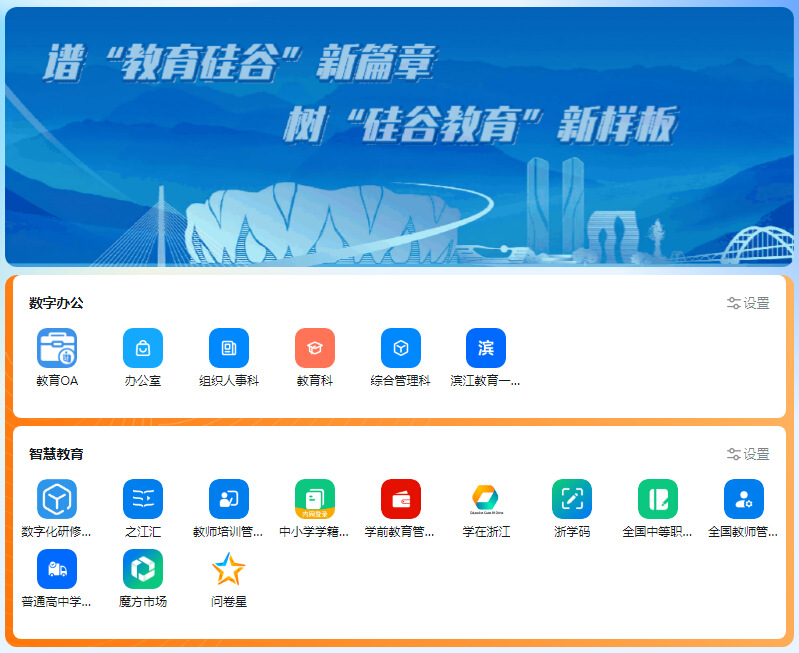
Digitalization is a systems engineering project. The Binjiang District Education Bureau has identified its digital development positioning, clarified its development goals, and made systematic plans. In its planning, the bureau adheres to the principle of "application first, service paramount," using application needs to drive the construction of the "Education Magic Cube" foundational database, the DingTalk application database, the One-Code-Access platform, and a structured application system framework. Through these applications, various profiles and governance dashboards have been developed. In both construction and application, the bureau emphasizes the key concept of "one database, one platform, multiple screens, N applications." By leveraging the DingTalk platform, the bureau promotes collaboration among district-level departments and schools, prioritizing business needs, strengthening practical applications and operational maintenance, and focusing on core requirements such as enhancing governance effectiveness, optimizing service quality, transforming teaching models, and promoting high-quality equity. This has led to the creation of application scenarios such as all-domain intelligent governance, digital society, holistic education, and learning-teaching transformation, using digitalization to support and lead the "Education Silicon Valley" initiative.
DingTalk enables organizations to go online
Multi-dimensional and立体 management
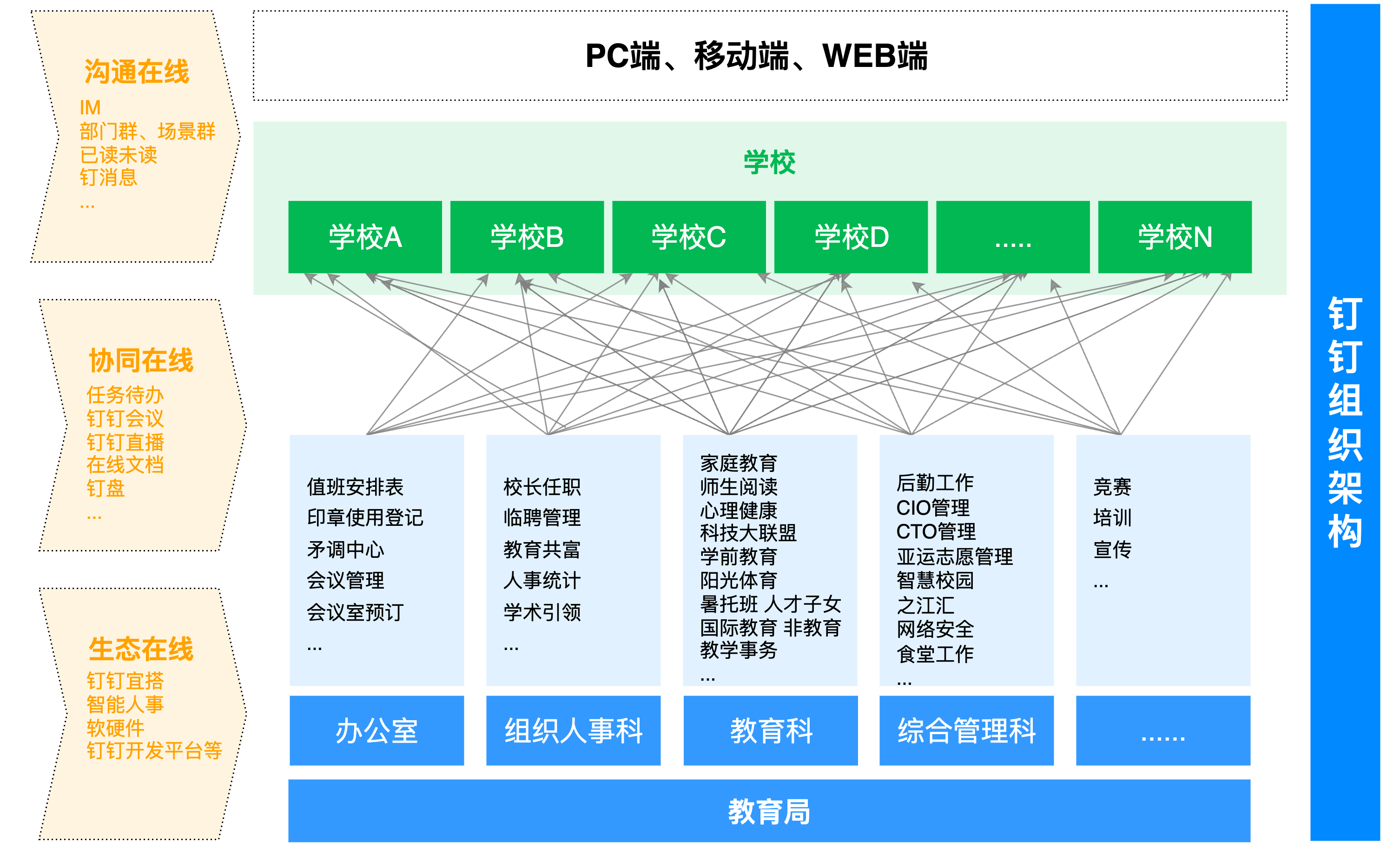
DingTalk builds on online organizations, enabling online communication, online collaboration, online operations, and online ecosystems around the organization. This transforms the original two-dimensional point-to-point management into a multi-dimensional,立体management that includes point-to-point, point-to-surface, and surface-to-point interactions.
In addition to breaking through the limitations of time and location, this approach also incorporates hierarchical levels and permissions, allowing for finer-grained management. It connects people in different roles and positions, making the management of the education bureau more立体.
Low-code helps bring business to life
Improves the efficiency of business personnel
As the head of digital education at the Binjiang District Education Bureau, Teacher Xu Huabin has been actively exploring products from various market platforms that offer strong integration with educational and teaching business management. He has closely followed the continuous growth and improvement of DingTalk Yida and ultimately chose Yida to build an online management system for the entire district's education system.
The largest workload for the education bureau involves collecting and summarizing information from various schools. Using a combination of simple coding and DingTalk Yida, Teacher Xu built an information collection system in just two days. The process involves initiating a form → selecting the receiving unit → filling in the collection details, which allows the bureau to collect information from all schools under its jurisdiction across the district. At the same time, real-time reports enable the bureau to monitor feedback from each school.
01. Asian Games volunteer management
The 2023 Hangzhou Asian Games require the education system to recruit, manage, and allocate volunteers, as well as organize numerous volunteer activities.
From the moment Teacher Xu received the task notification to confirming the recruitment details and collecting information—including strict requirements such as uploading volunteer photos in a specified format and naming files according to regulations—Teacher Xu completed the task in just two days. In contrast, using traditional methods, collecting, revising, reconfirming, and summarizing similar information would take up to 15 days, which simply cannot meet the time-sensitive demands of managing Asian Games volunteer activities.
Teacher Xu faces similar tasks more than a dozen times each year. By using the Yida platform, he saves the equivalent of two full-time employees' work each year. At the same time, Teacher Xu extends this mature solution to colleagues in other departments who face similar tasks, greatly improving the overall efficiency of the education bureau.

02. Temporary teacher management
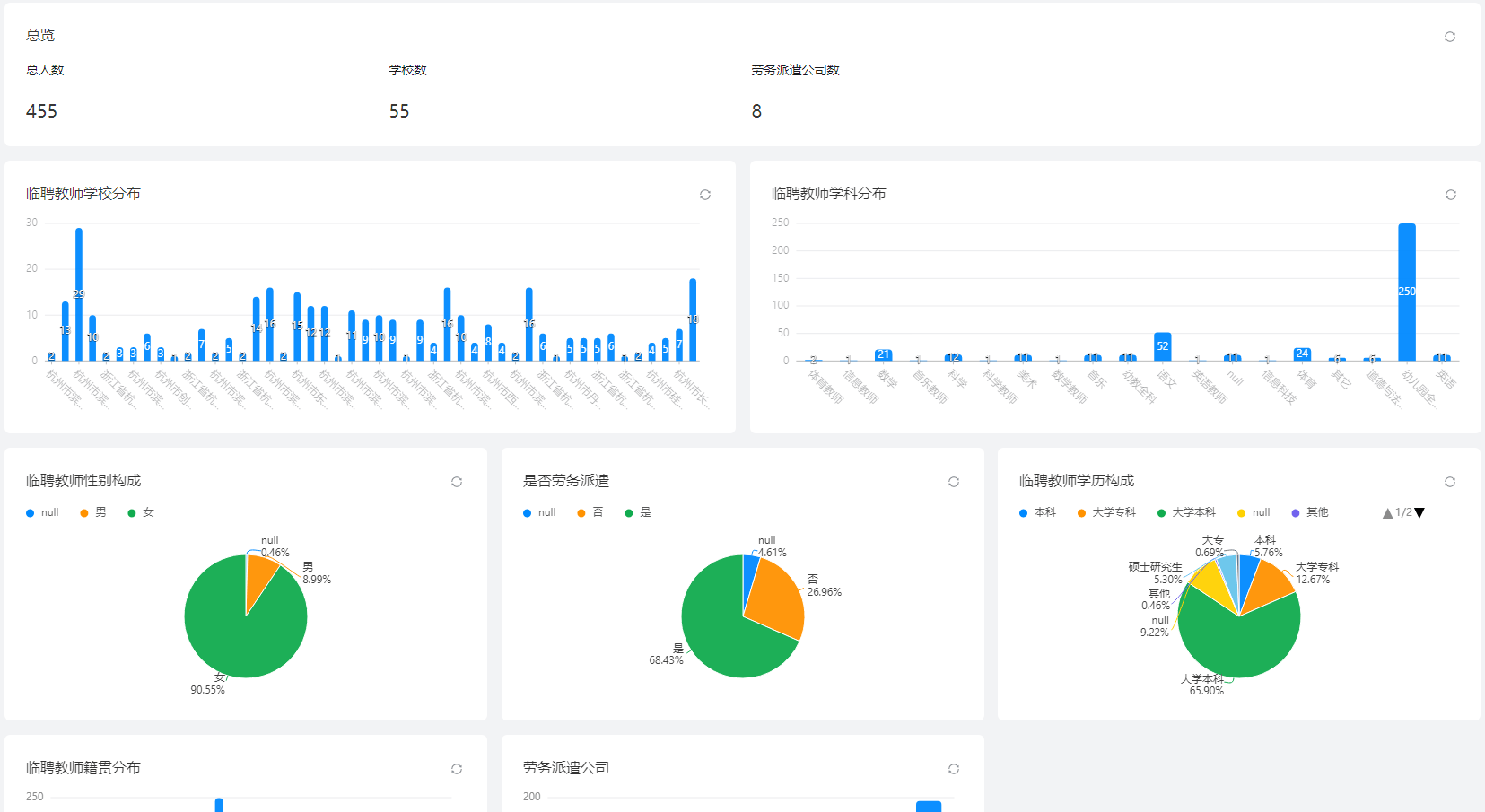
In traditional temporary teacher management, there are issues such as untimely data updates and low management efficiency. To address these challenges, Teacher Xu, based on the needs of the Organization and Personnel Department, independently developed a management platform using the DingTalk Yida platform to improve management efficiency and precision.
➔ Staffing management: Through the platform, Teacher Xu can monitor the staffing status of temporary teachers in real time, ensuring the rational allocation and use of teacher resources.
➔ Funding oversight: The platform provides real-time oversight of funds related to temporary teachers, ensuring the rational use and distribution of funds.
➔ Structural optimization: Through data analysis, the platform helps Teacher Xu optimize the structure of the temporary teacher workforce, improving teaching quality.
Through this platform, the district education bureau has achieved real-time oversight of temporary teachers, significantly improving management efficiency. For example, the platform's data analysis capabilities allow the bureau to promptly identify and resolve issues related to teacher staffing, optimizing the allocation of teacher resources. At the same time, real-time oversight of funding ensures the rational use of funds, improves funding efficiency, and provides decision-making support for the education bureau's temporary staffing needs.
03. Meeting management
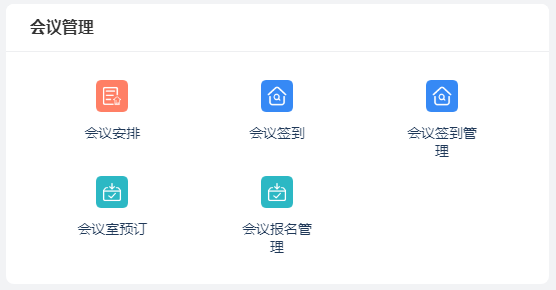
For management purposes, the education bureau frequently organizes various meetings, including work deployment meetings, business meetings, and work report meetings. Tasks such as registration, check-in, and document distribution require significant preparation and coordination by event staff, involving large amounts of paper-based materials. This not only wastes resources but also places a burden on the environment. Once paper documents are printed, updating information becomes difficult, potentially leading to information discrepancies. Addressing these pain points, Teacher Xu used DingTalk Yida to develop a "Meeting Management System."
➔ Registration management: Participants can easily register online. The system automatically collects participant information and generates reports, making it convenient for organizers to manage and analyze data;
➔ Check-in management: Users can check in themselves by scanning a check-in code, which is fast and convenient. Compared to traditional check-in methods, this approach can be up to 90% faster and provides real-time, dynamic updates on attendees;
➔ Document distribution: Through the digital platform, meeting materials can be distributed electronically. Participants can update meeting materials in real time, ensuring that everyone has access to the latest information;
➔ Real-time analysis: The digital event platform can track the number of registrants and attendees in real time, giving organizers a clear overview of the meeting situation.
Over the past year, the education bureau has independently developed and deployed more than two dozen platforms based on the underlying platform, including "Smart Campus Creation" and "Student Information Literacy Enhancement Activities." These efforts aim to collect and analyze work data, use visualization and reporting to track work dynamics, monitor work efficiency, conduct data diagnostics, and build data assets, significantly boosting overall efficiency. As application scenarios continue to expand and deepen, Binjiang Education, supported by DingTalk, is gradually shifting from rule-based management to process-based management and from experience-driven management to data-driven governance.
DomTech is DingTalk's officially designated service provider in Macau, specializing in providing DingTalk services to a wide range of customers. If you'd like to learn more about DingTalk platform applications, feel free to contact our online customer service or reach us by phone at +852 95970612 or by email at [email protected]. We have an excellent development and operations team with extensive market service experience, ready to provide you with professional DingTalk solutions and services!