




 Português
 English
Recently, media reports highlighted that Bunto’s 18 millionth printer has rolled off the production line. This marks Bunto as the No. 1 player in China’s domestic printer market and the No. 3 player in the global market.
Bunto’s rapid rise in a challenging environment stems not only from its cutting-edge hardware but also from its agile software capabilities. Features like “remote printing,” “mobile direct connection,” and “print on receipt” rely entirely on robust software support.
In today’s fast-paced manufacturing landscape, “software services” have become a key focus for Chinese manufacturers—and a major competitive advantage on the global stage. In many of Bunto’s product introductions, one familiar name stands out: DingTalk.
DingTalk plays an indispensable role in Bunto’s “software services.” For example, with DingTalk Cloud Print, Bunto users can print remotely via Bluetooth. After installing the print-sharing service, a single computer paired with cloud-printing software can share a printer across an entire organization.
Since 2017, DingTalk has been at the forefront of driving a new approach to office hardware—integrating software and hardware to create seamless, unified solutions. By lowering the barrier to entry, DingTalk has brought devices such as time clocks, access control systems, printers, routers, and conferencing equipment to a much broader audience.
As the No. 1 office app in China by market share, DingTalk’s efforts—and the commercial value of the new categories it has created—are truly remarkable. Beyond well-known features like clock-in, OA approvals, low-code tools, and document management, DingTalk is also investing heavily in less visible areas, such as printing, enterprise email, and security, which often fly under the radar but are equally critical to its mission.
1. Cloud printing, cloud conferencing: DingTalk uses technology to bring hardware into the cloud
Scenarios once dominated by traditional hardware—such as printers and conferencing equipment—are now evolving toward smart, cloud-based solutions through the dual-engine of software and hardware integration.
In the cloud-printing space, DingTalk already serves over 1 million enterprises, with large enterprises accounting for 60% of its user base. This demonstrates that DingTalk has achieved an astonishing level of penetration and stickiness in areas that most people don’t even notice.
By integrating printers with the DingTalk platform, older devices gain new life without requiring users to change their existing habits. For instance, DingTalk has partnered with Bunto to launch several cloud printers tailored for small and medium-sized businesses. These printers can handle up to 200,000 pages of continuous printing with a jam rate as low as 0.02‰, delivering a reliable and consistent printing experience for businesses. At the same time, they enable home users to achieve “print on receipt,” making remote education and home offices more efficient and convenient.
In the cloud-conferencing space, as of January this year, DingTalk Meetings has partnered with 77 hardware vendors and certified over 300 devices. DingTalk Meeting Rooms integrates multiple hardware platforms to create a “software-hardware integrated” conferencing solution, combining DingTalk’s audio, video, and AI capabilities with partners’ hardware strengths to meet diverse enterprise meeting needs. In addition, by providing room connectors and opening the DingTalk Meetings API, DingTalk is helping enterprises upgrade legacy conferencing systems to the cloud while maximizing their efficiency.
2. DingTalk Mail has become the top choice for large enterprises
Email, a product that often flies under the radar, has undergone significant underlying changes in recent years. As digital transformation accelerates, email is shifting from a simple tool for sending and receiving messages to a deeply integrated component of collaborative work and business digitization.
After AliMail joined DingTalk, the fusion of mail and collaboration features has made it the No. 1 enterprise email provider in China over the past few years. Today, AliMail processes hundreds of millions of emails daily, with large enterprises such as Shandong Heavy Industry, Sinopec, AVIC, and China Insurance all relying on AliMail.

● Email + collaboration platform:
Email breaks down barriers between organizational accounts, address books, group chats, and messaging. Users can log in with a unified account and easily manage emails within DingTalk groups, viewing or replying directly. Integration with DingTalk Drive, Calendar, and audio/video meetings further streamlines file sharing, meeting scheduling, and discussions.
● Security protection:
Because email allows users to send messages to strangers, spam and phishing emails have long been a headache for enterprise IT teams. AliMail continuously refines its spam-filtering and anti-phishing models and has introduced an isolation zone feature to keep threats at bay. Today, AliMail proactively blocks 2 million spam emails every day, building a strong security wall for enterprise users.
● Support for domestically developed IT infrastructure (XinChuang):
Many large enterprises consider using XinChuang solutions—covering CPUs, operating systems, databases, and middleware—when deploying IT systems. AliMail has been optimized to support XinChuang environments and offers both public-cloud SaaS and private-cloud deployment options, ensuring compatibility with security and reliability standards set by China’s National Information Security Evaluation Center.
● Global collaboration:
Due to time-zone differences and varying office cultures, many international businesses rely on email for communication. As Chinese companies expand overseas, cross-border communication and international email marketing are becoming increasingly important. AliMail and DingTalk Mail operate four overseas data centers in Singapore, Hong Kong, Germany, and the United States, with IP ranges covering all OECD countries. This boosts email delivery success rates and helps meet data-export compliance requirements.
3. Security: Balancing user experience with robust protection
Unlike traditional “black-and-white” security approaches, enterprise security requires striking a balance between user experience and risk management—neither allowing threats to slip through nor stifling employee productivity. To address this, DingTalk has implemented several key features:
● DingTalk’s zero-trust security framework combines nine factors to enable flexible, adaptive security management. The system intelligently determines whether to grant access based on an employee’s identity, device, and network environment. For example, when an employee in the design department is in the office, the device and network are trusted, allowing them to download blueprints. Once they leave the secure environment, the system immediately tightens permissions to prevent information leaks.
● The Security Operations Center provides a one-stop risk-management capability, enabling organizations to quickly detect behaviors such as frequent address-book lookups, excessive file downloads, or unauthorized API calls. This allows enterprises to take immediate action and prevent issues from escalating.
● Data-classification labels match security rules to the characteristics of each document. For instance, documents created by R&D staff are protected from the moment they’re generated, while more general documents enjoy looser permissions, allowing employees to collaborate freely. This “context-aware” approach ensures both security and productivity.
4. Bank-enterprise integration: Connecting 599 banks to DingTalk for easier financial operations
In the realm of corporate payments, DingTalk’s bank-enterprise payment solution connects to 599 banks nationwide, with nearly 100 banks offering direct integration. This significantly improves remittance efficiency and streamlines business-finance collaboration.
Enterprises can use the solution out-of-the-box without custom development. By integrating the “DingTalk approval, bank transfer” workflow, companies can connect their OA approval systems with finance and ERP systems, enabling automated workflows and one-click payments to ease the burden on finance teams. Banks also automatically generate transaction logs, eliminating the need for manual reconciliation and making bookkeeping more convenient.
5. Bringing specialized tools to the masses: Online mind maps, online CAD viewers
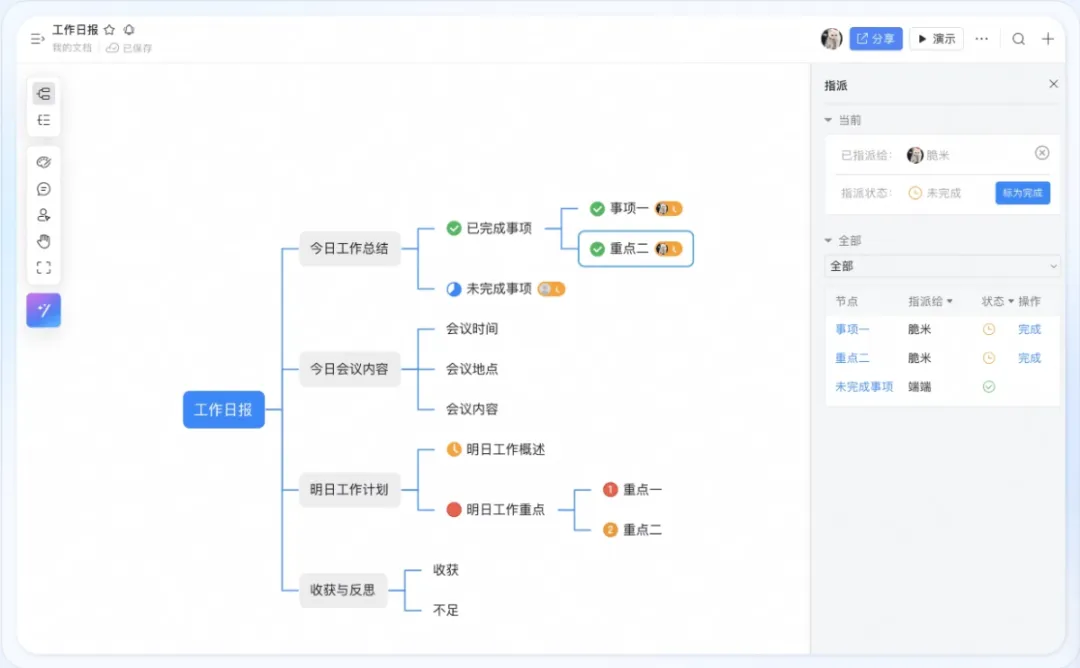
Creating mind maps, viewing large CAD files—tasks that once required specialized software and expertise—are now accessible to everyone through DingTalk.
With just a few words, DingTalk’s online mind map automatically generates a framework, helping you brainstorm quickly. It also supports real-time collaboration and integrates seamlessly with tasks and calendars, making it a powerful tool for guiding decision-making.
Large CAD files no longer require specialized viewing software. You can open them directly in DingTalk, measure them, and collaborate—all without needing additional tools. This makes niche functionalities available to a much wider audience.
6. R&D “high-speed rail mode”: Stay connected even in extreme weak-network conditions
When traveling by high-speed rail and facing poor internet connectivity, how can you stay connected? DingTalk has developed a dedicated “high-speed rail mode” that lets you access recently used documents, schedules, to-dos, and your workspace—even in no-network or weak-network environments. You can still create new schedules and send messages, and DingTalk will automatically send these messages once the network recovers. On mobile devices, DingTalk documents can be viewed and edited offline, and progress syncs automatically once connectivity returns, ensuring your work never goes “offline.”
In addition, DingTalk Meetings can switch conference audio to phone audio with a single tap, leveraging carrier networks to boost call stability and reduce dropouts in weak-network environments.
In the past six months, DingTalk has rolled out more than 10,000 product updates. To make DingTalk smarter, simpler, more inclusive, and more open, the company has launched a new AI assistant, upgraded its intelligent conferencing system, enhanced the document-collaboration experience, expanded its global capabilities, and further opened up its platform ecosystem. These advancements not only improve individual productivity but also provide enterprises with more efficient collaboration tools and smarter management solutions.
You can feel that in visible areas, DingTalk is constantly refining its features to deliver a better user experience. In invisible areas, too, its relentless technical efforts quietly create deeper value for customers.
DomTech is DingTalk’s official service provider in Macau, dedicated to serving a wide range of customers. If you’d like to learn more about DingTalk’s platform applications, feel free to contact our online customer service or reach us by phone at +852 95970612 or by email at [email protected]. Our expert development and operations team brings extensive market experience and can provide you with professional DingTalk solutions and services!